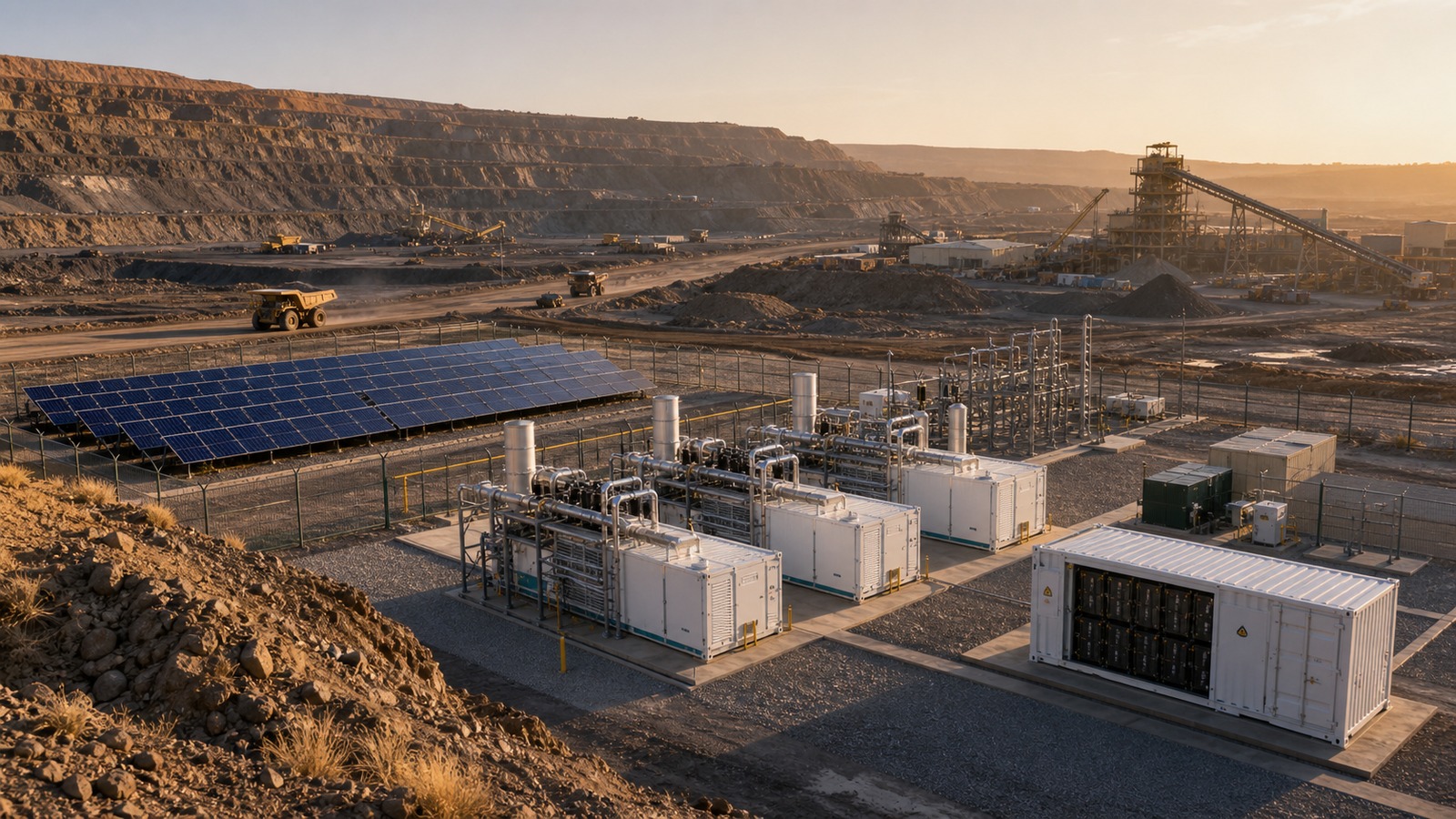
For a remote mine, electricity is not a utility expense in the normal sense. It is production infrastructure. Crushers, mills, pumps, ventilation, dewatering, workshops and camps depend on continuous power. A fuel delivery delay or generator trip can quickly become lost tonnes, damaged equipment, safety exposure and missed shipment schedules.
This is why the practical customer question is not simply whether solar is cheaper than diesel, or whether gas engines are more efficient than a legacy generator fleet. The real question is: How can African mining companies lower operating costs and improve energy reliability without waiting for grid expansion?
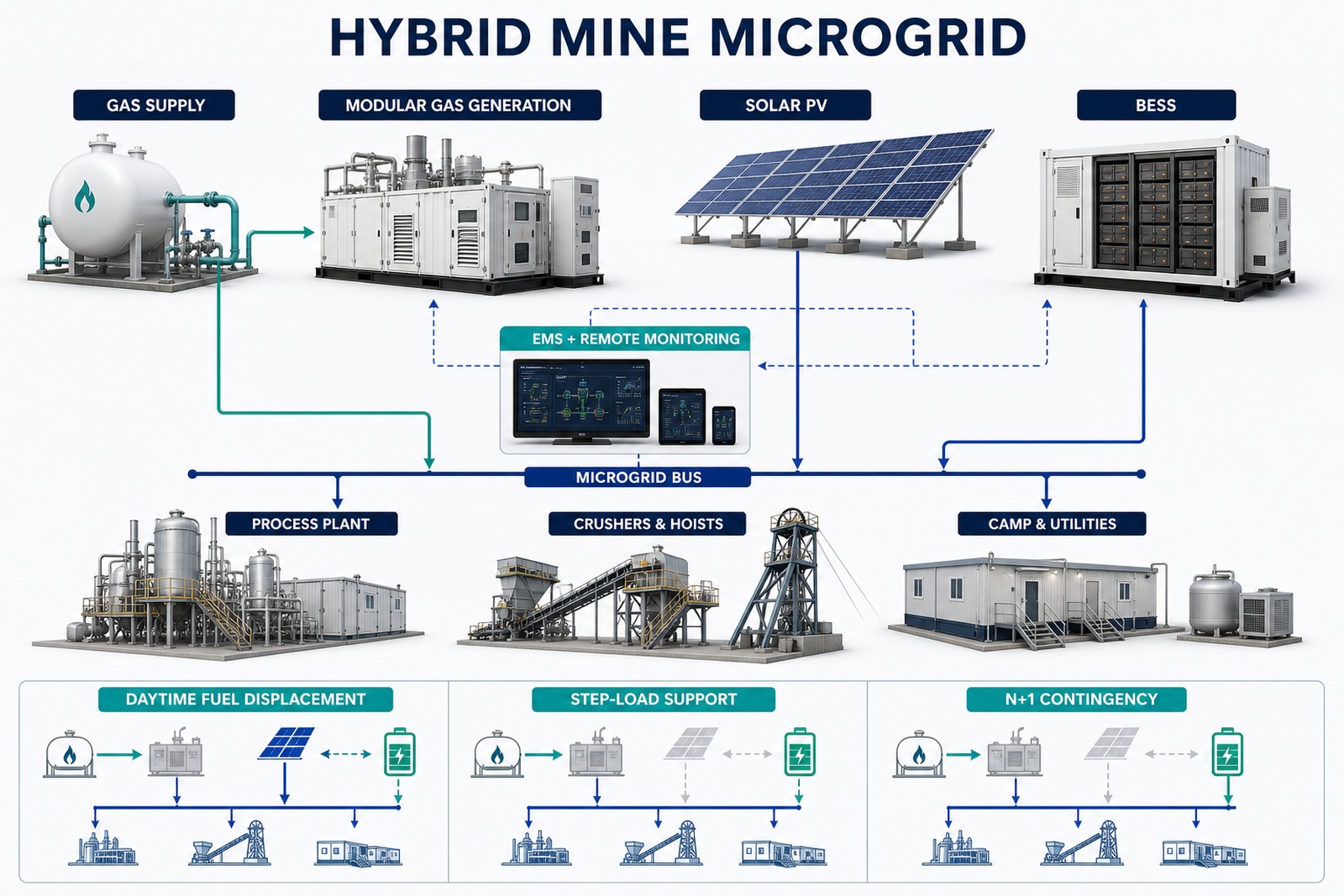
For many 10-50 MW sites, the answer is a hybrid power architecture built around three coordinated layers: modular gas generation for dispatchable power, battery energy storage for fast response and reserve, and solar PV for daytime fuel displacement. Diesel may remain for emergency duty or during transition, but it no longer has to carry the entire operating burden.
1. The diesel challenge in remote mining operations
Diesel-only systems are familiar and fast to deploy, but the generator purchase price is only one part of their lifecycle cost. Remote mines must also manage bulk transport, road conditions, theft and leakage, working capital tied up in fuel inventory, frequent maintenance, spare parts and the efficiency penalty of running multiple engines at poor loading.
The World Bank notes that mines require 24-hour steady power and that outages can cause equipment damage, production downtime and processing delays. It also highlights the unusually high electricity and transport costs faced by many Sub-Saharan African projects. Those conditions make on-site energy design a strategic mine-planning decision rather than a late EPC package.
A diesel fleet can still be useful, especially during construction or as black-start reserve. The problem is using high-cost delivered diesel as the default baseload source for the full life of mine.
2. A practical hybrid architecture: gas generators + BESS + solar PV
The optimal configuration depends on the mine's load curve, fuel route and operating philosophy. A common architecture uses modular gas engines as the firm source, solar PV to displace daytime fuel, and BESS to manage second-by-second variability.
Multiple engine blocks can follow load, support phased mine development and preserve capacity when one unit is offline. Fuel may be pipeline gas, LNG, CNG, LPG or treated associated gas, subject to site-specific screening.
BESS can provide spinning-reserve replacement, ramp control, frequency support, black start, load shifting and short-duration ride-through while keeping thermal units near efficient loading.
PV reduces daytime fuel burn and can lower the marginal cost of electricity. Its value increases when BESS and EMS prevent curtailment and manage sudden cloud ramps.
3. Illustrative operating scenario for a 10-50 MW mine
Consider an off-grid mine with an average demand of approximately 22 MW, a peak of 30 MW and large step loads from crushers, hoists and pumps. The numbers below are not a design offer. They show how an early-stage architecture can be framed before FEED.
Illustrative 30 MW peak screening case
- Firm generation: approximately 30 MW installed using multiple roughly 2 MW-class gas engine modules, arranged so the mine can meet critical demand with one module unavailable.
- Solar PV: approximately 12-18 MWp, subject to irradiance, land, dust and curtailment analysis.
- BESS: approximately 10-20 MW with 20-40 MWh usable energy, sized for ramp control, reserve, black start and selected load-shifting duties.
- Legacy diesel: retained initially for emergency reserve, commissioning support or fuel-transition risk.
- EMS: dispatches engines, PV and BESS against load, fuel cost, reserve margin and maintenance constraints.
During stable daylight conditions, PV carries part of the mine load while gas engines operate near efficient loading. The BESS absorbs short ramps and supports large motor starts. After sunset, gas generation increases and the battery returns to reserve duty. If one engine trips, BESS responds immediately while another module starts or increases output.
4. Diesel-only versus hybrid: compare the operating model, not one tariff
A credible comparison must use delivered fuel cost, not a headline fuel price. It must also include generator efficiency at actual loading, maintenance intervals, battery degradation, PV curtailment, gas conditioning, logistics, financing and the cost of unserved energy.
| Decision factor | Diesel-only plant | Gas + BESS + PV microgrid |
|---|---|---|
| Fuel exposure | High dependence on delivered liquid fuel and frequent transport. | Fuel is diversified; PV displaces daytime consumption and BESS reduces inefficient thermal operation. |
| Reliability | Achieved through multiple running gensets and fuel inventory. | Achieved through modular N+1 generation, fast BESS response, EMS and emergency reserve. |
| Load response | Engines may idle or run below efficient loading to hold reserve. | BESS handles fast ramps while engines operate in a more efficient band. |
| Expansion | Additional generators can be added, but fuel logistics scale with them. | Gas modules, PV and storage can be expanded in phases as pits and processing loads grow. |
| Bankability | Simple equipment scope, but long-term opex remains exposed to fuel and logistics volatility. | More interfaces at design stage, but clearer lifecycle optimization when fuel supply and dispatch are contracted properly. |
There is no responsible universal claim that hybrid power always saves a fixed percentage. The result is site-specific. The correct output is a sensitivity range showing how LCOE and uptime change with gas price, diesel price, solar yield, battery duration, mine load and financing assumptions.
5. Six design questions that determine whether the project works
N+1 must be defined against critical load
Redundancy should not be a slogan. The project must define which loads remain online after the largest credible equipment failure. A modular engine fleet can make N+1 easier to maintain, but only if switchgear, auxiliaries, fuel systems and controls are also designed without hidden single points of failure.
Fuel quality and logistics come before engine selection
Pipeline pressure, LNG delivery frequency, storage autonomy, gas composition, contaminants and seasonal supply constraints must be screened early. Use the MMSCFD-to-MW calculator for a first-pass capacity check, then complete gas analysis and load data before equipment selection.
BESS duration must follow the duty
A battery sized for frequency response is not automatically sized for evening energy shifting. The project should separate power requirements in MW from energy requirements in MWh, then model black start, motor starting, cloud ramps and contingency duration independently.
The EMS needs operating authority
Hybrid projects underperform when the controls are treated as a dashboard rather than the plant dispatcher. The EMS should coordinate start-stop sequences, spinning reserve, battery state of charge, PV curtailment, fuel efficiency and maintenance windows. Remote monitoring also gives operations teams evidence to improve dispatch after commissioning.
Mine life and load growth shape the financing case
A ten-year mine and a three-year satellite pit should not receive the same capex structure. Modular assets can be phased, relocated or financed through energy-service arrangements where local rules and counterparties support them.
Community and grid interfaces should be designed early
A mine microgrid may later support nearby communities, workshops or future grid interconnection. Those options affect protection, metering and commercial structure and are easier to include before construction than after the plant is energized.
6. Why African mines are becoming early adopters
Africa combines strong mineral potential with exactly the constraints that make hybrid power valuable: long distances, weak grids, high transport costs and the need for continuous processing. The IEA's 2025 critical minerals outlook also shows why reliable mineral supply is becoming a strategic global issue, strengthening the investment case for infrastructure that helps projects reach production.
The transition is already operational, not theoretical. In March 2025, B2Gold reported that the expanded Fekola hybrid plant in Mali had reached 52 MW of solar capacity and 27.7 MWh of battery capacity. The company expected the system to supply about 30% of site electricity demand and reduce annual heavy fuel oil consumption by an estimated 20 million litres. The lesson is not that every mine should copy Fekola. The lesson is that large off-grid mines can integrate renewables and storage while protecting production.
7. Building resilient and bankable mining power infrastructure
The strongest mining energy projects begin with operating data, not a product catalogue. Mine owners, EPCs, developers and financiers should align around one model that includes the hourly load curve, critical-load definition, gas route, delivered fuel cost, PV yield, BESS duty, maintenance strategy and expansion plan.
CIMC ENRIC's mining power solution uses this scenario-based route selection. Where gas is available, modular gas-to-power can provide firm generation. Where fuel or grid conditions favor storage, BESS and microgrid systems manage dispatch and resilience. Early-stage teams can use the project calculator to compare PV share and LCOE assumptions before detailed engineering.
The objective is straightforward: keep the mine online, reduce liquid-fuel exposure, and create a power platform that can expand with production rather than constrain it.
Sources and project context
- B2Gold, Fekola Solar Plant Phase 2 expansion, March 18, 2025.
- World Bank, Africa's Resource Future, mining power, transport and infrastructure context.
- IEA, Global Critical Minerals Outlook 2025, mineral supply and investment context.