For many telecom operators and tower companies across Africa, diesel has been treated as the default answer to unreliable grid power. It is familiar, dispatchable and easy to specify on paper. But in real projects, diesel is rarely just a generator choice. It becomes a logistics system, a theft risk, a maintenance schedule, a working-capital burden and, when roads or fuel supply fail, a direct uptime risk.
The practical customer question is therefore simple: How can telecom operators reduce diesel dependency while keeping remote towers online? In our view, the answer is not to replace every diesel generator with one new product. The answer is to screen each site, then choose the right energy route: solar and battery where the load profile allows it, LPG or LNG backup where dispatchable fuel is still needed, and remote monitoring so that the hybrid system is actually operated as a system.
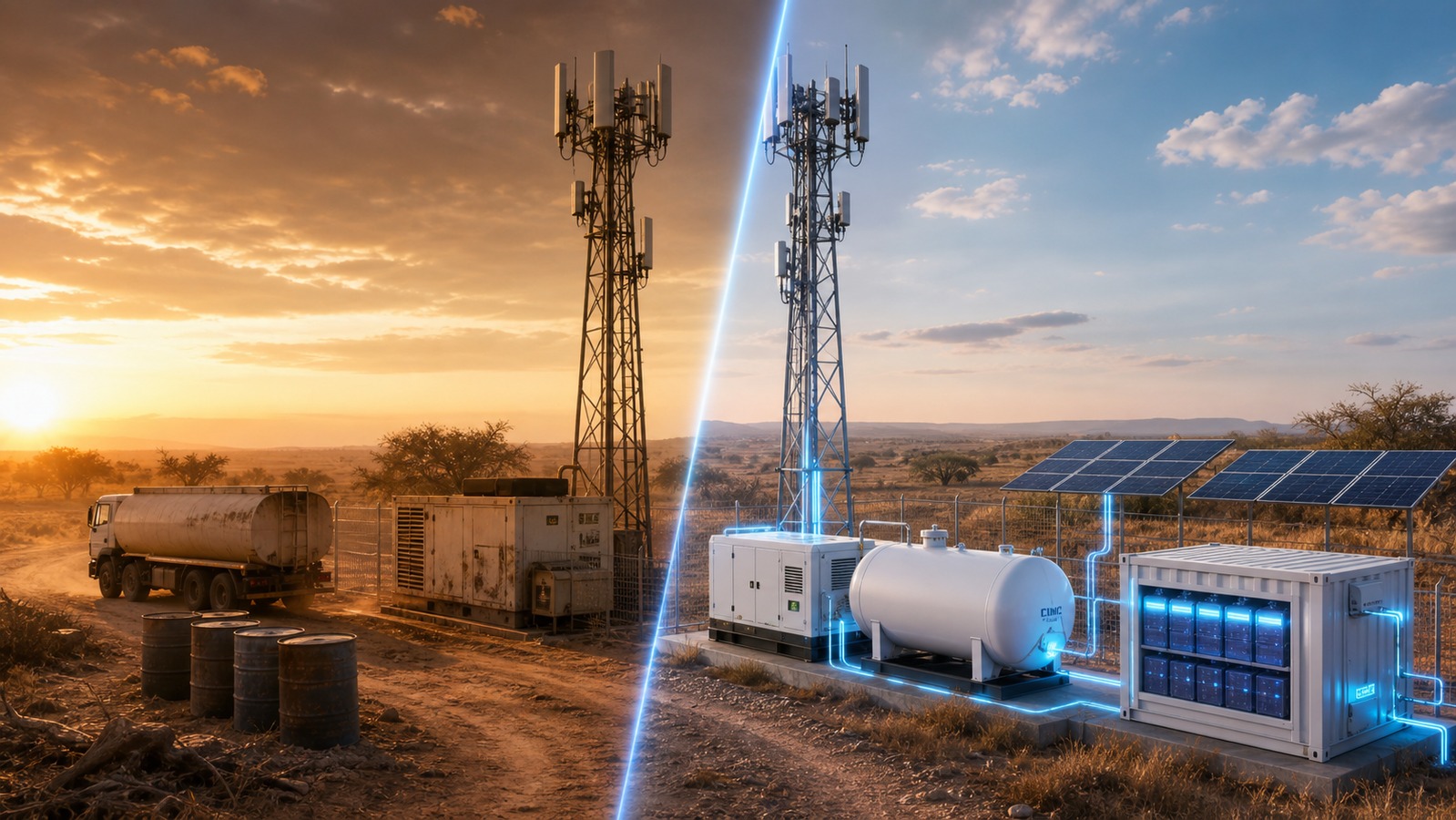
Why diesel becomes expensive at remote telecom sites
A generator can look affordable in capex. The problem appears after deployment. Fuel must be transported over long distances, often to dispersed and hard-to-access tower locations. Refueling visits increase road exposure and service cost. Fuel theft and leakage can distort the real cost per kWh. Generator maintenance is frequent when units run long hours or operate outside their efficient load range. When the tower is far from the service base, a small fuel or maintenance problem can become a network-availability problem.
This is why diesel-only thinking is increasingly weak for off-grid and weak-grid telecom portfolios. The cost that matters is not only fuel price. It is the blended cost of uptime: fuel, logistics, technician visits, spares, outages, site security and management time.
The market is moving toward hybrid power, but dispatchable fuel still matters
Solar and battery systems are already changing the economics of tower power. They can reduce generator runtime, stabilize site voltage and extend refueling intervals. In many sunny locations, PV + BESS becomes the first design layer. But telecom sites also have night loads, rainy seasons, security requirements and critical service obligations. Some sites cannot rely on PV and batteries alone without oversizing the system beyond a reasonable budget.
That is where LPG, LNG or local natural gas can become a better dispatchable layer than diesel. The gas generator is not necessarily running all day. It can operate as part of a controlled hybrid architecture: charge batteries during efficient operating windows, cover poor solar periods, support peak demand and provide emergency redundancy.
A practical three-route screening model
Before talking about equipment, operators should segment towers by load, accessibility, grid condition, fuel availability and uptime requirement. For early-stage screening, we usually see three practical routes.
Best for sites with stable telecom loads, good solar resources and enough land or rooftop area. The target is to reduce generator runtime and make diesel a limited backup source.
Best for smaller or medium remote sites where LPG distribution is easier than LNG logistics. It creates a modular and familiar fuel route while cutting diesel exposure.
Best for clusters, larger critical sites, island networks or locations near LNG, CNG or pipeline-gas supply. The system can centralize fuel planning and improve uptime control.
For tower clusters, the same logic can be applied at portfolio level. A single large fuel strategy can serve multiple nearby sites, while BESS and EMS reduce runtime and smooth the dispatch profile.
Why LNG/LPG-to-power can fit African telecom markets
In Nigeria, gas availability and diesel-cost pressure make telecom energy a natural candidate for LNG/LPG-to-power screening, especially where tower clusters or critical regional sites can justify a stronger fuel logistics plan. In South Africa, load shedding and grid uncertainty make hybrid backup and storage valuable for service continuity. In Angola, oil and gas infrastructure knowledge can support cleaner distributed power routes for industrial and telecom sites. In Cape Verde and other island markets, diesel import dependence, wind and solar resources, and weak-grid conditions make hybrid microgrids especially relevant.
None of these markets should be treated with one standard product package. A tower near a city, a remote mountain tower, an island telecom site and a mining-corridor base station all have different constraints. The common thread is the need to reduce diesel runtime while keeping the site online.
Gas access, diesel pressure and distributed tower clusters make LNG/LPG screening commercially relevant.
Grid interruption risk strengthens the case for PV, BESS and dispatchable backup power.
Oil and gas logistics can support gas-to-power routes for telecom and industrial corridors.
Island energy costs and weak-grid exposure make hybrid microgrids a strong resilience route.
Remote monitoring turns hybrid hardware into an operating system
A hybrid telecom site only performs well if it is operated well. Remote monitoring allows the operator to see fuel level, battery state of charge, generator runtime, alarm status and dispatch behavior. For a multi-site portfolio, this is where energy savings become controllable rather than theoretical.
CIMC ENRIC's scenario-based telecom power approach connects compact gas-to-power packages, telecom base station power solutions, BESS microgrids and project-level screening tools. For gas-available sites, gas-to-power can become the dispatchable layer. For no-gas or weak-grid sites, BESS-first planning may be more practical. The point is to choose the route based on the site, not the brochure.
Model the route before committing capex
Savings are site-specific and must be modeled by load profile, fuel price and dispatch strategy. The same telecom load can produce very different results depending on diesel price, LNG/LPG supply cost, solar resource, battery duration and refueling distance. That is why early-stage screening is valuable before FEED or procurement.
Operators can start with a simple comparison using the Telecom Fuel Savings Calculator, then move to a broader project LCOE screening when PV share, battery size and gas supply route need to be tested together.
Meet CIMC ENRIC at NOG Energy Week 2026
If you are reviewing telecom energy, gas infrastructure or distributed power opportunities in West Africa, CIMC ENRIC will be at NOG Energy Week 2026 in Abuja, Nigeria. The event runs from 5-9 July 2026. Our exhibition booth will be open from 7-9 July at F43 + F44 + F76.
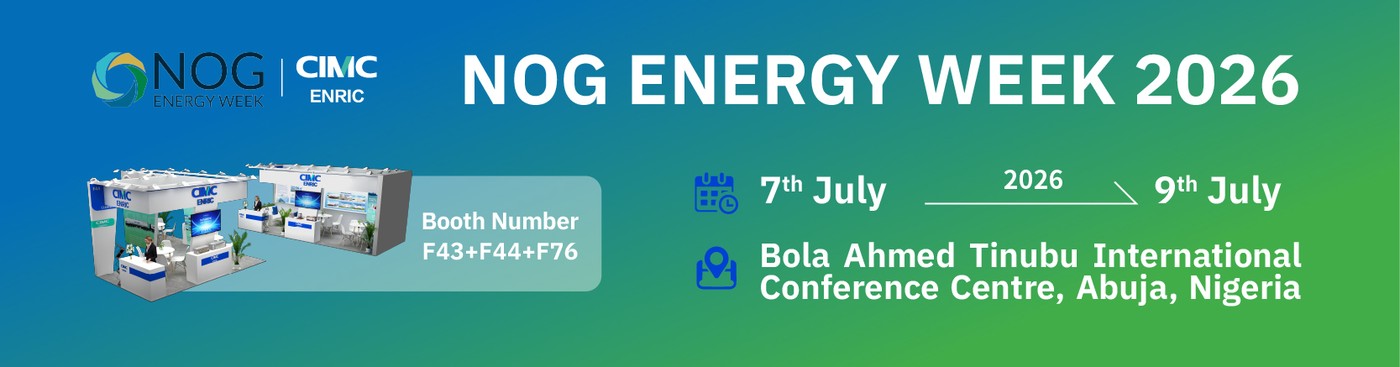
Bring a real site question: tower load, diesel consumption, fuel price, refueling interval, grid condition and whether gas or LPG supply is available. That is enough to start a practical route discussion.
Sources and context
- NOG Energy Week 2026, Abuja event information.
- IFC, sustainable access to communications and power infrastructure context.
- GSMA Tower Power Africa, energy challenges and opportunities for telecom towers.
- AP News, 2026 reporting on African telecom towers shifting toward solar and hybrid power.
Screen your telecom tower energy route.
Estimate fuel savings, then discuss whether PV+BESS, LPG backup, LNG-to-power or a mixed route fits your site conditions.