
A buyer’s guide for European biomethane developers, gas network operators and EPCs
A plant can produce biomethane without standing beside a suitable gas main. The question is how to move the gas safely and economically to an accepted grid entry point—or to a customer—while preserving the quality, traceability and operating conditions the buyer requires.
A direct pipe is not automatically the best route, and a trailer is not automatically cheaper. Compare the full chain, the time needed to establish each route and the responsibilities at every handover.
Start with the receiving point, not the trailer
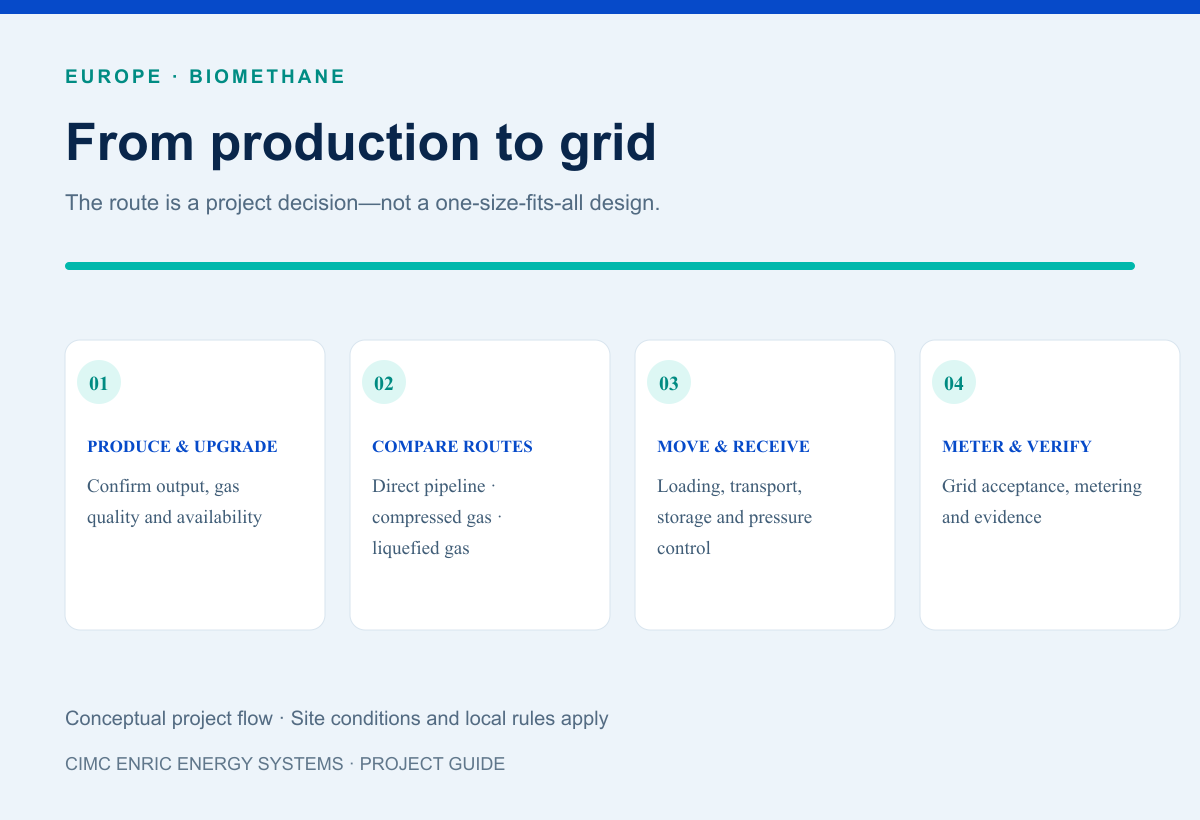
Before selecting equipment, ask the relevant network operator whether a proposed entry point can accept the expected gas volume and quality. Identify the required pressure, gas specification, monitoring, metering, operating hours and treatment of gas outside specification. Also ask who will own and operate the receiving facilities, and what permits and connection studies are needed.
If gas will be delivered to an industrial customer instead, agree the customer’s pressure, volume profile, quality and outage requirements. An industrial delivery point and a grid injection point are different interfaces; do not assume the same design applies to both.
Three routes to evaluate
Direct connection. A dedicated pipeline connects production to an appropriate network entry point. Compare routing, rights of way, land access, construction and reinstatement, metering, commissioning and future maintenance. Short distance alone does not guarantee a low total cost or a fast project.
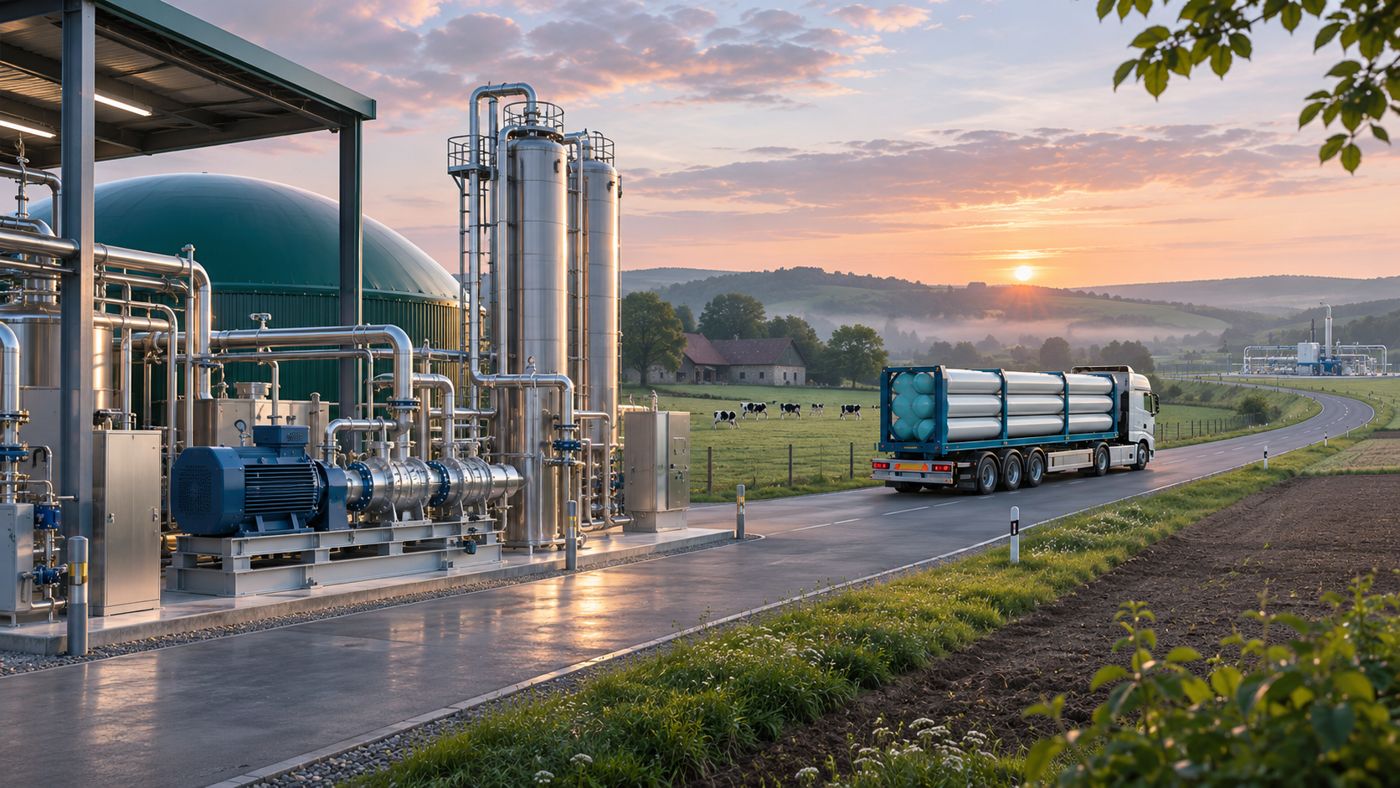
Compressed biomethane by road. Upgraded gas is compressed into approved transport modules, moved by an authorized carrier and discharged through receiving and pressure-control equipment. Check usable capacity per trip, not simply the geometric volume of a container. The cycle includes loading, travel in both directions, waiting, discharge, checks and maintenance.
Liquefied biomethane by road. Liquefaction and cryogenic transport may be considered where scale, route length and demand profile justify their added equipment and energy requirements. Compare liquefaction, storage, losses, logistics and regasification on the same delivered-energy basis. It is a project option, not a default recommendation.
The IEA’s review of biogas and biomethane projects identifies limited access to pipeline infrastructure as a reason why virtual transport can emerge. Whether it works for an individual site depends on verified local conditions.
A practical fleet-sizing starting point
- Confirm the expected net gas sent out per day and its seasonal variation, using an agreed energy or standard-volume basis.
- Obtain the usable quantity delivered per vehicle cycle from the proposed equipment and operating pressures; do not use nameplate water volume as delivered gas.
- Divide daily gas output by usable quantity per trip to estimate required trips per day.
- Calculate a realistic vehicle cycle: loading + outbound travel + waiting + discharge + return + required checks.
- Compare available vehicle operating hours with the cycle time. Add project-specific resilience for maintenance, route disruption, demand peaks and receiving-point downtime.
For illustration only, if 12 units of gas must move each day and one cycle carries 4 units, the route needs 3 loaded trips per day. This is a trip estimate—not a three-vehicle specification. Vehicle count depends on cycle time, legally available driving hours and standby policy.
Compare cost at the same boundary
For each route, build a project cash-flow model covering upfront equipment, land and civil works, compression or liquefaction energy, transport, labour, metering, inspection, maintenance, availability, financing and end-of-life or redeployment value. Use a consistent energy basis and timeframe. Stress-test receiving availability, vehicle utilization, energy cost, load profile and project duration.
Include the value of staged deployment if a direct pipeline may arrive later, but do not assume a pipeline will be built or that a mobile asset can be redeployed without cost. The IEA notes that grid connection is an additional project cost; the actual amount depends on the site and network requirements. IEA cost discussion.
Don’t lose the commercial attributes
Physical gas delivery and its renewable attributes are related but distinct project workstreams. Verify with the buyer, certification body and relevant authorities what sustainability evidence, chain-of-custody arrangements, metering and tracking are needed for the intended market and claim. Rules differ by country, feedstock and use. Do not assume that truck delivery automatically confers a certificate or a particular emissions outcome.
The project brief we need
Share the site and prospective receiving location, net gas volume and quality, production profile, available pressure, target delivery date, expected contract period, current grid discussions and any route restrictions. CIMC ENRIC can discuss the equipment and integration scope with your EPC, operator and local transport partners; detailed feasibility and pricing require project-specific engineering.
Explore our Europe biomethane hub · Discuss a project
Sources: IEA reports linked above; European Commission, Biomethane. Project and regulatory requirements must be confirmed for the relevant jurisdiction.