
For: Industrial power buyers, LNG suppliers and EPC engineers
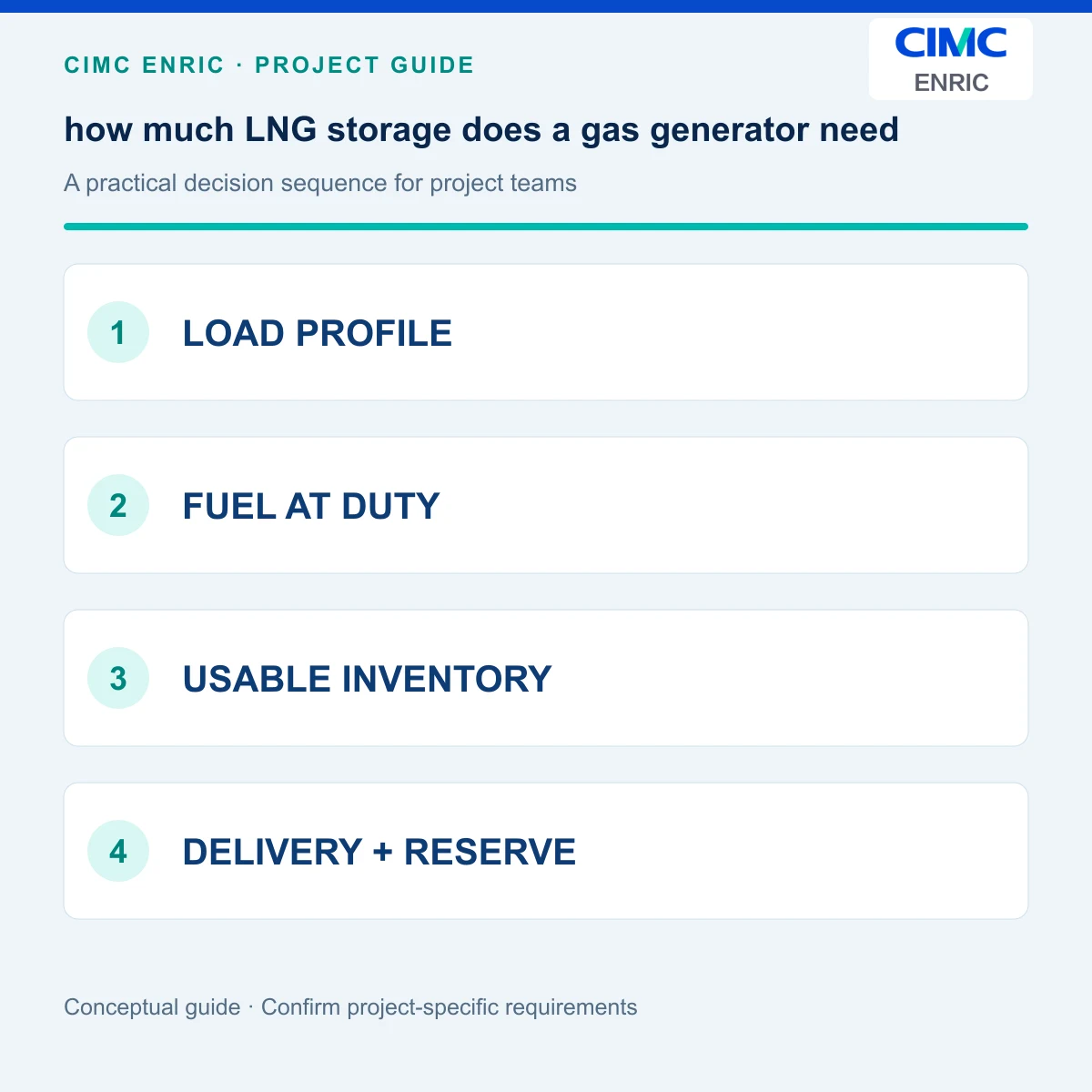
Start with the site’s actual electrical load over time, the generator’s fuel consumption at that load, and the minimum interval between dependable deliveries. Convert the energy requirement into usable LNG inventory, then add agreed reserve for delivery disruption. Tank nameplate volume and usable fuel are not the same.
Define the load and reserve window
Record the average and peak electrical demand, operating hours, starting loads and generator reserve philosophy. Calculate normal energy use as average kW multiplied by operating hours. A 500 kW continuous load over 48 hours requires 24,000 kWh of electrical output before station auxiliaries. A site operating at 500 kW for only 12 hours a day has a very different inventory profile.
Decide whether autonomy means time until the next scheduled delivery, time to the first emergency delivery, or the longest credible interruption. Seasonal road access, supplier loading slots and maintenance may matter more than a generic number of days.
Convert electricity to usable LNG
An illustrative method is electricity required divided by electrical efficiency, then divided by fuel energy per usable cubic metre. For example, assume—only for screening—40% electrical efficiency and 6,250 kWh of chemical energy per usable m³ of LNG. The result is 2,500 kWh of electricity per usable m³ before site auxiliaries. Under those assumptions, 24,000 kWh requires 9.6 usable m³.
This is an example, not a guaranteed conversion factor. LNG composition, density, heating-value basis, actual engine load, site altitude and efficiency vary. Use the supplier’s LNG analysis and the engine manufacturer’s fuel-consumption curve, with higher or lower heating value consistently applied.
Move from usable volume to a tank specification
Work backwards from the usable inventory. Account for permitted fill level, minimum heel, gas unavailable under the agreed operating envelope, boil-off handling, metering tolerances and the reserve held for interrupted deliveries. The site designer and supplier must define each quantity; do not invent a universal fill percentage.
Check whether one larger tank or several smaller vessels better fits vehicle access, foundations, outage continuity and permitted operating procedures. Vaporizer capacity must match peak gas withdrawal, not just average daily consumption.
Test supply interruption, not only average use
Model low, normal and high demand; a delayed delivery; reduced vaporizer performance in local weather; and a generator or tank unavailable for maintenance. Confirm refuelling windows, tanker turn-around and access. The storage calculation must sit beside a qualified safety and permitting review.
A calculator can organise assumptions, but the tank and vaporizer require an engineered duty specification and supplier confirmation. A target autonomy number is only useful when the initial fill, final usable level and reserve definitions are explicit.
Questions buyers ask
Does a 20 m³ tank always provide twice as much electricity as a 10 m³ tank?
Only if usable volume, fuel composition, engine efficiency and operating conditions are comparable. Nameplate sizes alone cannot establish operating hours.
Can one LNG storage calculation cover heat and power?
Include all gas consumers, their coincidence and the required delivery pressure. A process boiler and a generator can peak at different times.
Prepare a project brief
Location; hourly load; runtime; fuel analysis; engine fuel curve; delivery distance and cadence; operating pressure; required reserve; other gas consumers; target voltage and frequency.
Explore related CIMC solutions · Read the related project guide · Discuss your project
Source: US Department of Energy: LNG basics. The cited material provides context; project decisions require current site-specific engineering and applicable requirements.