
A policy signal. A broader project opportunity.
India is moving towards a larger and more flexible power system. For buyers, the question is no longer simply how much battery capacity to procure—it is how equipment, controls, local delivery and long-term operation fit together.
On 4 November 2026, India’s Union Cabinet approved a ₹14,500 crore viability gap funding scheme for 92 GWh of new grid-scale energy storage across FY 2026–27 to FY 2030–31. The plan includes pumped hydro, battery storage and emerging technologies. Capacity will be allocated through tariff-based competitive bidding. Read the government announcement ↗
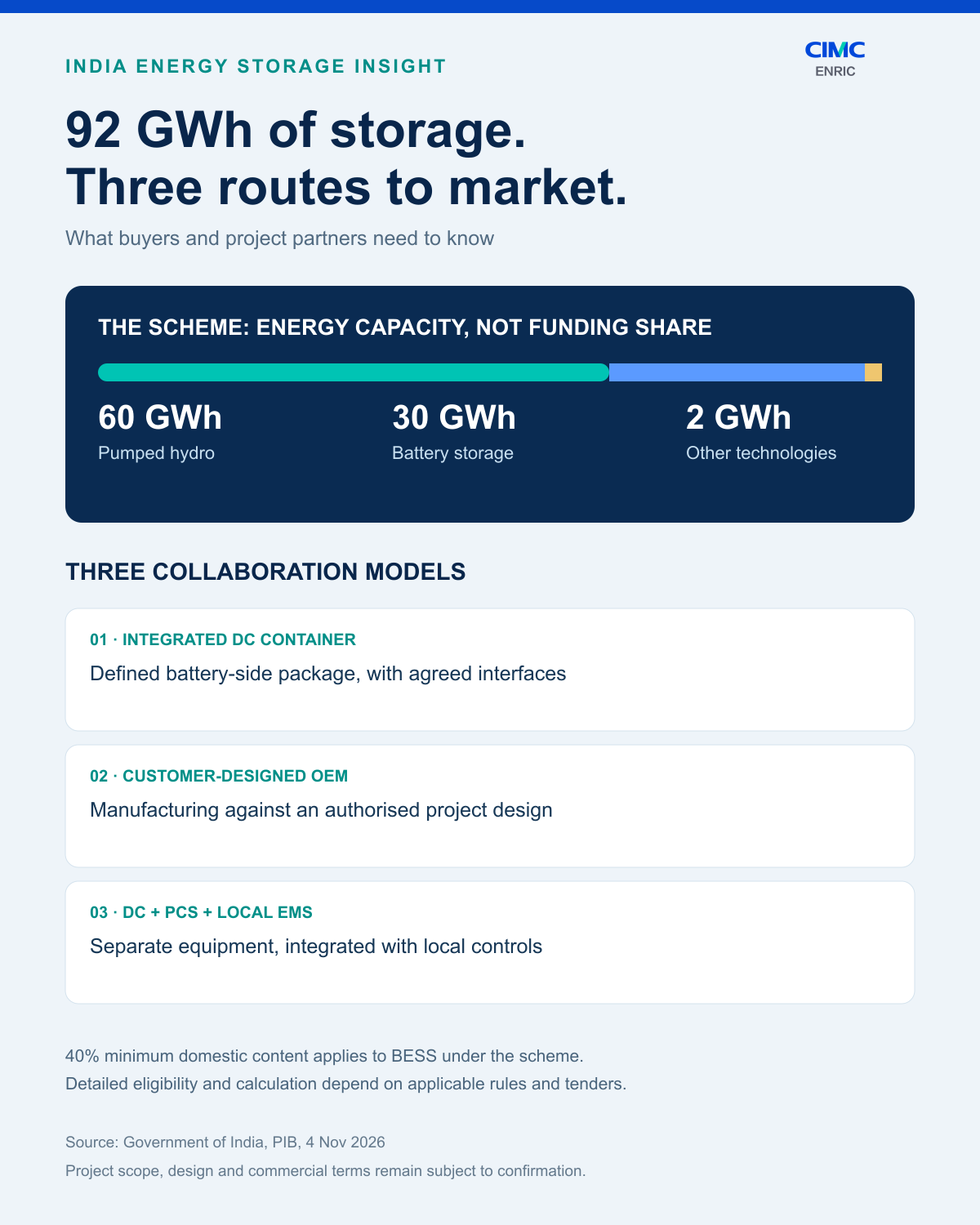
What makes up 92 GWh?
Capacity target · not a split of fundingThe announcement specifies a minimum 40% domestic content requirement for BESS projects in the scheme. Project owners and bidders should confirm the detailed methodology, eligible items, evidence requirements and procurement documents as they become available. A local assembly plan or an Indian EMS does not, by itself, establish eligibility.
The inquiries tell a wider story.
Alongside the policy signal, CIMC ENRIC is following several inquiries across different applications. They are at the discussion stage and have different technical and commercial requirements. Together, they point to growing interest across the storage value chain—not a confirmed order book or a statistical measure of the market.
Grid peak shifting
Exploring battery systems that can support peak demand management and time-shifting, subject to dispatch rules, tariff structure and project requirements.
Solar paired with storage
Looking at how batteries can move solar generation into later demand periods and support renewable integration.
Large BESS integrator demand
Discussing how a system integrator might source DC battery capacity and define the interfaces needed for a complete project.
These anonymised inquiry categories are at the discussion stage. Their order illustrates different applications rather than a chronology or confirmed orders.
Three demand models. Three ways to collaborate.
Integrated DC container
Source a defined battery-side package through an agreed delivery partnership.
Customer-designed OEM
Manufacture or integrate against an authorised design and a clear scope.
DC + PCS + local EMS
Combine separately procured equipment with local controls and integration.
01 · An integrated DC container
Some buyers want a defined DC-side battery package—for example, a 5 MWh-class container with cells, packs, BMS, cooling and fire-safety equipment, depending on the product specification. Working with a leading battery-cell manufacturer and other qualified partners, CIMC ENRIC can discuss the relevant manufacturing and integration scope for a project.
A DC package is one part of a complete system. PCS, transformers, switchgear, energy management, grid connection and site work may be separate. Exact equipment, certifications, warranty and delivery responsibilities must be agreed for each project.
02 · Customer-designed OEM manufacturing
Other buyers or technology owners already have a design and need a manufacturing partner. Where the design owner provides or authorises the necessary drawings, bill of materials and interfaces, we can evaluate a defined OEM manufacturing or integration scope. Design ownership, rights to use drawings, testing, compliance and performance responsibilities should be resolved before quotation.
The right question is not simply “What does an empty container cost?” It is what the buyer expects inside it, who owns the design, and which interfaces, tests and services are included.
03 · DC container + PCS + Indian EMS
For buyers that prefer a flexible supply chain, a DC container and PCS can be sourced separately, while an Indian integration partner configures the site-level EMS, completes system integration and supports local commissioning. CIMC ENRIC can discuss DC equipment, PCS or a defined integration package with the project’s chosen partners, subject to confirmed product capability and scope.
One system, clearly defined interfaces
Communication, protective interlocks, controls, cybersecurity, testing and warranty boundaries must be agreed across suppliers.
In this model, the BMS monitors and protects the battery; the PCS converts power and executes power commands; and the EMS coordinates the operating strategy within the project’s technical and contractual limits. Local software and engineering can support dispatch, monitoring and operational flexibility, subject to the rules and contracts for the relevant market.
Supply capacity is expanding. Delivery planning still matters.
China’s battery industry continues to invest in production capacity. In its March 2026 annual-report release, CATL reported 772 GWh of global production capacity at the end of 2025, with another 321 GWh under construction. These are CATL’s total battery capacity figures, not capacity reserved for this project or the Indian storage market. Read CATL’s release ↗
According to factory personnel, five CIMC manufacturing lines at the production base of a leading battery-cell manufacturer are scheduled through the first quarter of 2027. This is a point-in-time account of the production schedule, not a guaranteed delivery date; availability and lead times should be confirmed for each project.
What determines the business case?
Battery performance is only part of the decision. A project’s value may come from contracted capacity, time shifting, demand management or other eligible services. Whether any service is available—and whether revenues can be combined—depends on the applicable tariff, market rules, contract and operating constraints. EMS software can execute an agreed strategy; it does not guarantee a subsidy or arbitrage income.
For an initial assessment, align on AC power and usable energy, charge/discharge duration, delivery point, cycle profile, grid conditions, local content obligations, technical interfaces, ownership of operating controls and the long-term service plan.
Questions buyers and partners are asking
Does the 92 GWh scheme mean 92 GWh of battery projects?
No. The approved scheme identifies 30 GWh of BESS, 60 GWh of pumped storage and 2 GWh of emerging storage technologies.
Can an Indian EMS be combined with separately sourced DC containers and PCS?
It is a possible project architecture. The parties must first confirm communication, control authority, safety, performance and warranty interfaces.
Does local assembly automatically meet the 40% requirement?
Not necessarily. Eligibility and calculation must be checked against the applicable implementation rules and the individual procurement documents.
Building a storage project in India?
Share your application, target capacity and preferred delivery model. We can discuss the equipment scope and the interfaces with your local partners.
Discuss your project →Sources and publication notes
- Government of India, Press Information Bureau: Cabinet approval of the grid-scale storage scheme, 4 November 2026.
- CATL: 2025 annual-report release, 10 March 2026.
- Inquiry categories reflect ongoing discussions without naming customers. The five-line production schedule is attributed to factory personnel and reflects their account at the time of writing.
Policy implementation, tender eligibility, delivery schedules and project economics require independent project-specific verification.