
A practical screening guide for industrial energy buyers, local gas suppliers and EPCs
A factory may operate in a country with extensive gas infrastructure and still lack a practical connection at its own gate. For that customer, the useful question is not whether Mexico has pipelines. It is whether a specific site can secure reliable gas at a workable delivered cost, on the schedule and operating terms it needs.
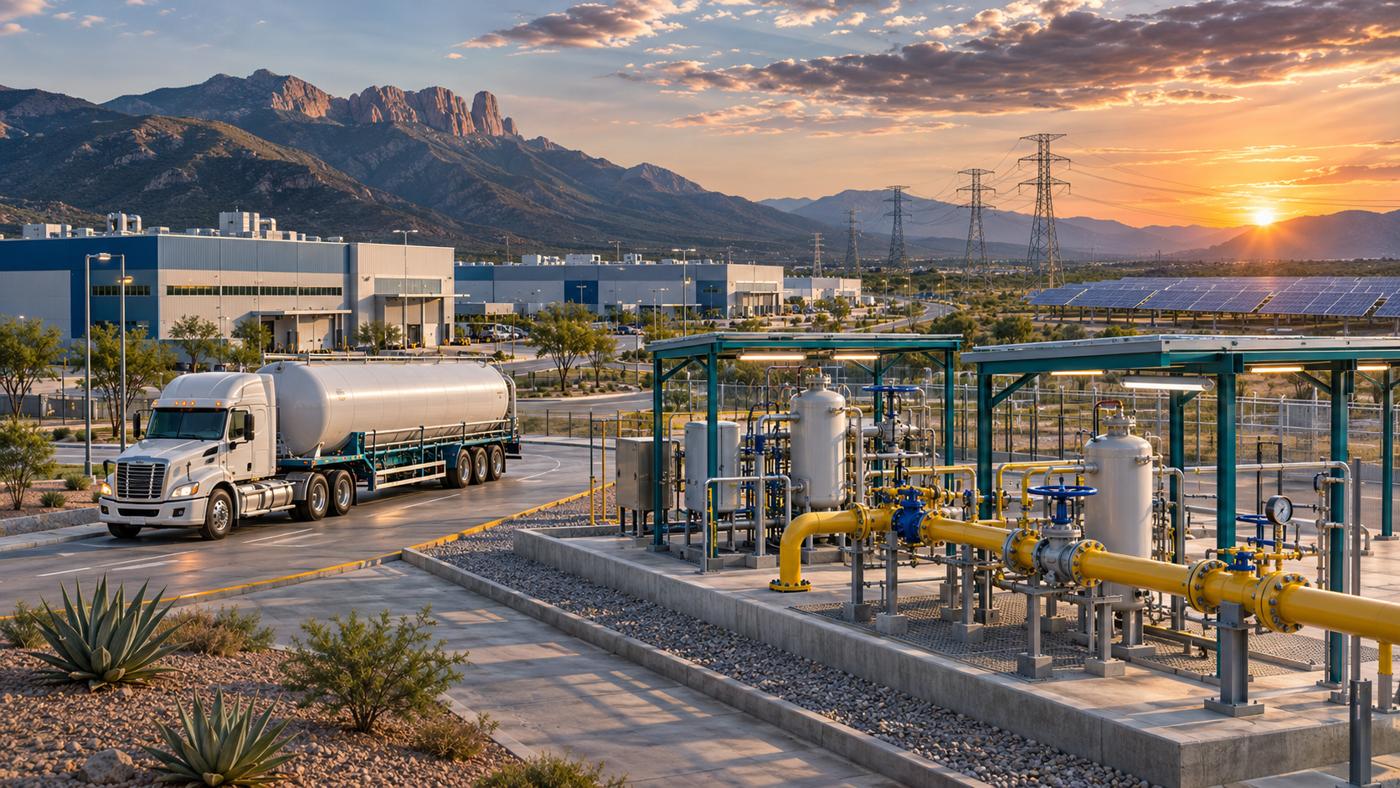
A virtual gas pipeline is one possible route: source gas through an authorized supplier, transport CNG or LNG by road where appropriate, receive it safely at the site and use it for process heat, generation or both. It is a project concept that requires local permits, supply arrangements and engineering—not a claim that every remote site can be served economically.
Why start with the last mile?
The U.S. Energy Information Administration reported that U.S. natural gas pipeline exports to Mexico averaged 7.5 billion cubic feet per day in May 2025. Its October 2025 analysis also noted pipeline infrastructure constraints and limited Mexican storage capacity. Those figures describe a national and cross-border market, not the gas available at an individual factory. Read the EIA analysis.
Mexico is also investing in pipeline infrastructure. A project should compare actual connection timing and terms with road delivery, rather than assume either that no pipeline is coming or that expansion solves every last-mile connection. Proyectos México: gas pipeline plan.
Choose the anchor load before the equipment
Start with one customer or cluster whose demand can be measured. Useful candidates to investigate include industrial parks, manufacturers, mining operations and temporary or expanding facilities. The customer’s location, gas demand, operating hours, current energy costs and requirements for continuity determine whether a route deserves further study.
A plant using gas mainly for heat has a different load and receiving requirement from a site producing electricity. A project serving both must establish the gas quality, pressure and redundancy needed by each user. Nearby fleet refuelling may be explored separately if demand and permits support it; it is not automatic additional revenue.
CNG or LNG: a comparison, not a rule
| Question | CNG route | LNG route |
|---|---|---|
| Source | Is a licensed compression and loading point available? | Is a dependable LNG loading source available? |
| Logistics | What useful energy can each module deliver per trip? | What are the usable cargo, storage and delivery windows? |
| Site interface | What pressure reduction, metering and controls are required? | What cryogenic storage, vaporisation, pressure control and metering are required? |
| Operations | How are vehicle cycles, standby and inspections covered? | How are storage management, maintenance and supply interruptions covered? |
Distance, load size, road access and fuel pricing influence the result, but none alone selects the solution. Ask qualified suppliers for a like-for-like delivered-energy comparison with the same availability requirement.
A screen that an energy buyer can actually use
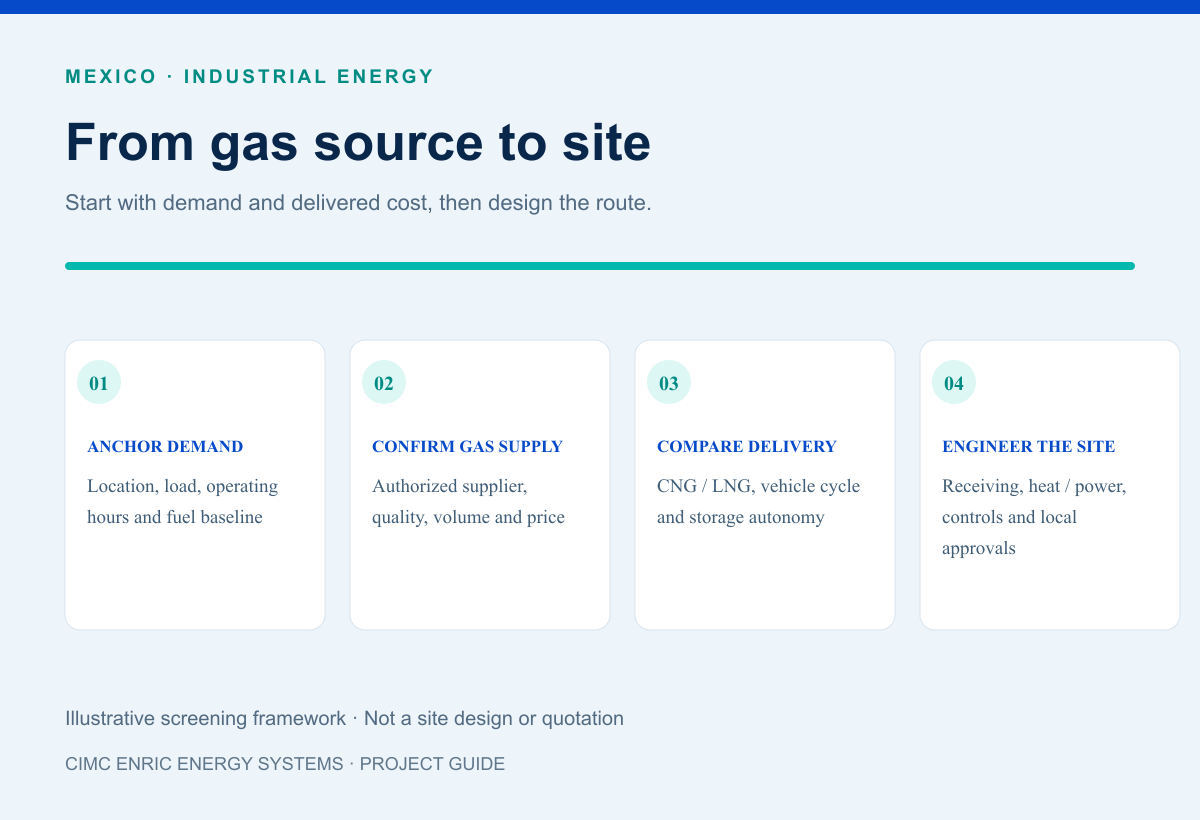
- Establish the baseline: twelve months of bills or fuel deliveries, actual delivered diesel or LPG cost, load profile and annual operating hours. Separate electricity and process-heat loads.
- Confirm supply: gas availability, composition, pressure, contract duration, price formula, minimum purchase and contingency arrangements with a licensed local supplier.
- Build the logistics: source-to-site route, usable quantity per delivery, loading and unloading time, road restrictions, reserve storage and maintenance plan.
- Define the site: land, civil works, electrical connection, receiving station, gas treatment, equipment scope and commissioning responsibility.
- Evaluate the system: compare an agreed baseline with gas generation or process-heat options. Where relevant, test solar and battery integration using the actual duty cycle and control strategy.
- Review the economics: include fuel delivery, equipment, installation, maintenance, financing, taxes, spare parts and residual value. Use high and low cases for gas price, diesel price and utilization; savings are not guaranteed.
CIMC’s gas-to-power feasibility calculator can help organise an initial assessment. Check its assumptions and units for the project: an indicative calculator result is not an engineering design, a gas-supply agreement or a binding quote.
Who does what?
A workable project needs a clear responsibility matrix. A local gas supplier may address source and fuel contracts; authorized transport and site-service partners may manage the agreed delivery and operating scope; the EPC and equipment suppliers define interfaces, permits, installation and commissioning. These are possible roles to negotiate, not commitments by a named company.
What to send for a first conversation
Share the site location, operation type, current fuel and delivered price, peak and average electrical load if power is needed, process-heat demand if applicable, operating hours, site access, any identified gas source, target start date and required backup duration. If data is incomplete, state what is known; a staged screening can identify the next measurements.
Explore Latin America gas solutions · Discuss a project
Market references are dated as indicated. Supply, economics, environmental performance and regulatory requirements must be confirmed for each location; no named partnership or completed Mexican project is implied.