
Latin America already has large LNG import capacity, but the next growth layer is scenario-based power: diesel conversion, mining backup, industrial parks and modular LNG logistics. Here is what the Santiago forum season means for buyers — and what CIMC ENRIC already delivered in the region.
1. What Santiago is actually about
Organized by GNL GLOBAL, the forum runs 19–21 October 2026 at the InterContinental Santiago Hotel. The published agenda is practical, not ceremonial:
- LNG market challenges and growth opportunities in Latin America and the Caribbean
- Infrastructure development, terminal expansions and new investment projects
- Small- and mid-scale LNG commercialization
- Innovations in LNG transportation, storage and regasification
- LNG bunkering, land transportation and marine fuel applications
- Price dynamics, contracting structures and project financing
For project developers, the useful question is not “who speaks.” It is whether your fuel, power and logistics stack can move from molecules to megawatts on a real site schedule. See the GNL GLOBAL Forum 2026 event page.
2. The region already has LNG terminals — power is the next bottleneck
According to an EIA-based report summarized by LNG Industry (30 October 2025), Brazil’s LNG regasification capacity grew from 2.5 billion ft³/d in 2020 to 5.1 billion ft³/d in August 2025. Three terminals alone added about 1.74 billion ft³/d in 2024.
The same report frames Brazil’s build-out as an integrated LNG-to-power strategy: new import facilities paired with large gas-fired plants (for example Barcarena with Novo Tempo / CELBA, and Port of Açu with GNA II). About 80% of Brazil’s electricity comes from hydropower, wind and solar; hydro alone was 56% of generation in 2024. When reservoirs fell toward 29% of capacity in key regions in 2024, gas plants linked to LNG terminals were the flexible backup.
A GECF regional commentary (August 2025) puts Latin America & Caribbean existing regasification near 72 Mtpa, with roughly 15 Mtpa under construction, and notes that new importers often use LNG to displace diesel and heavy fuel oil in power. Chile’s Quintero / Mejillones complex and Colombia’s Cartagena FSRU sit inside that same map.
3. Chile’s mining load shows why firm power still matters
Chile is hosting the forum for a reason that goes beyond LNG trading. Copper mining remains one of the country’s heaviest electricity consumers.
- Cochilco, via Reuters (27 June 2024): Chile copper mining electricity demand expected to rise 31.4% from 2023 levels to about 34.2 TWh by 2034 (from 26.0 TWh in 2023).
- Plusmining (August 2026), citing Cochilco / national energy balance: copper mining accounts for roughly 15% of Chile’s final energy use; about 51.3% of that is electricity and 48.7% fossil fuels (mainly diesel). Renewable electricity share in mining reached nearly 80% by 2025, yet demand is still projected to keep rising as ore grades decline.
- Skarn Associates’ 2025 drought note: hydropower is about 19% of Chile’s generation capacity; hydro output fell 22% year-on-year in 2025, while thousands of GWh of solar and wind were curtailed because the grid could not absorb them — a classic firm-capacity problem that storage and dispatchable gas can help close.
For mine operators, the design question is familiar: renewables where they are cheap, diesel or gas where the site must stay online, and BESS + microgrid control where peaks and black-start matter.
- 5th GNL Global International Forum, Lima, Peru: CIMC ENRIC and partners received the conference “Annual Project Award” for constructing a regasification unit station in Latin America. Related orders covered LNG tank container carrier vessels and a batch of tank containers, with total contract value exceeding RMB 500 million. Source: CIMC ENRIC company news.
- Integrated logistics chain (verbatim project architecture): FSU offshore receiving — tank container transfer — onshore vaporization — pipeline injection, designed to support more than 60 million cubic feet of natural gas per day on the west coast of a Latin American country.
- Naturgas 2026, Cartagena (15–17 April): CIMC ENRIC exhibited LNG storage tanks, LNG semi-trailers, LNG refueling stations, CNG cylinder bundles and LPG semi-trailers, and engaged around Colombia LNG import projects with local partner Regasificadora del Pacífico S.A.S. Source: CIMC ENRIC Naturgas note.
- Brazil road logistics: since December 2024, five super-large 61.7 m³ LNG semi-trailers from CIMC Sanctum (a CIMC Enric subsidiary) have been deployed for Brazilian customers — described by the company as the largest-capacity LNG semi-trailers then available in that market.
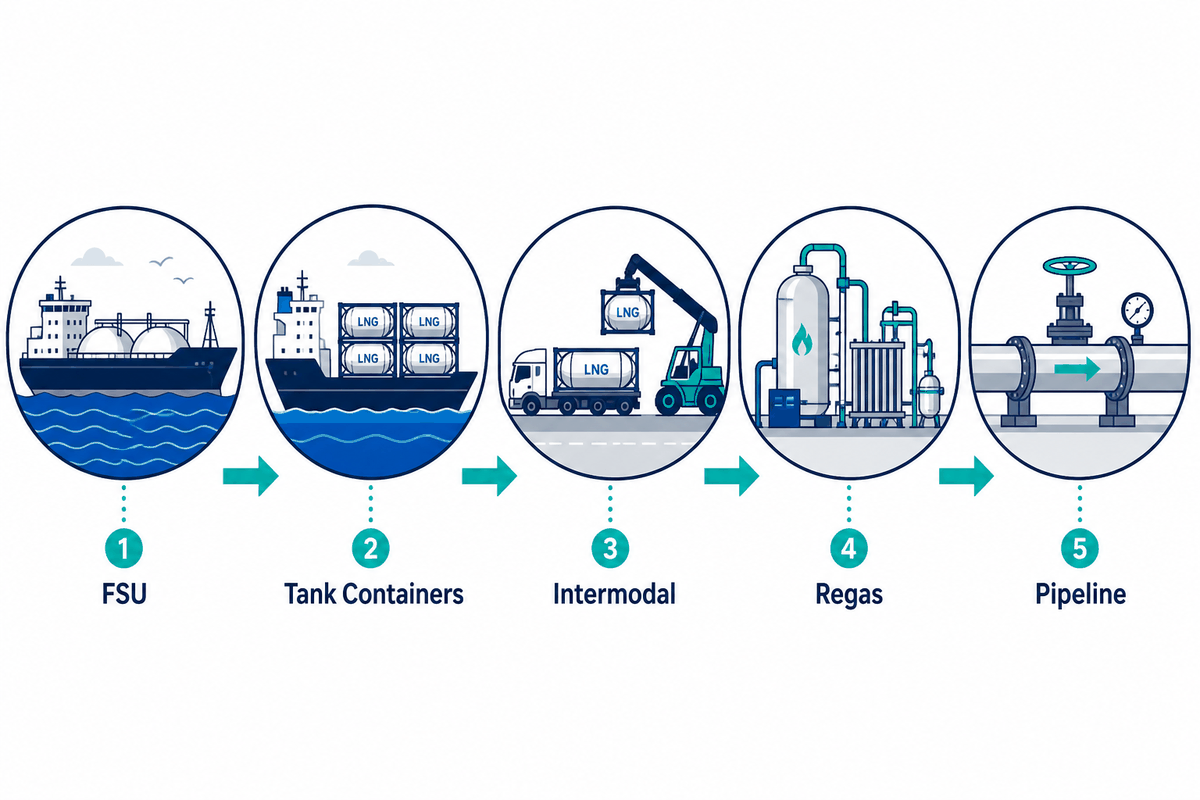
Small- and mid-scale LNG, ISO container / virtual pipeline logistics, modular generation and BESS are one system, not four RFQs.
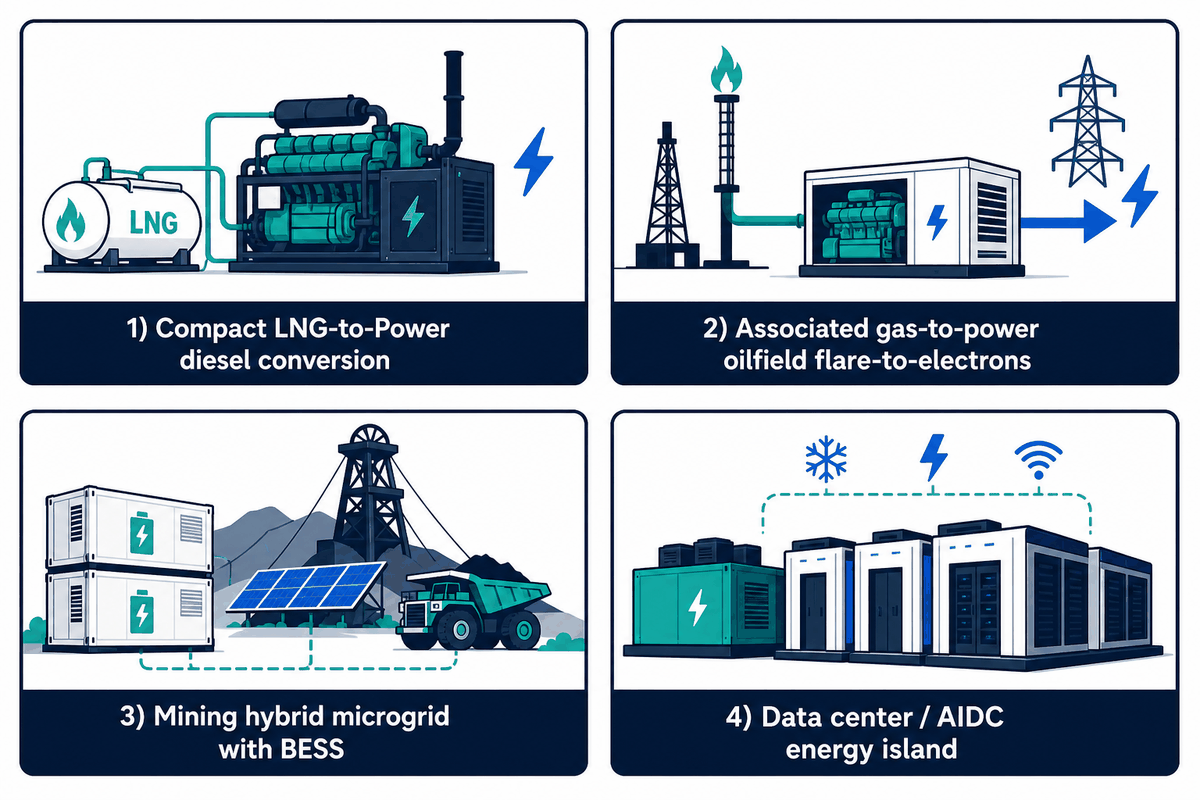
For industrial parks, remote plants and sites where pipeline gas is late — see Compact LNG-to-Power Diesel Conversion.
Where molecules are on site but electrons are expensive — see Associated Gas-to-Power and the gas-to-power calculator.
Gas gensets, containerized BESS and EMS for peak shaving and resilience — see Mining Power.
Where grid intake is slow — see Data Center and AIDC.
If you are evaluating LatAm LNG-to-power before or after the forum, these five inputs shorten the engineering loop:
- Site load profile (MW base / peak) and required redundancy
- Fuel reality: pipeline gas, LNG truck, CNG, associated gas, or diesel baseline
- Logistics constraint: port distance, road limits, FSRU / ISO container option
- Whether the offtake is mining, telecom/industrial, oilfield or data center
- Target COD and whether the first phase must be relocatable
CIMC ENRIC can then map a modular route — fuel intake, power block, BESS, control and turnkey packaging — instead of forcing a one-size plant.
Sources cited above include GNL GLOBAL’s event page, EIA reporting via LNG Industry (30 Oct 2025), GECF regional LNG commentary (Aug 2025), Cochilco figures via Reuters (Jun 2024), Plusmining / Skarn drought and mining energy notes, and CIMC ENRIC company news on the Lima award, Naturgas 2026 and Brazil LNG trailers. Figures are quoted as published; verify against primary documents before investment decisions.
Bring a LatAm brief — or a Santiago follow-up.
If you are preparing a LatAm gas-to-power, diesel conversion or mining hybrid brief, start with a project assessment or run a first-cut fuel-to-MW check. We will keep publishing scenario notes as Santiago approaches.