
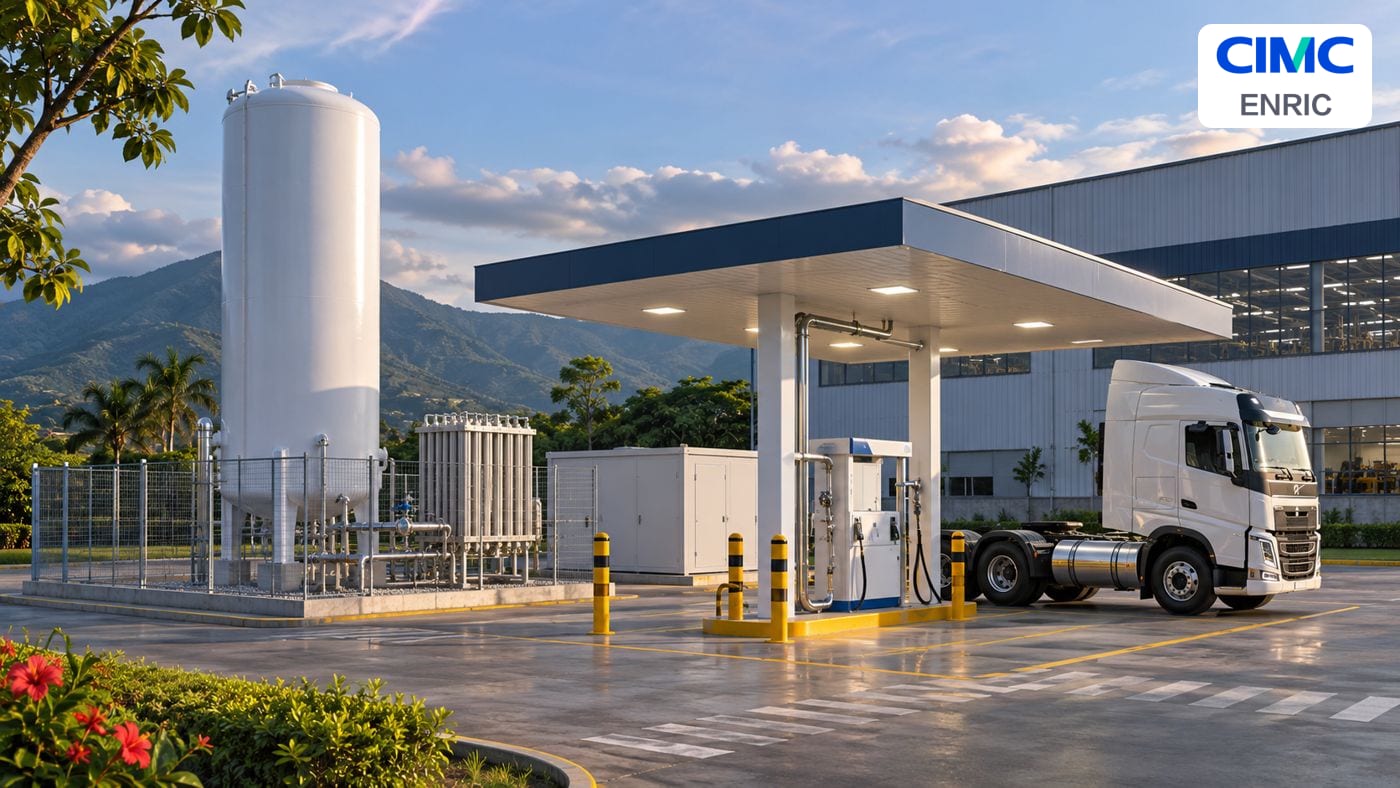
For: Industrial parks, fleet owners, local gas distributors and EPCs
Potentially. A common supply route can be studied for an industrial anchor load and a transport fleet, but the gas contract, storage, demand coincidence, vehicle fuel specification and dispensing station each require a defined commercial and safety boundary.
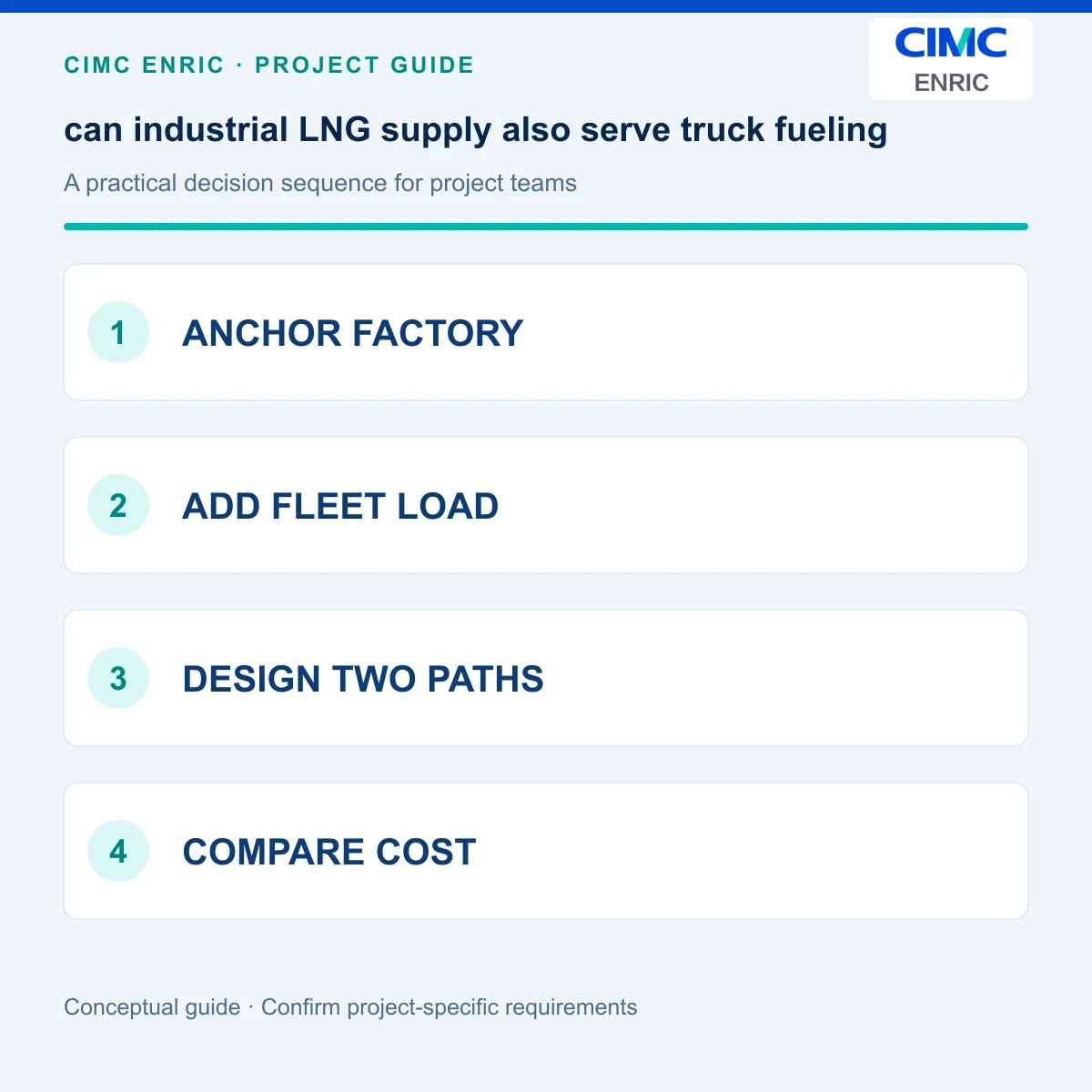
Start with the reliable anchor demand
Quantify the factory’s daily and hourly gas demand, whether for process heat or generation, its minimum operating inventory and its delivery schedule. Then obtain the fleet’s vehicle count, fuel per trip, refuelling windows, route and growth outlook. Separate owned vehicles from third-party demand.
An indicative scenario of 100 units per day for industry and 20 for a fleet totals 120 units before losses and reserve, if both are measured on the same energy basis. It does not prove the peak filling and vaporization equipment can serve both at once.
Draw two separate end-use paths
Industrial power may require vaporization, pressure control and gas-quality monitoring. A vehicle fueling station has its own storage and dispensing design, operating procedures, metering and safety requirements. CNG and LNG vehicles use different fuel arrangements; confirm the actual vehicle and station specification.
Do not assume every tanker, vessel or dispensing component is interchangeable. Decide where ownership transfers, who maintains each package, who pays for fuel losses and how the customer is served during maintenance.
Size deliveries and site buffer together
Plot the daily factory profile and vehicle refuelling peaks against supplier loading and truck cycles. Include minimum operating inventory, delivery disruption, receiving capacity and future expansion. A fleet can improve utilization only if its demand is sufficiently predictable and the station remains commercially viable.
Review road access, unloading and dispensing layouts, emergency vehicle access, hazardous-area classification and applicable permits with local licensed professionals. The article does not replace detailed fire and safety engineering.
Make the commercial case explicit
Compare a factory-only route against the combined route using delivered energy cost, extra equipment, construction, staffing, metering, land, maintenance, permits and reserve. Separate the costs borne by the factory, fleet, gas supplier and station operator.
Use low, base and high cases for fleet utilization and gas price. A shared route may improve a project’s economics, but savings, third-party station access and supply rights are not automatic.
Questions buyers ask
Can a power generator use LNG directly from the liquid tank?
The selected gas engine generally needs an engineered vaporization, pressure-control and gas-quality interface; confirm the approved package boundary.
Does adding a fleet guarantee cheaper fuel?
No. Incremental station, staffing, permitting and demand variability must be included.
Prepare a project brief
Factory demand profile; vehicle fuel type and refuelling windows; supply contract; route and tanker size; storage reserve; metering; land; permits; ownership and service model.
Explore related CIMC solutions · Read the related project guide · Discuss your project
Source: US DOE Alternative Fuels Data Center: natural gas fuels. The cited material provides context; project decisions require current site-specific engineering and applicable requirements.