
CIMC ENRIC Energy Systems · local gas suppliers, industrial customers and EPCs
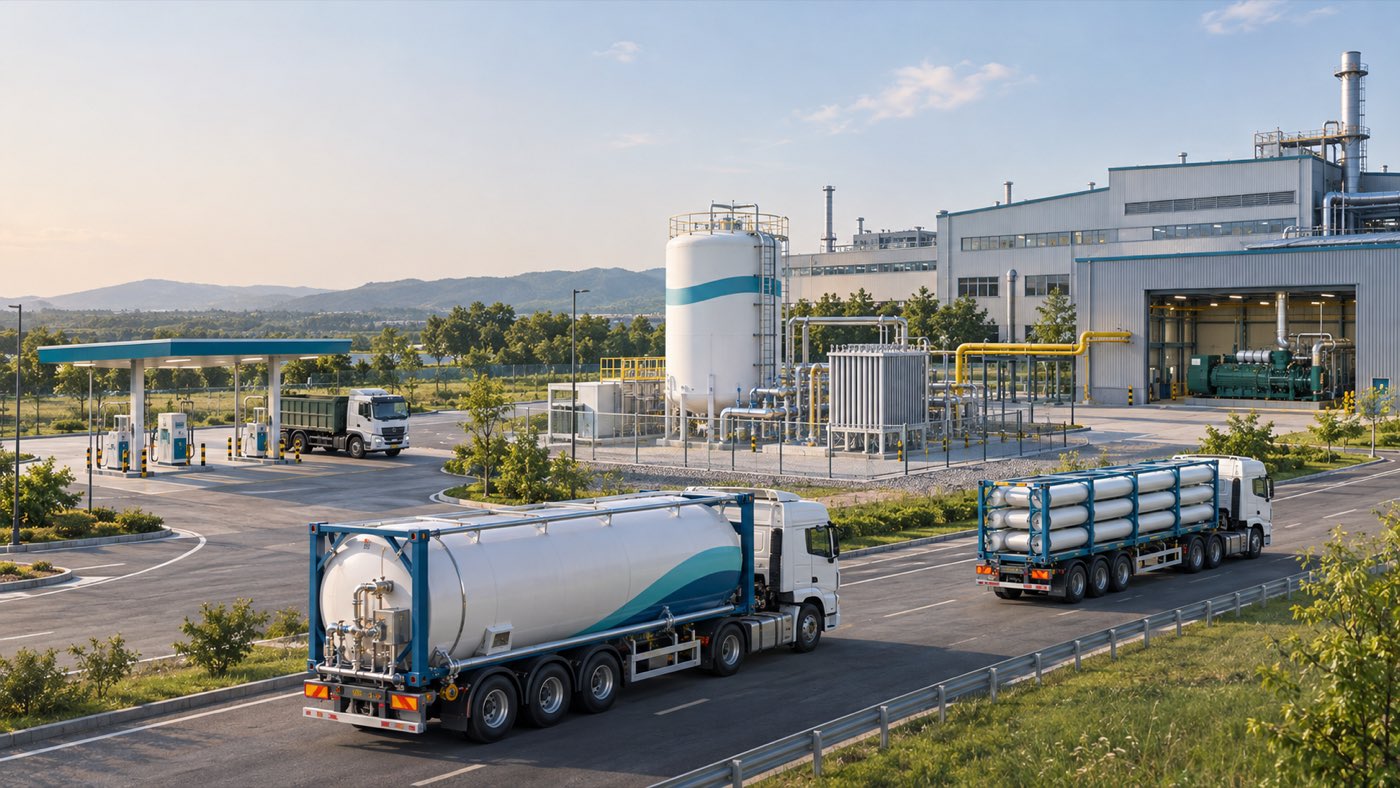
A factory, mine or industrial park does not have to wait for a gas pipeline at its gate before it can assess gas-to-power. Where a reliable gas source, road access and suitable demand exist, LNG or CNG can be delivered by road to a local receiving point. Gas is then prepared for the site's generators or processes. The arrangement is often called a virtual pipeline.
For a local gas supplier, the opportunity can be larger than one generator. An industrial customer can become an anchor for a delivery route; additional customers, a fleet depot or a refuelling station may be assessed as demand develops. Every connection still needs its own supply contract, technical design, permits and economic case.
The accompanying image is a concept illustration, not a photograph of a CIMC customer project.
1. Start with a customer problem, not a tank
Consider an industrial site that runs diesel generators because the grid is unreliable. The buyer needs to understand four questions before choosing equipment:
- How much electricity is required each day, and which loads are critical?
- What does delivered diesel generation actually cost, including operation and maintenance?
- Can an eligible gas supplier deliver a specified quantity and quality consistently?
- Who owns the supply, delivery, on-site system, operation and response when something goes wrong?
A virtual pipeline is one possible answer to the fuel-access question. It does not remove the need for fuel contracts, engineering, road access, permits or an independent assessment of project economics.
2. How the physical route works
Gas source → treatment and loading → road transport → on-site receiving and pressure control → gas generator / industrial process → customer loads.
Depending on the project, gas may originate at a pipeline-connected loading point, an LNG terminal, an eligible production facility or another approved source. CNG is delivered in pressure vessels; LNG is delivered in insulated cryogenic equipment and needs suitable vaporisation and pressure control before use. The selected design depends on gas specification, demand, distance, road conditions and local rules.
The World Bank's review of small-scale associated-gas technologies describes CNG road delivery to power plants, industrial users and refuelling stations that lack a pipeline connection. It also notes that logistics and energy density affect the choice between CNG and LNG. This is a technical route, not a claim that a particular site already has gas available.
3. Build an anchor before expanding the network
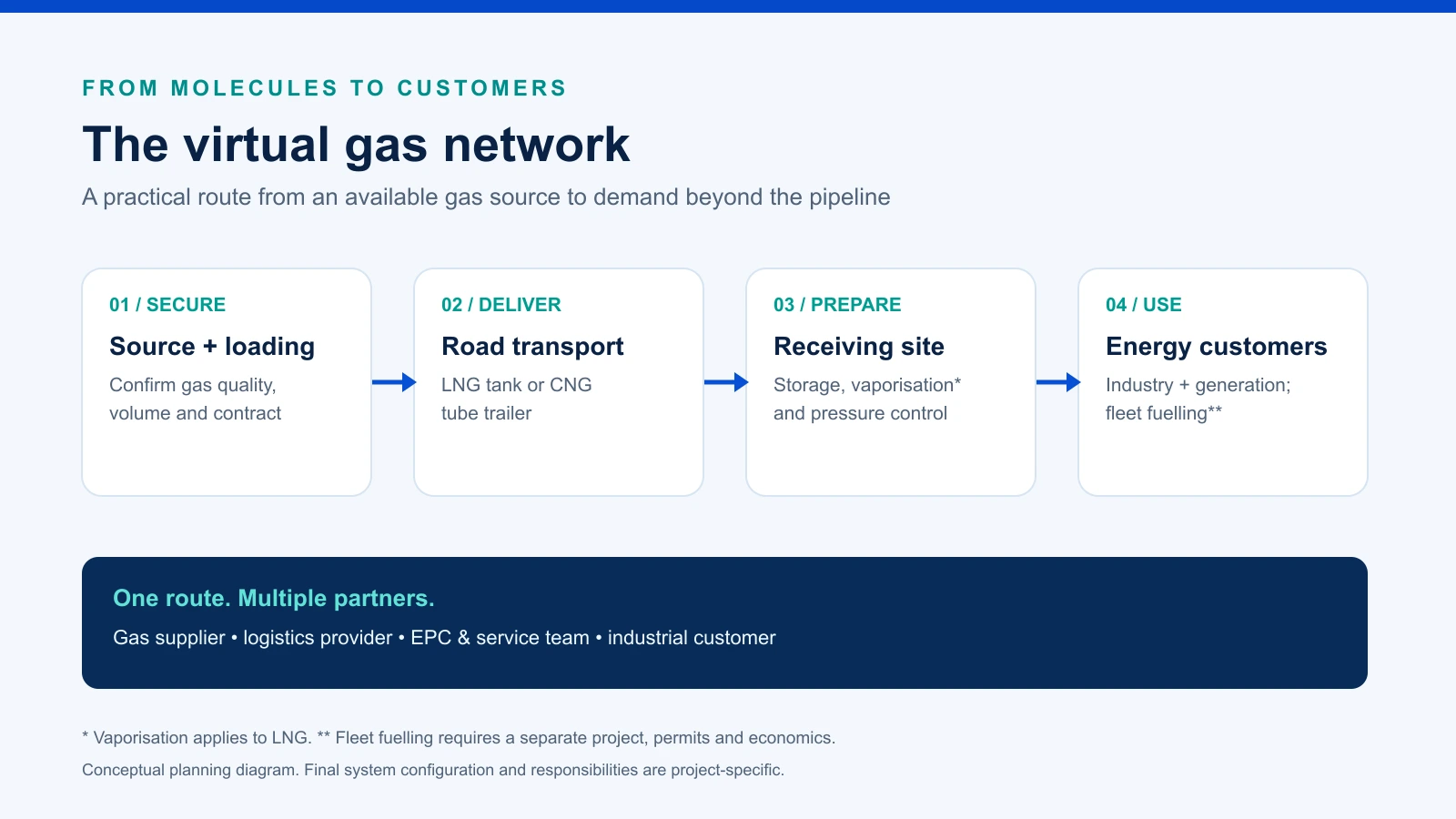
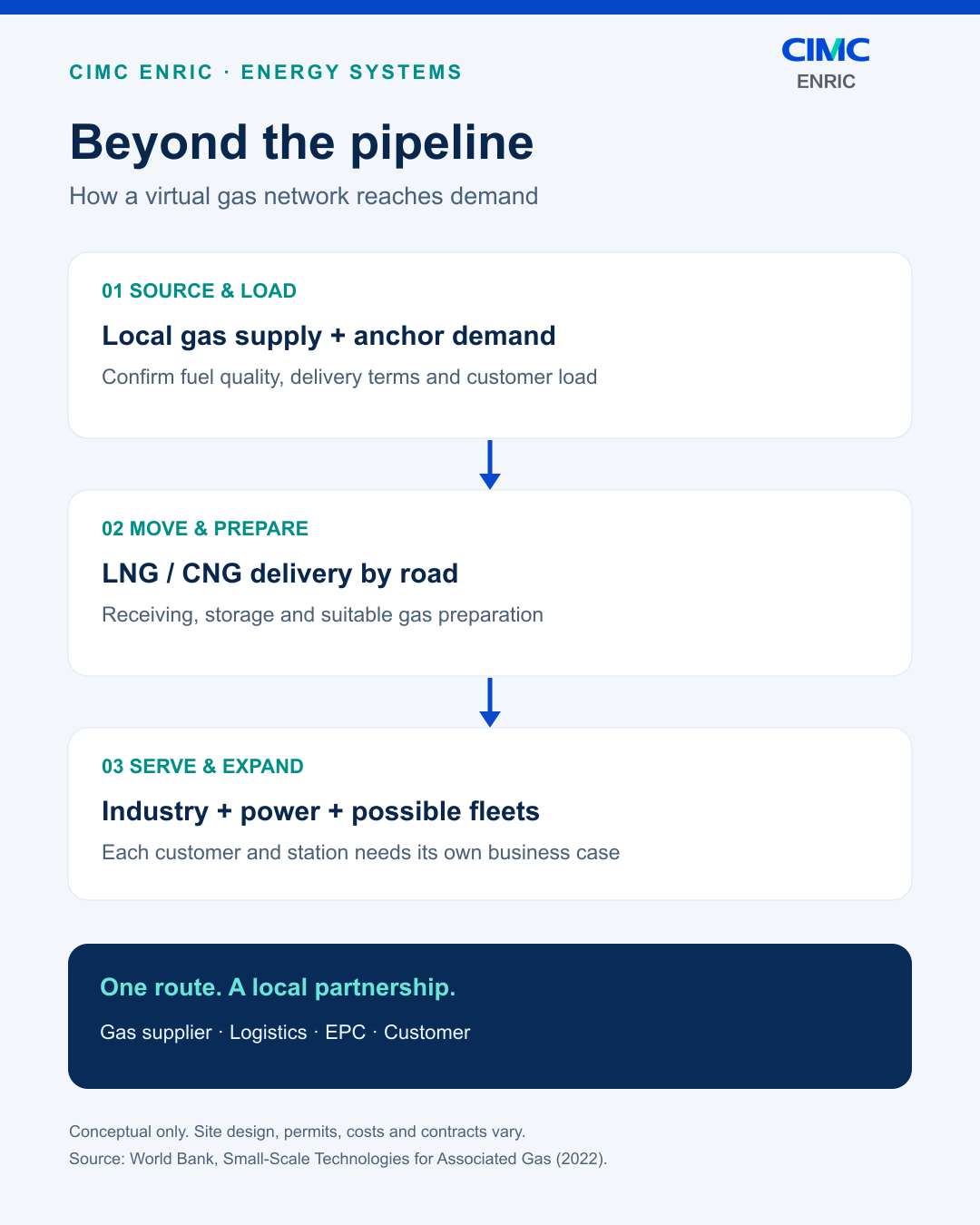
A practical partnership can start with one industrial customer and expand in stages:
- Stage 1 — Establish supply: the local gas supplier confirms source, quantity, quality, delivery price and continuity arrangements; the customer provides its load profile and diesel baseline.
- Stage 2 — Design the first site: CIMC ENRIC and relevant project partners assess the receiving, conditioning, generation and integration interfaces within the agreed scope. The EPC and local operators address civil, electrical, permitting and service responsibilities.
- Stage 3 — Test a delivery corridor: identify other potential users close enough to share a logistics route. Compare demand timing, minimum delivery volumes, truck turnaround and reserve storage.
- Stage 4 — Assess transport demand: where there is a suitable fleet, gas specification and commercial case, study a fleet fuelling point or station. Vehicle compatibility, permissions, land, equipment and fuel supply require separate assessment.
An anchor customer can help establish demand; it does not guarantee that a fuelling station or wider distribution network will be viable. A future fixed pipeline may later change the route or supply arrangement.
4. Compare delivered energy, not fuel names
A fair comparison uses the same site output, hours, currency and time period. For diesel, establish delivered fuel price, actual consumption per kWh, generator maintenance and other relevant operating costs. For gas, include delivered fuel, conditioning and handling, generation efficiency, maintenance, logistics and agreed site responsibilities. Separate up-front investment from recurring costs.
For illustration only, suppose a facility consumes 2,000,000 kWh per year, its comparable diesel operating cost is $0.30/kWh, and a gas option is estimated at $0.21/kWh on the same boundary. The indicative operating difference is $180,000 per year. If the incremental project investment is $630,000, simple payback is 3.5 years before financing, taxes and changes in prices, utilisation, maintenance or other excluded costs. These are arithmetic assumptions, not a CIMC quotation or a typical market result. If annual savings are zero or negative, simple payback is not meaningful.
Gas does not automatically win every comparison. The IEA's 2026 review describes how higher gas and LNG prices affected consumption and fuel choices in some markets. Diesel exposure over the next one to two years is a reason to examine scenarios, not a universal forecast.
5. Add solar and storage when the load profile supports them
Gas generation, solar PV and batteries can serve complementary roles: generation supplies dispatchable power within its operating envelope; solar contributes when available; batteries can support short-duration balancing or backup within their rated power and energy. The controls and protection design determines how they work together. A battery does not replace a fuel-supply contract, and an engine package does not by itself establish site-wide availability.
Read our mining microgrid interface guide and factory battery load-data guide before selecting equipment.
6. Use a first-pass calculation and identify the missing inputs
Use the gas-to-power feasibility calculator to organise the fuel, operating and cost assumptions for a preliminary comparison. The project calculator provides a separate first-pass route for a broader gas, PV and BESS screening. A calculated result depends on the inputs and scope; it is not an investment guarantee or binding quote.
For a useful review, gather:
- country, site location and potential gas source;
- peak and average load, daily profile and operating hours;
- diesel consumption, delivered price and maintenance basis;
- proposed gas specification, volume, delivered price, transport distance and supply reliability;
- existing generators, grid/PV/BESS interfaces and required critical-load support;
- voltage, frequency, permitting route, project timing and the party responsible for each scope.
If data is unavailable, mark it as unknown. Our buyer project brief helps organise those questions for a local supplier, EPC and end user.
Are you a local gas supplier, industrial user or EPC exploring a diesel-to-gas project? Discuss your project with CIMC ENRIC. Share the location, demand, gas source and delivery assumptions so the team can assess a practical first route.
Frequently asked questions
Can a virtual pipeline operate before a fixed pipeline arrives?
Potentially, where supply, road access, permits and economics support it. The delivery and receiving system must be engineered for the site and can be reassessed if fixed pipeline service becomes available.
Is LNG or CNG always cheaper than diesel?
No. Compare delivered energy on the same basis, including logistics, equipment, operation, financing and downtime. Results vary by location and contract.
Can the same gas network supply a factory and truck fleet?
It may be possible, subject to gas supply, vehicle compatibility, safe design, permitting and separate economics for each connection. The two demand profiles can differ substantially.
Is the calculator output a quotation?
No. It is a preliminary screen based on entered assumptions. Equipment selection, logistics, installation and commercial terms need project review.
Does switching to gas guarantee lower emissions?
No. Emissions depend on fuel supply, methane leakage, transport, equipment efficiency and the comparison boundary. A project-specific assessment is needed.
Explore a regional application
For mining, telecom and off-grid opportunities in Brazil, read our Portuguese-language guide: Gasoduto virtual no Brasil →.