
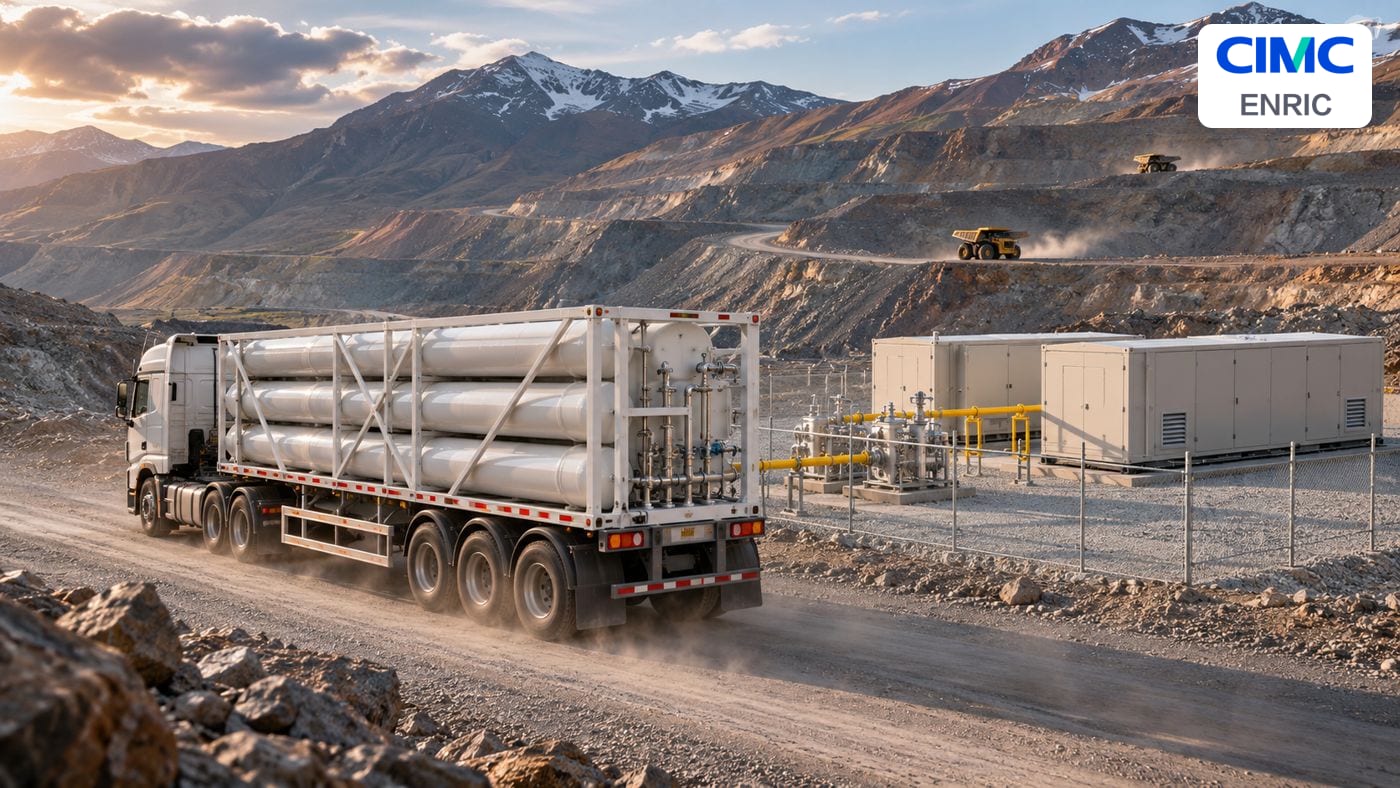
For: Gas distributors, fleet operators, mines and industrial energy buyers
Calculate loaded trips from daily gas demand and actual usable gas per delivery; then calculate how many trips each tractor–trailer combination can make during a complete operational cycle. Add standby after testing the actual service commitment.
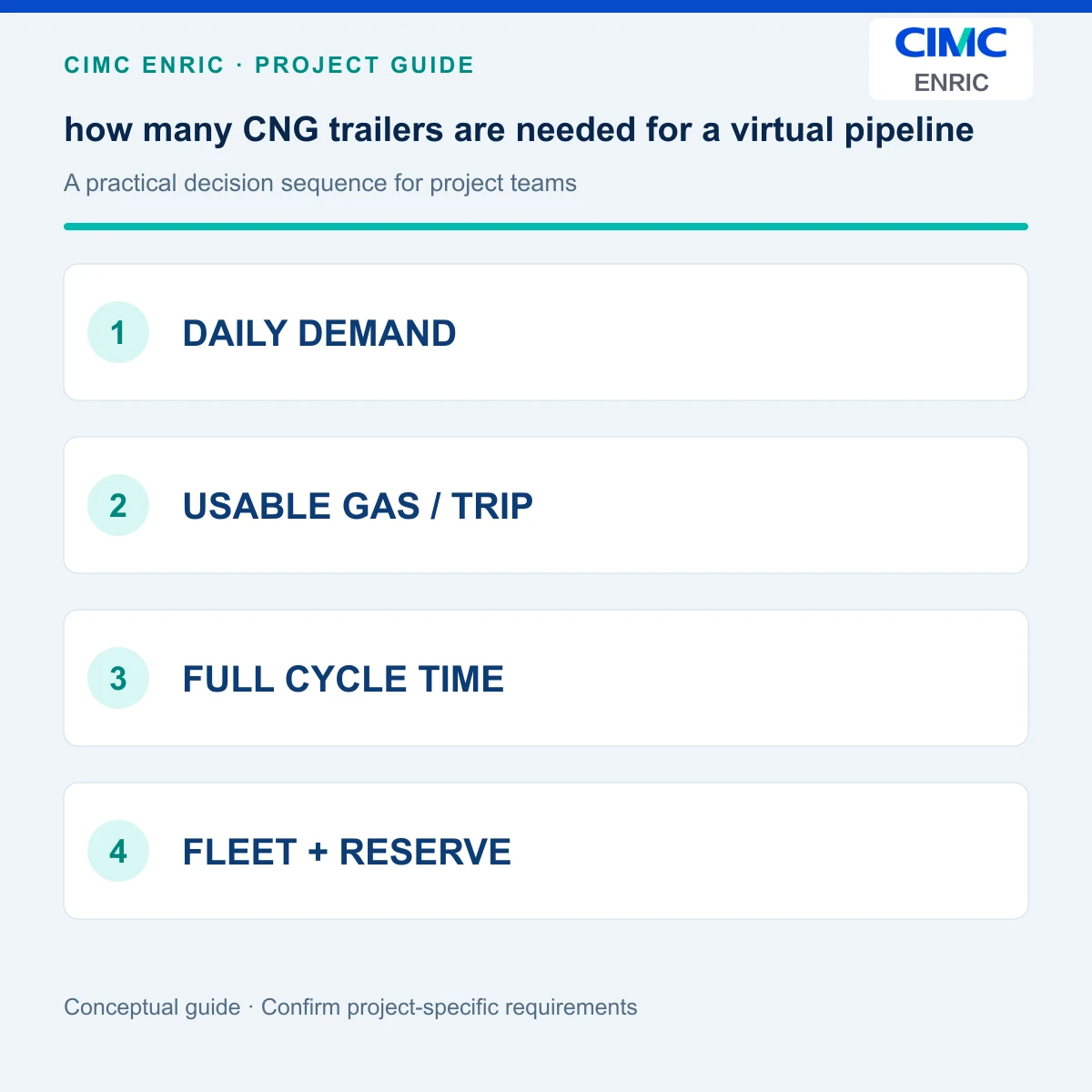
Specify demand in the same units as delivery
Obtain the customer’s hourly and daily demand profile, gas composition, required pressure and minimum buffer. Convert generator fuel use and any process-heat demand to the same standard-volume or energy basis used in the supplier’s quotation. Check reference temperature, pressure and heating-value basis.
A site consuming the same energy each day can have very different peak flow. Buffer storage and pressure regulation must satisfy that peak even when the average number of trips appears adequate.
Calculate the trips before the number of trailers
Illustration: a site requires 12,000 standard m³ per day and one approved module can deliver 3,000 standard m³ of usable gas between the agreed loading and minimum delivery pressures. It therefore needs 4 loaded trips per day. The numbers are hypothetical and do not represent a particular CIMC module.
Usable delivery volume depends on gas conditions, temperature, maximum pressure, minimum receiving pressure, equipment rating and the delivery process. The geometric water capacity of cylinders is not the quantity of gas delivered to the customer.
Model the full operational cycle
Add loading, inspection, outbound drive, queue, changeover or unloading, return travel, and cleaning or checks where required. Then compare that cycle with lawful and practical daily operating hours. Four trips per day do not necessarily mean four trailers: one combination may complete multiple cycles, or long routes may require several assets.
Where modules are swapped, tractor, trailer, chassis and on-site buffer can be separate resources. Map which asset is loading, driving, unloading or standing by at each hour; shared equipment or a single loading station can become the real bottleneck.
Test the weakest day
Run the route with one vehicle under maintenance, a loading outage, abnormal traffic and a customer demand peak. Define backup supply and the minimum remaining on-site gas at which the operator acts. Ask licensed carriers and local authorities to validate route and vehicle constraints.
Compare annual delivered cost per unit of energy, including compression electricity, drivers, equipment, maintenance, permits, insurance, loading, reserve and losses. Use comparable assumptions when evaluating LNG or a permanent pipeline.
Questions buyers ask
Is the number of trips the number of trailers?
No. Vehicle cycle time, driver hours, swap arrangements and on-site buffer determine the fleet.
Can the same route later serve a fuel station?
Potentially, but only after a separate demand, design, permitting and gas-supply assessment.
Prepare a project brief
Daily and peak demand; standard conditions; loading and receiving pressures; usable quantity per cycle; round-trip route; loading and unloading times; driver limits; reserve policy.
Explore related CIMC solutions · Read the related project guide · Discuss your project
Source: US Department of Energy: natural gas fuel basics. The cited material provides context; project decisions require current site-specific engineering and applicable requirements.