
For: Factories, microgrid EPCs and energy managers
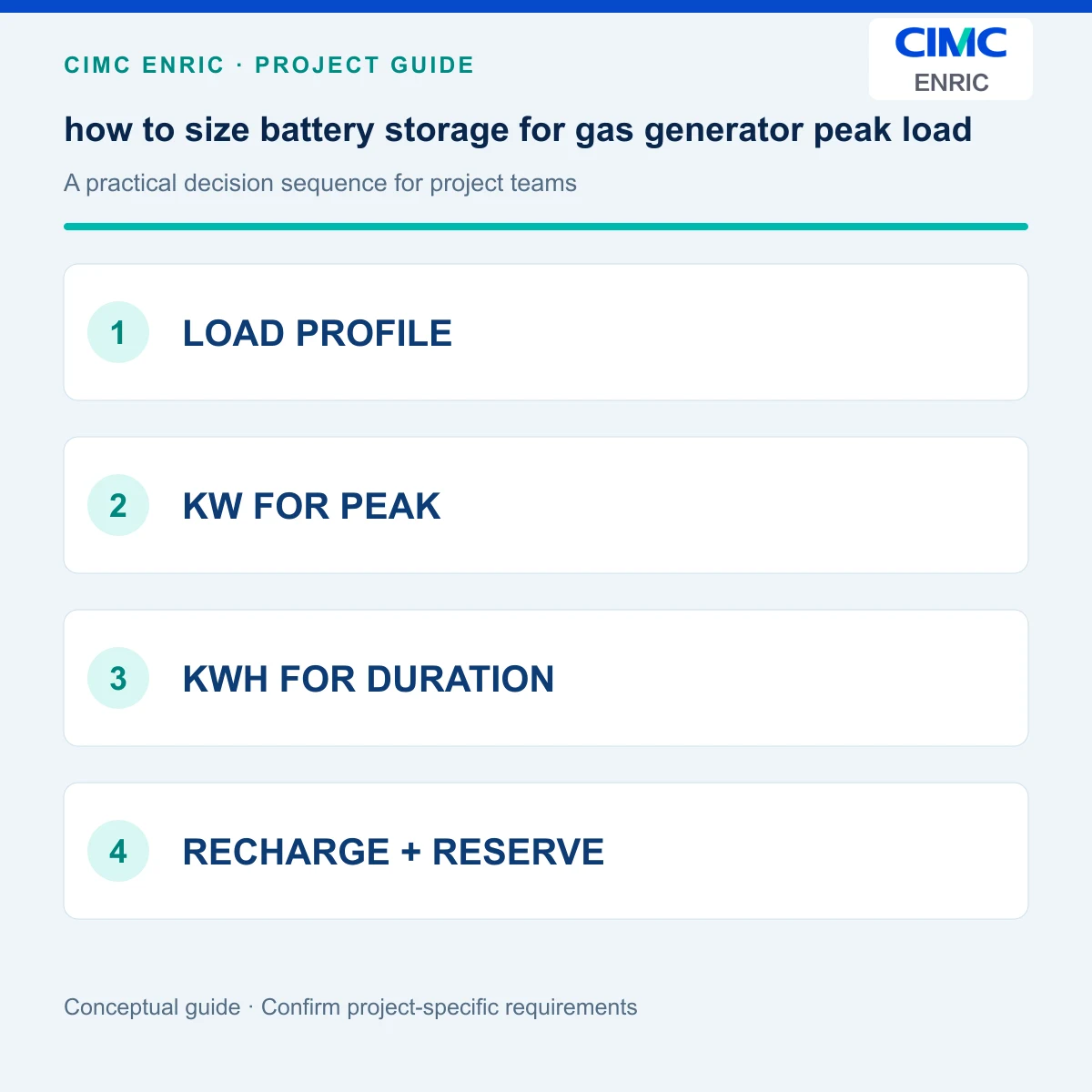
First identify what the battery must do: support a short power step, shave a recurring peak, cover a transition or shift solar energy. Size inverter power in kW and usable battery energy in kWh separately, then verify the control strategy and reserve.
Define the job in time, not in equipment names
Collect time-stamped site demand, generator operation and any solar output. Identify peak size, duration, frequency, time between events and critical loads during outages. A short motor step and a two-hour tariff peak may need very different inverter and battery configurations.
The generator remains responsible for the load assigned to it by the dispatch strategy. Check minimum engine loading, ramp rates, fuel supply and recovery after a battery event; a battery should not be assumed to replace a missing firm-energy source.
Work a simple power and energy example
Suppose an illustrative site wants the battery to supply a steady 300 kW for two hours. The energy delivered at the relevant AC boundary is 600 kWh. A 500 kW inverter could meet the power requirement only if its applicable continuous rating, voltage and operating conditions are confirmed.
If a nominal 1,200 kWh battery were allowed to use 80% of its nominal energy, that would be 960 kWh at the stated battery-side basis before conversion losses, aging allowances and operating reserve. Actual usable AC energy depends on the supplier’s warranty, temperature, state-of-charge window and defined measurement boundary.
Check the recharge window and repeated peaks
If the generator or grid has only a limited excess capacity after the event, recharging may take longer than the discharge. Solar availability varies and cannot be assumed at a nighttime peak. Calculate energy to recharge, conversion losses, available charging power and time before the next event.
Reserve for outages or an unplanned generator trip is a separate requirement. The same kWh cannot be simultaneously committed to tariff optimization and reliability unless the control rules explicitly preserve sufficient state of charge.
Specify the interfaces and failure modes
Ask whether the BESS operates grid-following or grid-forming for the chosen architecture, how it synchronizes with generator controls, what happens on a unit trip, and who owns protection settings. Define battery fire safety, isolation, alarms, communications and operating responsibility with qualified designers.
Compare a no-battery baseline, a peak-support case and an expanded case using the same load data, fuel assumptions and availability targets. Savings and emissions outcomes require actual site modeling rather than generic claims.
Questions buyers ask
Does a 1.2 MWh battery always supply 500 kW for 2.4 hours?
No. Power limits, usable energy, conversion losses, reserve, temperature and aging change the delivered duration.
Can the BESS reduce generator nameplate size?
Sometimes, but only after checking firm capacity, repeated peaks, recharge, reliability and transient requirements.
Prepare a project brief
Load interval data; peak duration and recurrence; generator dispatch and fuel; BESS power and energy; AC/DC boundary; SOC limits; recharge source; reserve; protection and controls.
Explore related CIMC solutions · Read the related project guide · Discuss your project
Source: NREL: microgrid power requirements and reserves. The cited material provides context; project decisions require current site-specific engineering and applicable requirements.