
CIMC ENRIC Energy Systems · Project owners, EPCs and energy dealers
A 500 kW / 1.2 MWh battery energy storage system (BESS) describes power and energy requirements. It does not define a complete supply package. Compare quotations only after agreeing the energy basis, discharge conditions, equipment boundary and delivery responsibilities. A price per kWh becomes useful when those inputs match.
1. Start with the energy you need at the site
An owner asks for “1.2 MWh with 500 kW output.” One supplier quotes a battery package. Another adds PCS, controls and a transformer. Both descriptions can be consistent with the headline requirement, while their prices cover different work.
The U.S. Energy Information Administration distinguishes power capacity from energy capacity. Power describes the rate of delivery; energy describes the amount stored. For the requested example:
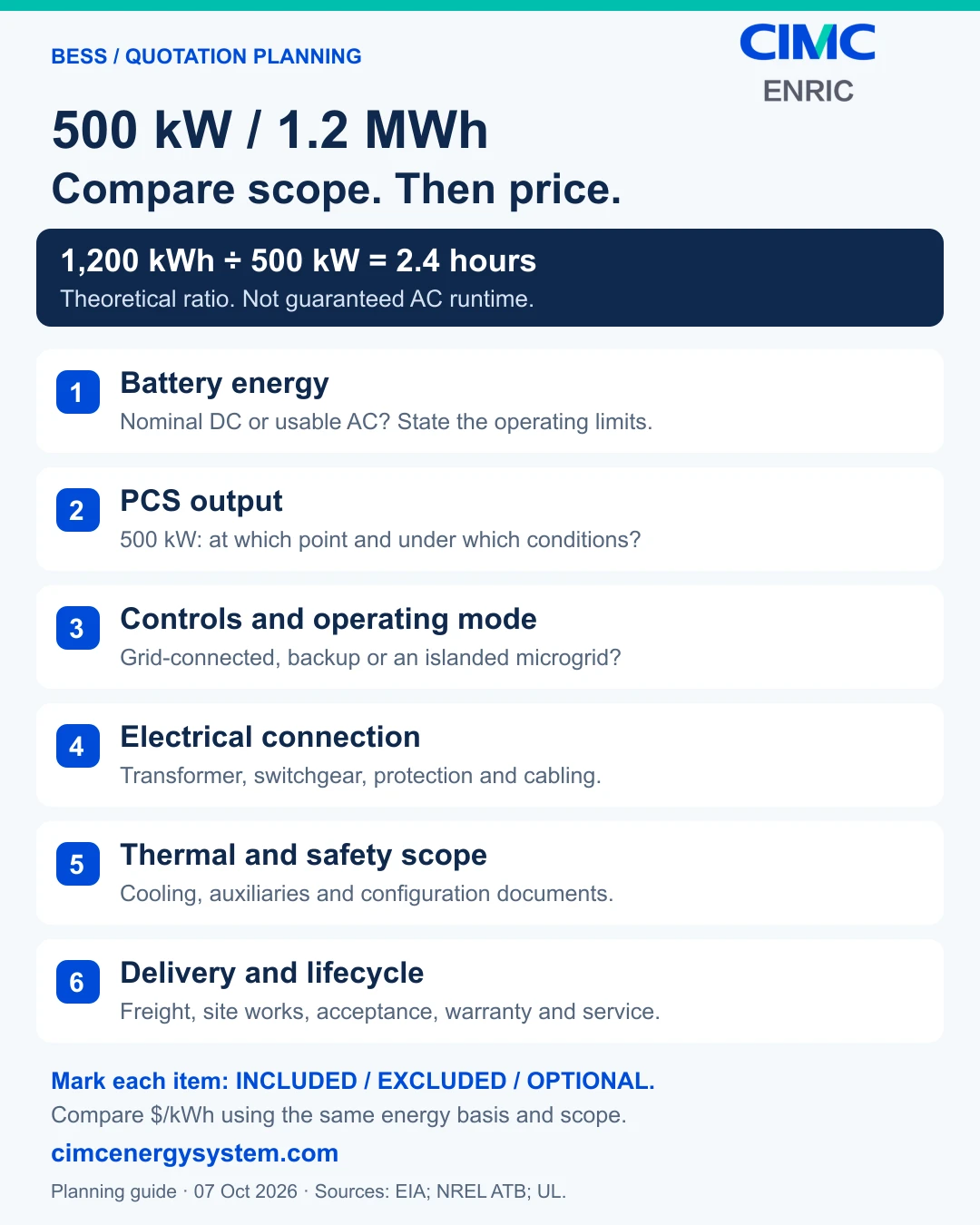
1.2 MWh = 1,200 kWh; 1,200 kWh ÷ 500 kW = 2.4 hours.
This is a theoretical ratio. If 1.2 MWh is nominal battery energy, it is not a guarantee of 2.4 hours delivered to the load. Confirm the permitted state-of-charge range, conversion losses, auxiliary consumption, temperature and aging conditions. If the quoted energy is already net usable AC energy, do not deduct the same losses again.
Ask where output is measured: battery terminals, PCS output or the site's connection point. Also confirm whether the requirement applies at beginning of life or at an agreed later warranty milestone. A net site requirement and a component nameplate rating need separate checks.
2. Give every supplier the same scope sheet
Request an explicit included, excluded or optional status for each item. Name the party responsible for excluded work. Use this starting matrix:
| Scope item | What to confirm | Why it affects comparison |
|---|---|---|
| Battery and BMS | Nominal DC and usable energy, chemistry, operating limits and warranty basis | The same headline capacity can have different usable energy and conditions. |
| PCS | Continuous AC power, voltage, frequency, reactive-power requirement and operating temperature | A power rating alone does not establish output under the site's conditions. |
| EMS and integration | Dispatch functions, metering, communication and interfaces to grid, PV or generators | Monitoring and a complete microgrid control scope are different deliverables. |
| Transformer, switchgear and protection | Connection voltage, isolation, relays, grounding and included cables | Equipment may stop at PCS output rather than at the customer's connection point. |
| Enclosure, cooling and safety | Environmental design, auxiliary supply, thermal management, detection and protective systems | Site conditions and the proposed configuration determine the required scope. |
| Delivery and site work | Freight, taxes, foundations, unloading, installation and commissioning | An equipment price is not automatically an installed project price. |
| Acceptance and support | FAT/SAT scope, documentation, training, spares and service responsibility | Compare the handover obligations as well as the hardware. |
This matrix is a purchasing aid, not a prescribed bill of materials. An existing transformer or site controller may be reusable, subject to an interface review.
3. Compare price per kWh on one stated basis
Write the price basis alongside the number:
Comparable unit price = price for the agreed scope ÷ energy on the agreed basis.
For a nominal-energy comparison, the denominator in this example is 1,200 kWh. A usable-AC comparison requires a supplier-confirmed usable-AC figure under the agreed conditions. Keep currency, quote date and delivery basis consistent too.
The NREL 2021 utility-scale storage cost model separates energy-related and power-related costs. Its historical modelling illustrates why both battery capacity and power equipment matter; its figures are not a current quotation for this project.
For your purchase, keep equipment, integration, logistics, site works and commissioning visible as separate cost lines. Add priced options only when they are part of the agreed comparison. If an excluded item is unpriced, mark the total incomplete. Avoid creating an apparently precise installed price from an equipment-only offer.
No universal $/kWh figure is supplied here: actual configuration, delivery destination and commercial terms are still needed.
4. Check the operating mode and local conditions
Describe the job first: peak shaving, solar shifting, backup or an islanded microgrid. A grid-connected PCS is not automatically a complete off-grid solution. Confirm grid-forming capability where required, protection, transition behaviour, black-start requirements and any generator/PV interfaces.
For the installation, ask the local engineering team about connection approval, environmental conditions, access and safety requirements. Match documents to the actual offered equipment and configuration. UL Solutions distinguishes UL 9540 system safety evaluation from the UL 9540A thermal-runaway test method. A component certificate or a test report should not be presented as approval of the entire proposed site. Applicable requirements depend on the destination and installation.
Warranty comparison also needs conditions: retained capacity, throughput or cycling limits, temperature limits, service arrangements and responsibility for replacements. An annual performance assumption is not a contractual guarantee unless agreed as one.
Questions customers ask
Will a 500 kW / 1.2 MWh BESS power my load for 2.4 hours?
The nominal calculation is 2.4 hours. Actual duration depends on usable energy, net output, reserve settings, auxiliaries and operating conditions. Ask for guaranteed usable AC energy at the agreed measurement point and a discharge profile matching your load. See the existing BESS sizing answer.
Why do two 1.2 MWh quotations have different prices?
They may use different energy definitions, PCS ratings, controls, electrical interfaces, safety provisions, delivery scopes or warranty terms. Compare the scope matrix before ranking prices. Use our project answer finder to identify the questions relevant to your role and site.
Prepare a useful quotation request
Send the country and site, application, load profile, peak demand, target discharge duration, connection voltage/frequency and grid condition. Add existing PV/generators, environmental conditions, the preferred supply boundary and target handover date. If 1.2 MWh is a preliminary estimate, say so.
Explore our BESS and microgrid system scope, then use the downloadable comparison sheet to align the requested work with your project team. CIMC ENRIC can review the project context and discuss the equipment and integration scope before a commercial quotation is prepared.
Discuss your BESS requirements with CIMC ENRIC →
Sources reviewed: 7 October 2026. This is a quotation-planning guide, not an equipment offer, performance guarantee or site approval. The NREL reference is a historical cost-methodology source; no benchmark price has been imported into this example.