For: Data-center developers, EPCs and infrastructure operators
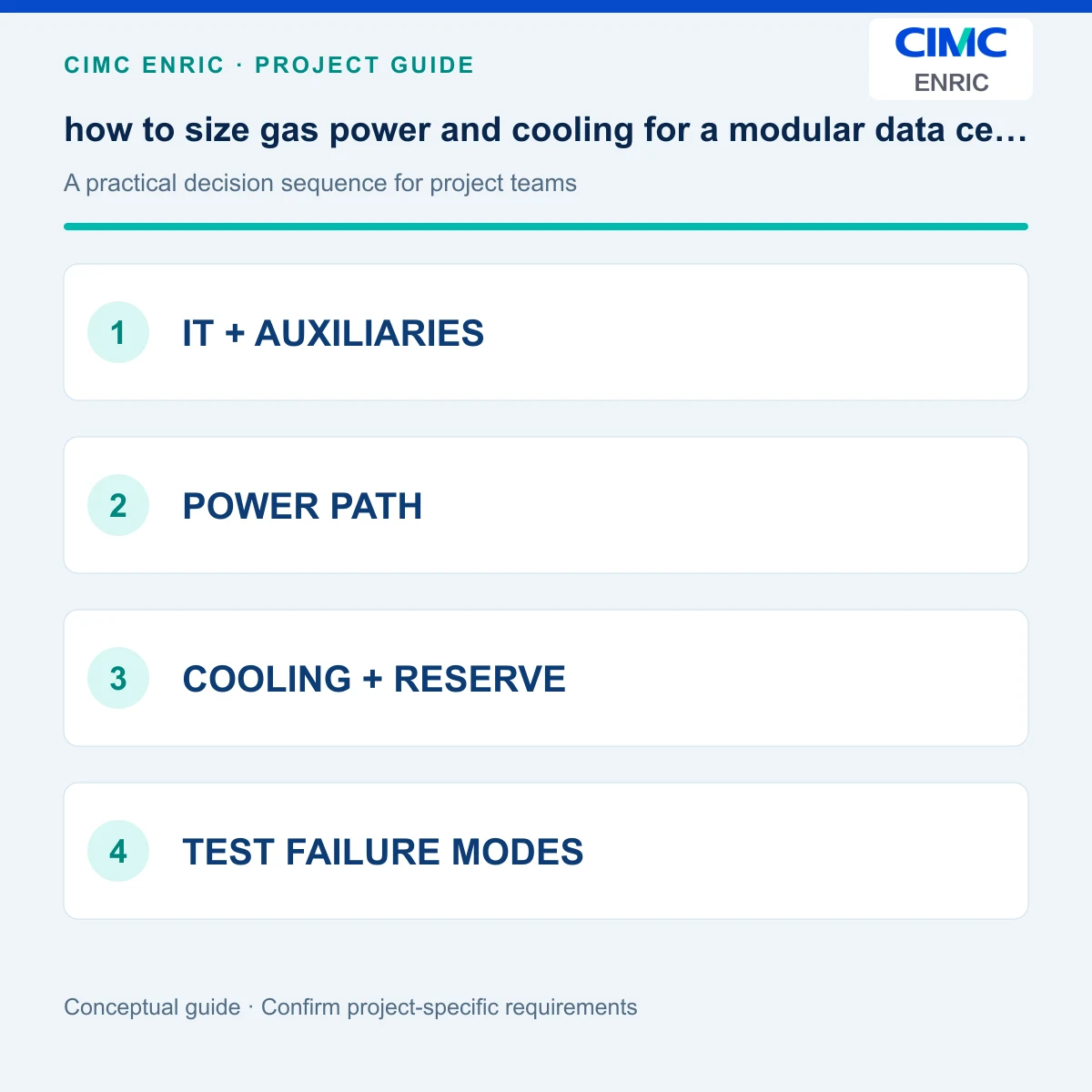
Size the power supply against the whole facility electrical load—including cooling, pumps, controls, UPS losses and future growth—not only server IT load. Define the electrical and thermal failure scenarios together before selecting modules.
Start with the site load boundary
Collect the IT load profile, equipment inlet conditions, cooling technology, local temperature and humidity, water constraints and expansion schedule. Calculate the coincident load of chillers or cooling modules, pumps, fans, UPS, switchgear losses, lighting and auxiliary systems.
An illustrative 1 MW IT load plus 300 kW of cooling and other facility loads is 1.3 MW at that stated boundary before any unlisted losses or reserve. The 300 kW is an example, not an assumed PUE or guaranteed cooling requirement.
Trace the power path during a disturbance
Map normal source, UPS, switchgear, transfer logic, gas generators and cooling controls. Decide which equipment must ride through an interruption, how generators start and accept load, and which cooling components must remain available during that transition.
A battery intended to smooth generator dispatch is not automatically a substitute for a data-center UPS. Confirm power quality, transfer time, autonomy, bypass, maintenance and protection requirements for each electrical path.
Compare redundancy by shared dependency
An N+1 generator count alone does not establish N+1 facility resilience. Check shared gas sources, pressure control, common busbars, cooling water, control power and maintenance access. For each selected failure scenario, calculate the remaining derated capacity and the service provided to the load.
The same applies to cooling: one spare chiller does not remove a shared pump or control failure. Align electrical and cooling maintenance windows and define what load shedding is acceptable.
Specify gas, heat and location
Confirm fuel contracts, gas composition, pressure, on-site storage where applicable, emissions and noise requirements, ambient derating, water use, equipment spacing and access. Consider heat recovery only where there is a stable useful thermal demand and a credible year-round operating case.
Modular generator, switchgear, cooling and building packages can simplify interface planning when scopes and commissioning responsibilities are explicit. Factory integration does not replace a project-specific safety, power-quality or local permitting review.
Questions buyers ask
Can IT load alone size the gas plant?
No. Include cooling, electrical losses, auxiliaries, coincident peaks and the required reserve.
Does a gas generator replace a UPS?
A generator and UPS perform different functions; the transition and ride-through scheme must be engineered.
Prepare a project brief
IT load and growth; cooling duty and ambient; UPS ride-through; power quality; fuel conditions; redundancy and common dependencies; water; permitting; step-load schedule.
Explore related CIMC solutions · Read the related project guide · Discuss your project
Source: US Department of Energy: data-center design guide. The cited material provides context; project decisions require current site-specific engineering and applicable requirements.