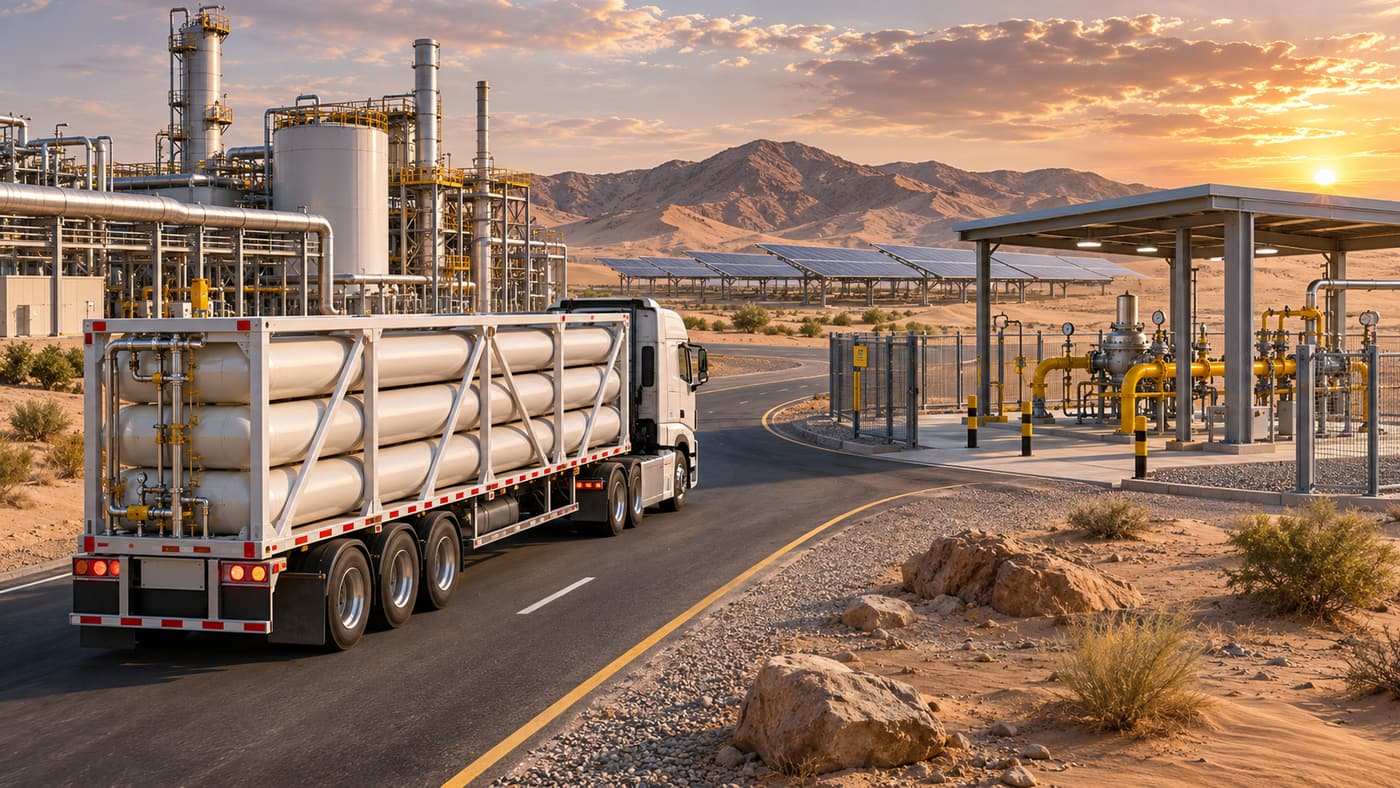
Quick answer: A virtual gas pipeline can connect commercial or industrial users to a gas source when a fixed pipeline is not available at their site. The system may combine a licensed local supplier, compressed-gas trailers or LNG logistics, a receiving station and, where appropriate, gas generation. Local gas allocation, permits and delivered economics determine whether a particular project works.
A proven concept, assessed locally
The idea already has a practical reference in the region. ADNOC City Gas states that its virtual pipeline supplies compressed natural gas by specialised trailers to commercial and small industrial customers unable to access its underground network. This describes ADNOC City Gas’s own service, not a CIMC project or partnership. Availability, route and service terms must be checked directly with the relevant supplier.
The same decision framework can be used to screen other markets, including Saudi Arabia, without assuming that gas access or commercial rules are the same across borders. Aramco explains that potential hydrocarbon buyers must establish an account and enter a sales agreement. A project developer must still confirm the applicable allocation, supply route and local approvals for its specific fuel and customer.
Where should a developer start?
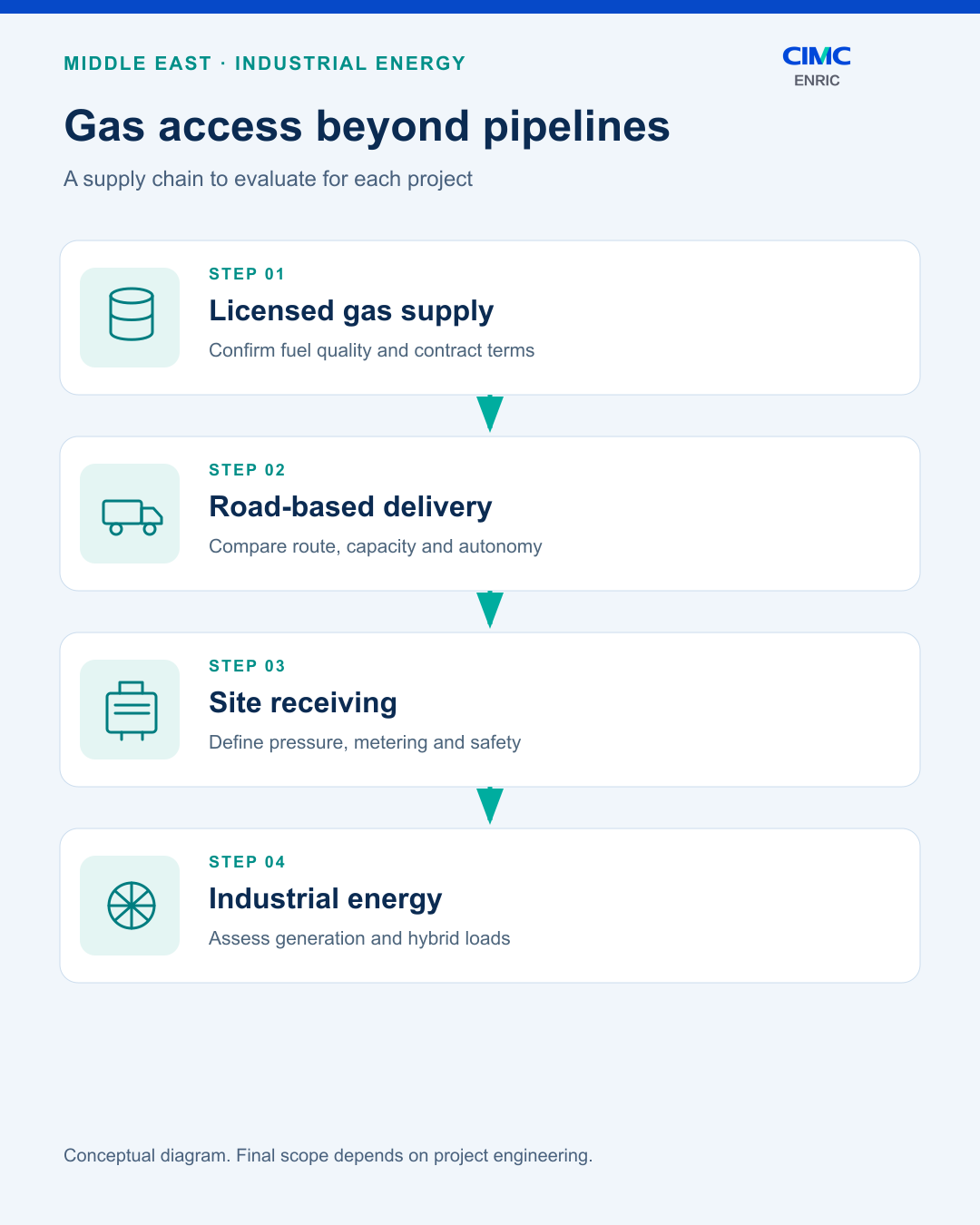
- Confirm the source. Identify gas quality, available volume, loading pressure or LNG loading arrangements, contract term and delivered price with an authorized supplier.
- Choose an anchor customer. An industrial facility, services base or remote operation with measurable consumption may support the first route. Do not assume every small site can justify a dedicated delivery.
- Build the delivery case. Compare real road distance, vehicle cycle times, access restrictions, storage autonomy and operational redundancy. CNG and LNG should be compared on an equivalent delivered-energy basis.
- Define site interfaces. Receiving, pressure regulation, metering, vaporisation if needed, generation controls and safety boundaries must be included in project engineering.
- Consider expansion. Nearby businesses or fleet refuelling can add demand when commercially and legally viable; vehicle-fuel infrastructure is a separate scope requiring its own design and approvals.
How does the gas system interact with solar and batteries?
A gas generator can be studied alongside solar PV and battery storage for a particular duty cycle. The battery may serve short-duration load changes while dispatchable generation serves the agreed operating strategy. The actual contribution depends on load profiles, generator turndown, controls, redundancy and the quality and continuity of the fuel supply. A diesel generator may remain as standby if required by the project. No architecture or savings should be assumed before a site study.
The cost comparison that matters
A meaningful comparison includes the actual delivered diesel baseline and the delivered gas cost, vehicle and loading costs, onsite storage and receiving, generator efficiency at actual load, maintenance, operating hours, financing, taxes and standby requirements. Run high/low scenarios for delivered fuel price and utilisation rather than using a single regional average. CIMC's gas-to-power calculator can support an initial screen; it is not a binding quotation or a substitute for engineering and fuel-supply contracts.
Questions buyers and local partners ask
Is a virtual pipeline suitable for every site? No. It requires a practical fuel source, transport route, viable demand and project-specific approvals.
Does gas always cost less than diesel? No. Compare verified delivered fuel prices and total lifecycle costs for the location and operating hours.
Can the network later serve a fleet? Potentially, subject to demand, permits, vehicle-fuel standards, supply commitments and a separate station design.
What information should we prepare? Provide location, existing fuel and electricity costs, hourly or daily load profile, operating hours, reliability requirement and any identified gas supplier. Discuss a project or read our introduction to virtual gas networks.
Market application analysis, November 2026. The cited operator is an independent example; no partnership or project award is implied.