
CIMC ENRIC Energy Systems · Household dealers and local financing discussions
A household energy dealer can start a bank discussion with a defined equipment plan, a clear funding purpose and a documented repayment route. CIMC can support agreed equipment and commercial information. The bank decides eligibility, security and lending terms; the factory confirms the order's payment structure. Household customer instalments require their own arrangement.

Why financing belongs in the household discussion
Reliable household energy needs equipment, installation and a service route. A local dealer may need funding to buy demonstration equipment, import stock or fulfil customer orders. A household may separately want to spread the cost of its own system.
Keep those decisions clear. The dealer's funding facility supports its business. It does not automatically create a consumer instalment offer, and a household's monthly repayments do not automatically match the factory's payment dates.
Our household roadmap includes local partner and financing development as planned stages. This guide helps prepare a discussion with your own lender; it does not announce an approved bank, interest rate or retail finance programme.
First tell the bank what the equipment is for
| Intended use | Funding discussion to explore | Question for the lender |
|---|---|---|
| Demonstration or service equipment the dealer retains | Equipment finance or leasing | Who owns the equipment, where may it be used, and what security is required? |
| Equipment imported as stock for resale | Inventory, import or working-capital finance | Can stock be sold, and how are proceeds, security and release handled? |
| A household buying its installed system | A separate customer loan or instalment arrangement | Who lends, who collects repayments, and what customer terms apply? |
The British Business Bank describes business asset finance through arrangements such as leasing and hire purchase. This is useful background on financing structures, rather than evidence of eligibility in your country. Read its asset-finance guide.
Do not assume that equipment intended for resale can be financed on the same terms as a machine your business keeps and operates. Ask the lender which facility fits the actual business model.
Prepare an equipment file and a business file
Start with two organised folders.
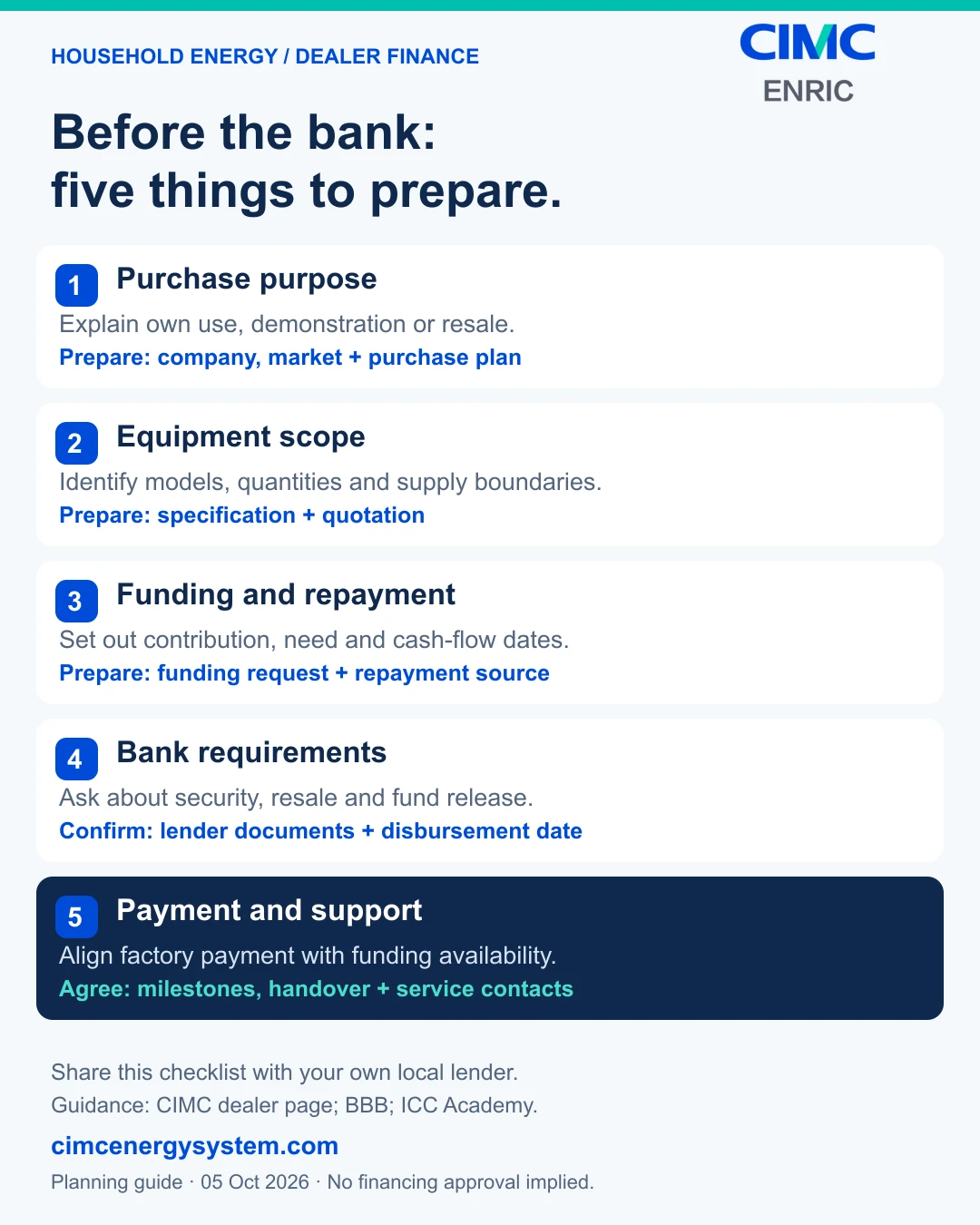
The equipment file should identify proposed models, quantities and supply scope. Separate equipment from freight, import charges, installation and local service. Include the quotation's currency, validity and delivery basis, together with expected production and shipment milestones.
The business file should explain your company, market, own contribution, requested funding and repayment source. Show when cash is expected to leave and return to the business. Ask the bank for its application checklist before collecting sensitive customer records or assuming particular documents will be sufficient.
For household distribution, explain how installation and after-sales work will be supported. A proposal should show who will commission the equipment, handle warranty enquiries and obtain service parts. These responsibilities matter to your ability to serve customers after a purchase.
What CIMC can help you put in front of the bank
The existing dealer financing and payment page describes the documents and commercial discussions we can support:
- Equipment specifications and the agreed supply scope.
- A quotation or pro forma invoice, as agreed for the order.
- Expected production and delivery milestones.
- Relevant commercial and shipment documents.
- Written warranty, service and cooperation responsibilities.
Send us the lender's requirements so that the available documents can be reviewed against the proposed order. A specification sheet identifies equipment; it does not establish collateral value. A quotation describes an offer; it does not guarantee funding or repayment.
Align bank disbursement with factory payment
Use one timeline for the dealer, lender and supplier:
- Define the purchase. Identify the equipment, use or resale model, supply scope and intended delivery window.
- Discuss the funding route. Ask the lender about contribution, security, repayment, insurance and any restrictions on resale.
- Agree the documents and timing. Identify what is required before funds can be released and who can provide each document.
- Confirm the factory payment structure. Align the lender's actual funding availability with the contracted payment milestones.
- Coordinate delivery and support. Track shipment, installation, handover and the applicable repayment obligations.
Check for a timing gap: funding available only after equipment arrival may not cover a factory payment due before shipment. Raise that gap before committing to customer delivery dates.
T/T, L/C and combined routes can be discussed
| Discussion route | What to agree before an order |
|---|---|
| Staged telegraphic transfer (T/T) | Initial amount, subsequent payment triggers, evidence and shipment timing |
| Initial T/T plus a letter of credit (L/C) | Amount covered, issuing bank, wording, documents, validity, payment timing and charges |
| Approved bank funding supporting the purchase | Dealer contribution, disbursement conditions and the contracted T/T or L/C payment route |
These are discussion structures. Deposit percentages, accepted banks, deferred terms and final dates are confirmed by the commercial team and the relevant agreement. A local loan approval does not replace the factory's payment requirements.
For documentary credits subject to UCP 600, banks examine the required documents; they do not perform physical equipment acceptance. ICC Academy explains the separation between a credit and the underlying sale. Read its documentary-credit guide.
Agree inspection and acceptance responsibilities in the supply scope, and review proposed L/C documents with the supplier and banks before issuance.
Make dealer interests visible in the agreement
Discuss delivery milestones, inspection evidence, warranty handling, local installation, parts support and responsibility for customer commitments. Address customer or territory arrangements where relevant; exclusivity requires a separate agreement.
For any proposed household instalment route, clarify the lender, customer assessment, repayment collection, ownership and service responsibilities. Give the household the actual applicable terms before it decides to buy. A partnership announcement is not a consumer credit offer.
Questions customers ask
What documents can CIMC provide for a bank-financing discussion?
Share your lender's checklist. We can discuss specifications, supply scope, a quotation or pro forma invoice, delivery milestones and relevant commercial documents. Availability is confirmed for the order. The bank determines the required evidence and lending decision. See the existing financing answers.
Can we combine a T/T payment with an L/C?
Yes, a combined structure can be discussed for the proposed order. The amounts, issuing bank, document conditions and payment dates need agreement between the relevant parties. No standard deposit percentage or deferred-credit offer is announced here. Discuss the payment route.
Your next step
Prepare your country, dealer profile, intended household market, equipment and quantity, own-use or resale plan, proposed contribution and lender requirements. Share this article or checklist with your bank, then discuss dealer cooperation with CIMC ENRIC.