
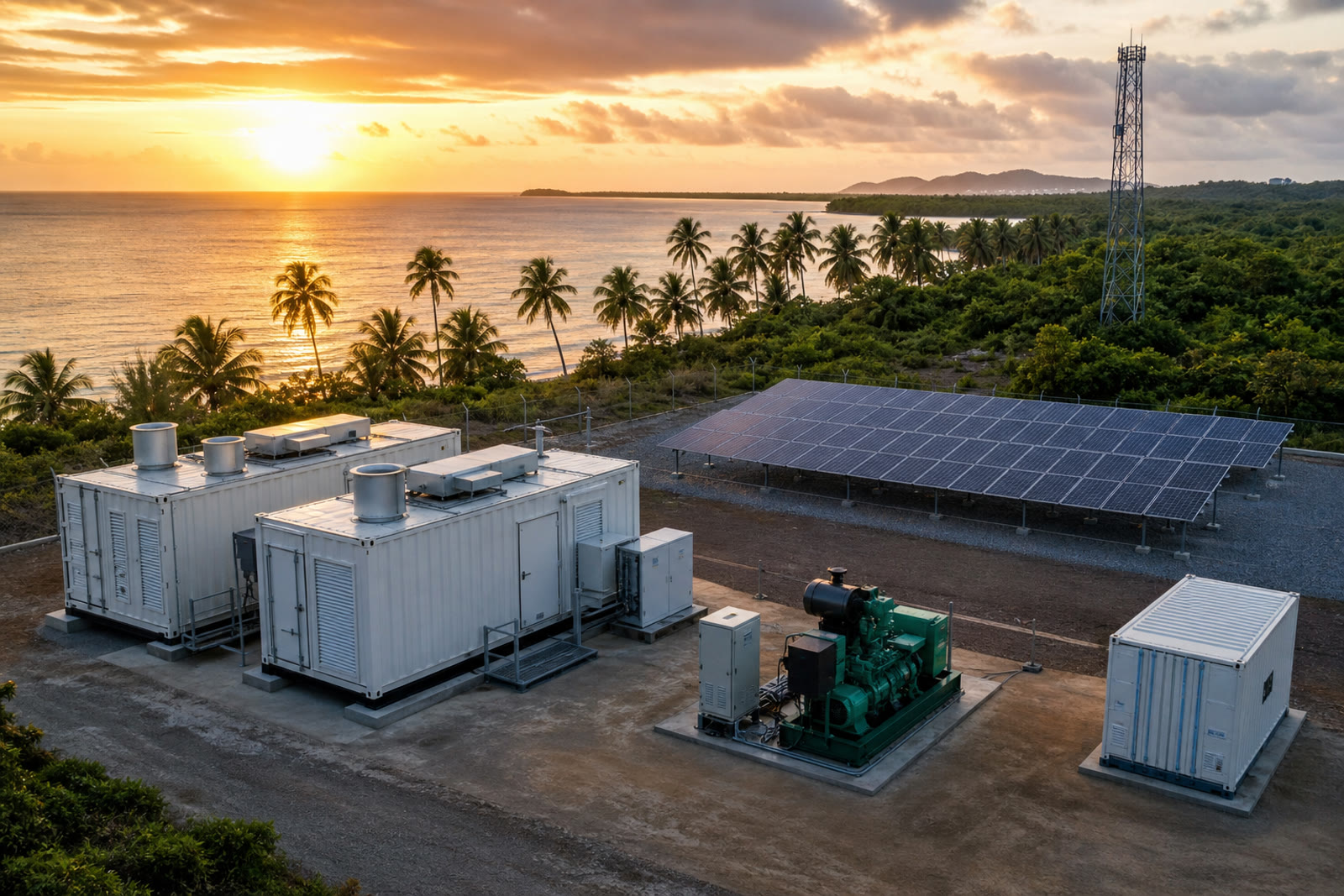
OVERSEAS BRIEFING | ISLAND & REMOTE POWER
Hybrid microgrids for off-grid islands, telecom clusters, relocatable camps and weak-grid sites
Start with two numbers every owner already knows: how many MW of diesel sit on site today, and how many days per month those sets actually run. Diesel is the right tool for emergency and rare starts — nobody should be talked out of that convenience in the first hours of an outage. The commercial problem appears when the same sets become daily baseload: freight, theft risk, price spikes and night load turn “easy to buy” into a recurring convenience tax.
That pattern shows up on island and remote projects worldwide — Nigeria telecom and camp loads, Lusophone remote relocatable camps, and Latin American sites where hydro or weak grid leaves long diesel hours. This briefing maps when a PV+BESS microgrid honestly covers about 3–4 hours of load shifting, and when gas / LPG / methanol should replace diesel as the always-on baseload. It does not invent case metrics; it routes you to the live calculators and the partner decision tree.
1. Pain on island and remote sites
Island and remote operators rarely fail for lack of generators. They fail on logistics and duty cycle:
- Diesel freight and theft — every trucked litre carries distance, security and stockout cost.
- Night load and continuous run — when sets run many days per month, OPEX and maintenance dominate the story, not CAPEX.
- Weak or off-grid stations — telecom towers, camps and industrial pads that cannot wait for a firm utility feed.
- Temporary relocatable camps — phase-1 must move with the workfront; permanent plant comes later.
A related trap is “shore gas still on oil”: gas molecules may have arrived nearby, but pressure, pipe or gasification cannot yet serve the load. Until that last-mile gas path is real, diesel (or another firm fuel) still carries the site. The fix is not rhetoric — it is matching the duty cycle to the right stack.
Shareable map — days/month of diesel runtime
Forward this one-pager with partners. Same three forks as the decision tree.
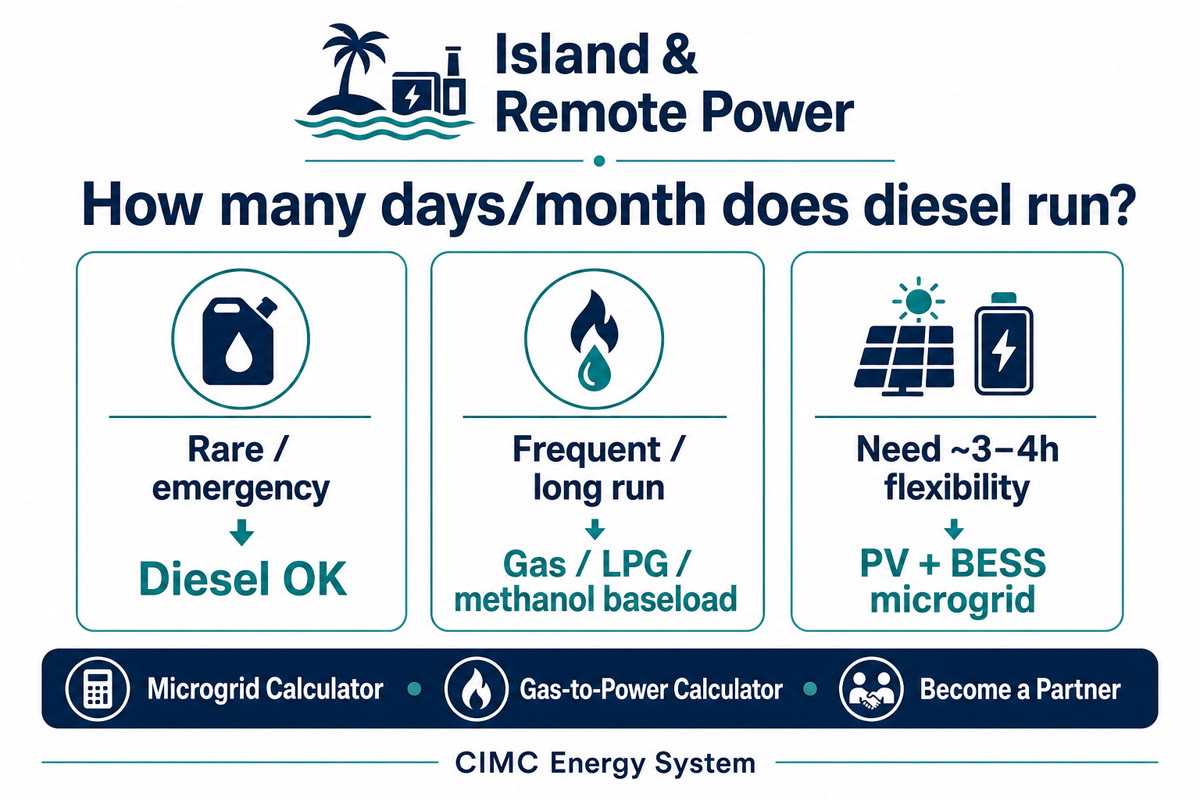
Links on the graphic: Microgrid Calculator · Gas-to-Power Calculator · Become a Partner
2. Three-path decision (align with the partner briefing)
Use the same tree partners already share with clients. Full visual map: Partner Decision Tree — Gas Baseload vs Microgrid.
- Frequent / long run → gas / LPG / methanol baseload
When diesel MW runs many days per month, replace diesel as the firm runner with gas, LPG or methanol. Batteries are not baseload. First-cut sizing: Project / gas-to-power calculator. - ~3–4 hours of flexibility → PV+BESS microgrid
Position storage honestly: about 3–4 hours of battery-side load shifting and peak support — not multi-day firm energy. Size that path on the Microgrid Calculator. - Emergency-only → diesel OK
If the grid is strong enough and sets rarely start, keep diesel as contingency. Dig the convenience tax only when runtime has already become baseload.
Do not sell PV+BESS as a fake baseload story. Do not force a microgrid where the client will not own storage. Do not attack diesel where it is truly emergency-only.
3. What a hybrid stack looks like
Most serious island / remote hybrids combine three layers — sized to duty cycle, not to a brochure:
- PV for daytime energy when irradiance and land allow.
- BESS for roughly 3–4 hour shifting, peak support and short bridging — see also BESS & microgrid solutions.
- Small gas / LPG (or methanol) genset when the site needs firm hours beyond what storage can honestly carry.
Optional building blocks on the CIMC Energy System route map include modular packages such as AM20 (compact gas power for telecom / distributed sites) and containerized PV-storage modules. Treat them as configurable blocks inside a site design — not as invented kWh, dollar or case results. Final selection still depends on load profile, fuel logistics, ambient conditions and service model.
4. Soft GEO: where this conversation shows up
Without claiming offices we do not have, the same questions recur in three theaters partners already discuss:
- Nigeria — telecom and camps — diesel MW on towers and temporary camps; LNG / LPG reachability and days/month runtime decide gas-to-power vs microgrid assist.
- Lusophone remote relocatable camps — phase-1 often must be modular and movable (Afungi-style camp logic: power follows the workfront before permanent plant).
- Latin America — hydro / weak-grid islands and pads — when hydro softens or the feeder is weak, local dispatchable MW and short-duration BESS become the practical conversation, not terminal capacity alone.
5. Customization blockers (plan them early)
Island and remote RFQs stall less on nameplate MW than on operations:
- Remote ops staff — who starts, monitors and resets the plant when the site is hours from a city?
- Spare-ship lead times — salt fog, typhoon and island freight change which SKUs and redundancy you stock.
- Environment — corrosion, wind, humidity and noise limits reshape enclosure and foundation choices.
- Pilot-then-replicate — one validated pad or tower cluster beats a paper megawatt; expand after fuel and service prove out.
Modular, relocatable phase-1 lowers the gas-infra barrier versus a full permanent plant — it is still not as instant as buying another diesel set. Say that clearly so expectations stay bankable.
6. Owner intake — four questions before any proposal
Before CIMC Energy System or a local partner drafts scope, lock these four owner answers:
- Diesel MW today? Nameplate and how it is dispatched (base / peak / N+1).
- Fuel type, delivered cost and supply cuts? Diesel, LNG, CNG, LPG, methanol or pipeline — plus theft, stockout and freight reality.
- Grid / outage hours? Strong feeder with rare outages, weak grid with daily gaps, or true island / off-grid.
- Relocatable phase-1 OK? Must the first block move with a camp or tower cluster, or is the site permanent from day one?
Those four answers choose the branch: gas baseload calculator, microgrid calculator, or diesel-as-emergency with no forced conversion.
7. Which tool to open next
- ~3–4 hour PV+BESS path: Microgrid Calculator
- Always-on fuel-to-MW / diesel replacement baseload: Project Calculator
- Partner shareable decision tree: Gas baseload vs microgrid briefing
- Become a local partner: Partners
- Discuss a live site: Discuss your project
Field rule (keep this visible)
Diesel stays valid for emergency and rare starts. Dig the convenience tax when sets already run as baseload. Always-on firm energy → gas / LPG / methanol replacing diesel. PV+BESS microgrids cover about 3–4 hours of load shifting — not fake baseload. Shore gas that cannot yet reach the load pressure or pipe is still “on oil” until the last mile is engineered.
CIMC Energy System — Overseas Briefing. Content for partner and owner alignment; verify site inputs before investment decisions. No invented case kWh, dollar or runtime claims in this draft.