
Overseas Briefing · Small C&I · Classification: small_ci_lpg (separate from AM100 catering)
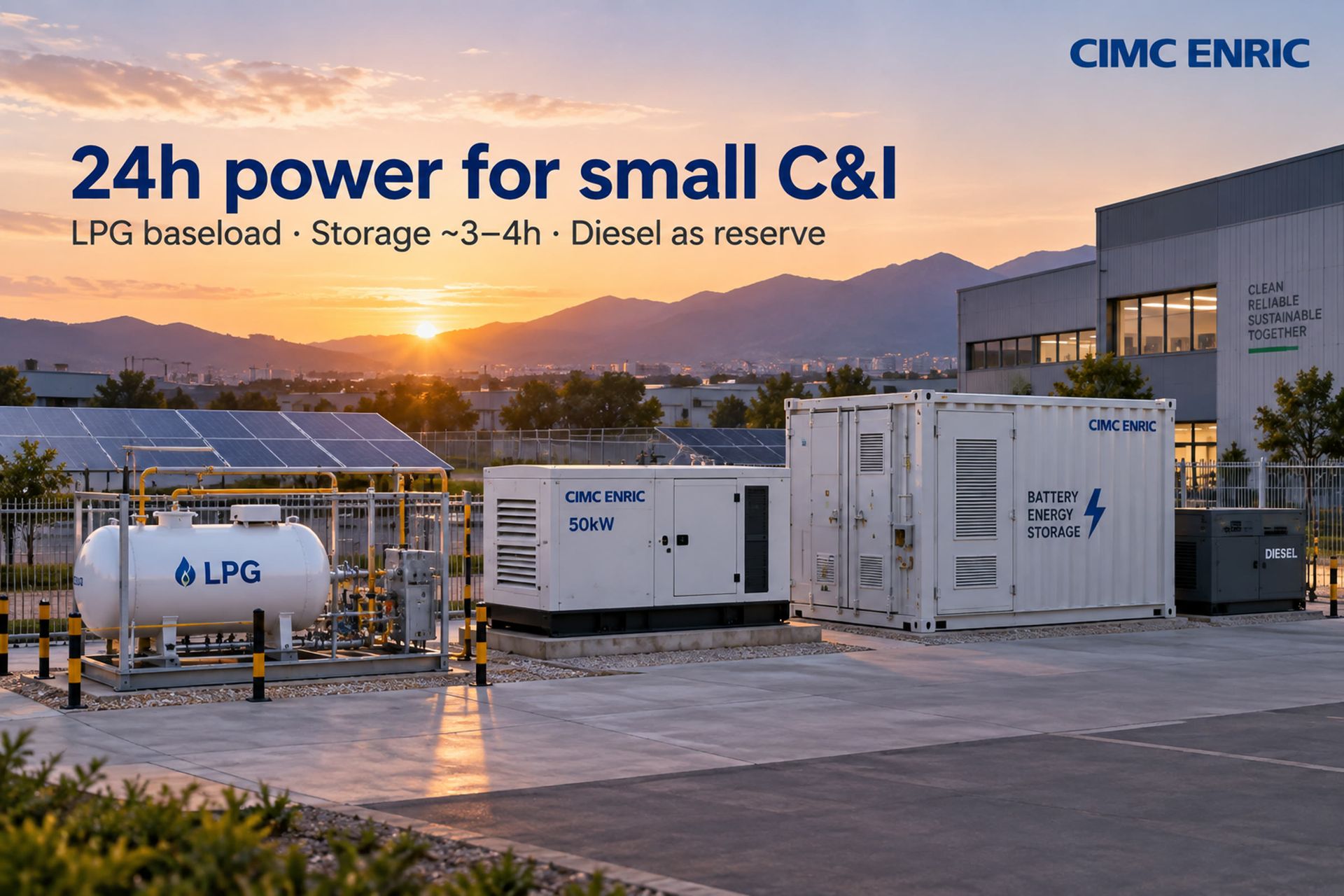
24h Power for Small Sites: LPG Genset + Tank + Microgrid Storage
Many small commercial and industrial sites pay twice: once for an unreliable grid, and again for diesel or bottled fuel that keeps critical loads running overnight. The costly pattern is operating a diesel genset as continuous baseload. For sites in the tens of kilowatts — retail, clinics, light industry, remote compounds — a practical route is firm LPG baseload plus short-duration storage, with diesel retained only as emergency reserve.
Audience
Owners and operators of small C&I sites that need 24-hour continuity, with priority theaters in island markets, Nigeria and South Africa. Secondary readers: Local Partners (distributors, installers, gas retailers) who can deploy a compact LPG and storage package. This line is separate from multi-site food and catering packages in the ~100 kW class (AM100).
System definition
- LPG genset (~50 kW class) with a small LPG tank — firm, continuous baseload for small C&I.
- PV with battery energy storage (BESS) — approximately 3–4 hours of load shifting and outage ride-through. Not a substitute for 24-hour baseload.
- Diesel — emergency and rare starts only. Continuous overnight diesel operation is the cost to measure and reduce; diesel itself remains appropriate as reserve.
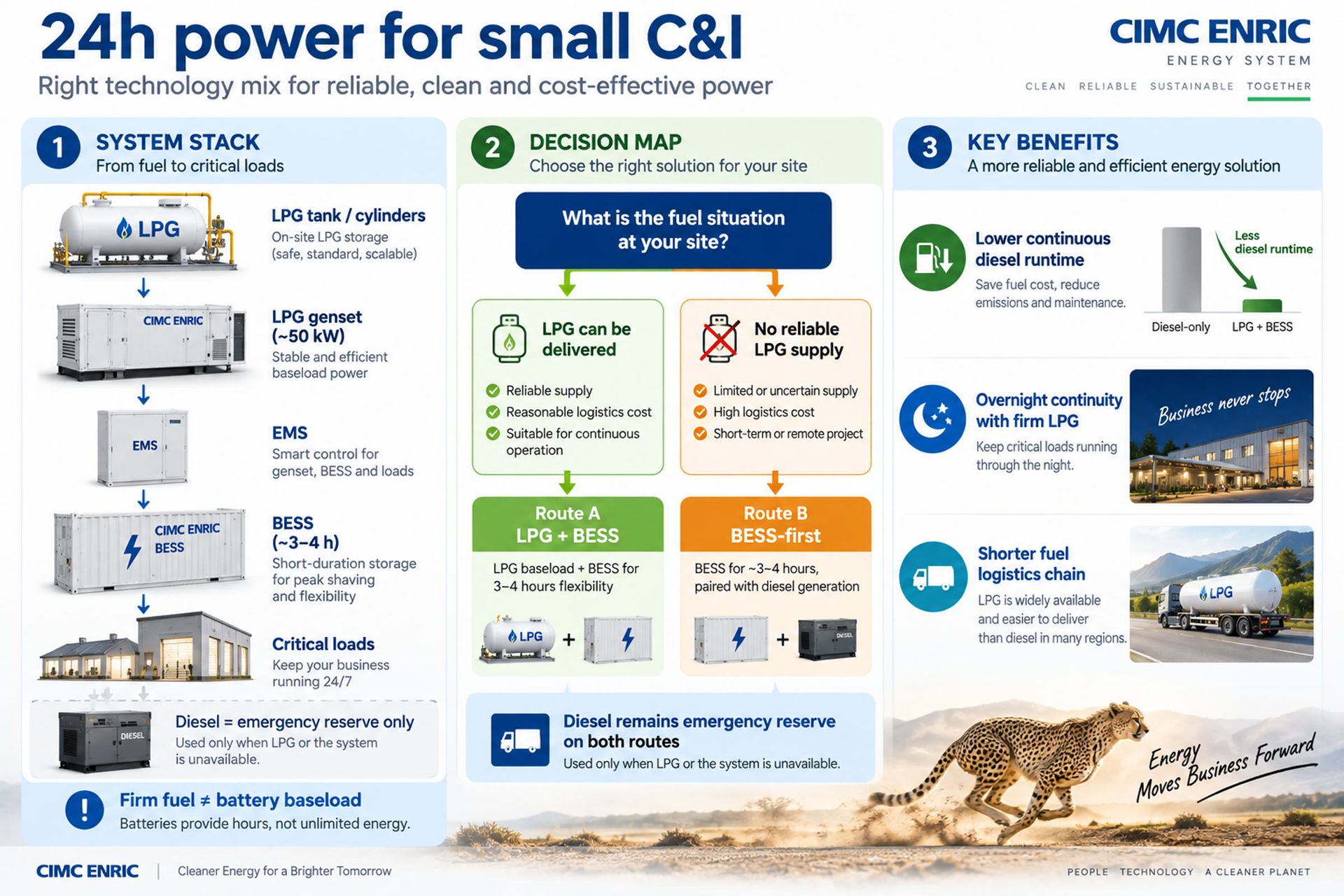
Figure — one overview board: system stack · decision map · key benefits. LinkedIn posts reuse this board with section-focused captions (source pixel width does not support sharp third-column crops).
Firman genset module and local service coverage
For this small C&I LPG line, CIMC ENRIC works with Firman on the LPG power generation core module. The aim is practical: deliver a Firman-class service and maintenance path in priority theaters such as Nigeria and island sites, where continuous uptime depends on spare parts access and trained local response—not only on first delivery.
CIMC ENRIC remains the system integrator and the customer’s single backstop: site assessment, LPG tank and fuel interface, BESS and EMS integration, and the overall architecture. Firman contributes the genset core and the service standard we rely on in those theaters. Commercial terms stay case-by-case; this Briefing does not imply exclusivity or commission arrangements.
Two site routes
Route A — LPG or gas can be delivered
Use the LPG genset and mini-tank as the firm source. Add PV and BESS so the genset operates near an efficient load point and the site rides through multi-hour outages without converting diesel into baseload. First sizing conversations should use the project / gas-to-power calculator.
Route B — No reliable LPG supply; weak grid
Start with a BESS-led hybrid: PV, containerized storage and an energy management system (EMS), with existing diesel or a small backup set as reserve only. BESS is the control layer for roughly 3–4 hours — absorb solar, cover outages, and reduce inefficient diesel cycling. Size that path on the Microgrid Calculator.
Operational outcomes
- Lower diesel runtime and reduced fuel logistics exposure when LPG carries overnight baseload.
- Critical loads remain available through multi-hour feeder outages.
- Modular skids and containers reduce on-site interface work versus stick-built plants.
- EMS schedules LPG, solar, battery and backup — operators are not switching plant by radio.
Four inputs for a first assessment
- Average and peak kW, and whether the load can island.
- Outage hours observed in the last 30 days.
- Whether LPG cylinders or a mini-tank can be delivered to site.
- Primary objective: lower diesel runtime, or true 24-hour continuity.
With those inputs we return a first-pass architecture and order-of-magnitude operating range — not a hardware catalogue.
FAQ
Is battery storage sufficient for 24-hour small C&I power?
No. Under our product logic, BESS provides about 3–4 hours of flexibility. Overnight and continuous baseload require a firm fuel path such as LPG (or other gas), with diesel retained only as emergency reserve.
When should diesel remain on site?
Retain diesel for rare starts and true emergencies. If the genset already runs most nights, measure that continuous runtime as an operating cost and move always-on hours to LPG or gas rather than specifying another diesel baseload set.
How does this differ from the AM100 catering line?
AM100 targets multi-site food outlets around the ~100 kW class. This Briefing addresses smaller C&I and household-scale sites (~50 kW class LPG with mini-tank and microgrid storage). Commercial lists and CRM tags keep them separate (small_ci_lpg versus catering_am100).
Why mention Firman in this Briefing?
Because the LPG genset core module and the local service path in Nigeria and island markets matter as much as the diagram. Firman supports that module and service standard; CIMC ENRIC integrates the full solution and remains accountable to the customer for the system outcome.
Where should partners start?
Local Partners contribute customer access, fuel logistics or local installation. We contribute technical assessment, equipment selection and system integration according to the agreed scope. Start at Become a Project Partner. This page does not promise exclusivity or commission terms.
Next step
Diesel should remain reserve capacity, not the site grid. If your small site needs 24-hour power and LPG can reach the fence line, map the architecture before ordering another continuous-duty genset.
Discuss your project · Project partners · Microgrid calculator (~3–4h) · Project / gas-to-power calculator