
CIMC ENRIC Energy Systems · industrial end user / household energy supplier / dealer / distributor / EPC / developer
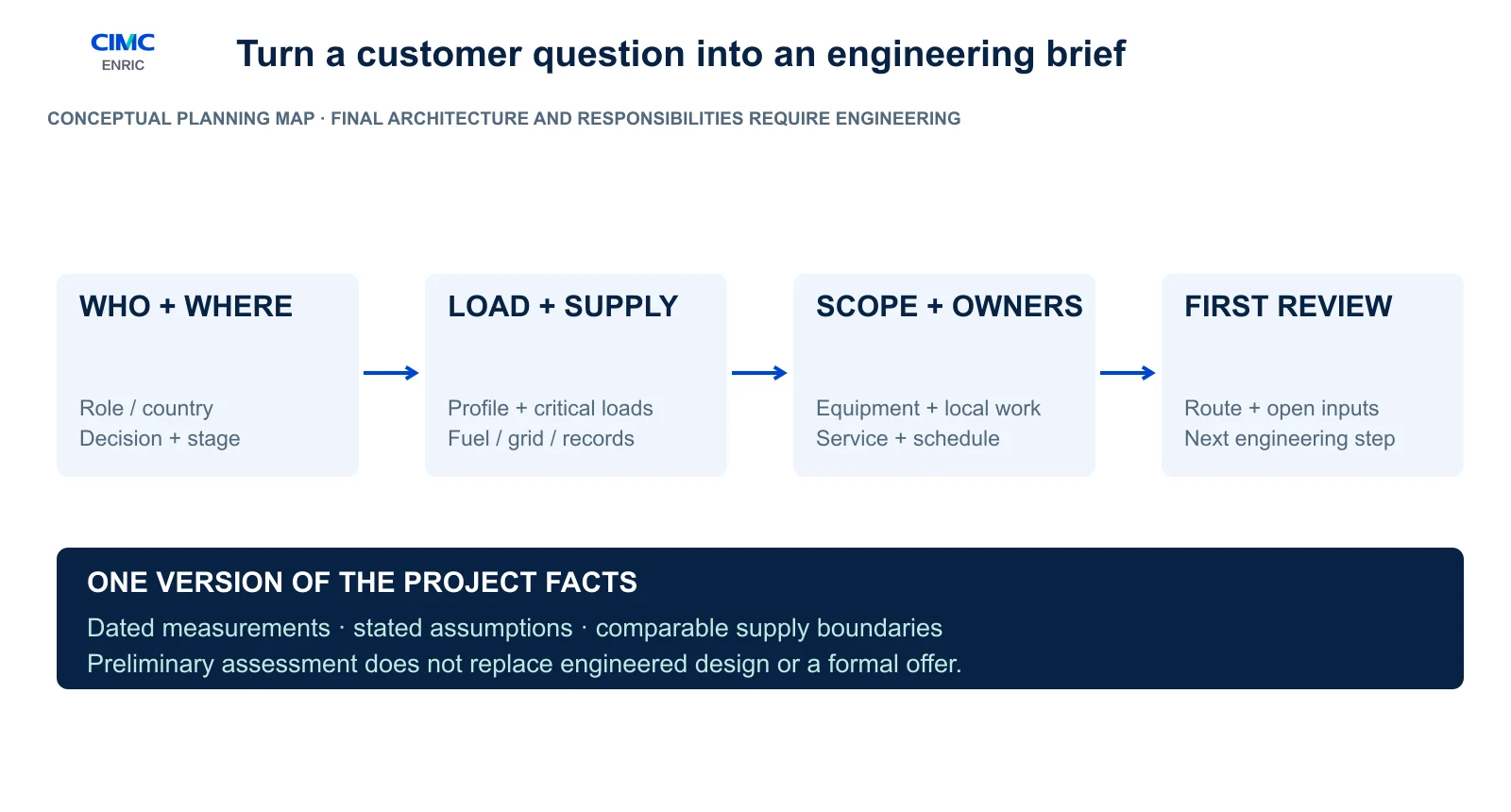
Send the country, your role, the load and operating problem, available energy supply, existing equipment, target scope and timeline. Mark unknowns instead of guessing. This gives the first assessment a clear basis for recommending a route, identifying missing data and defining what a preliminary estimate includes.
1. Describe the decision you need to make
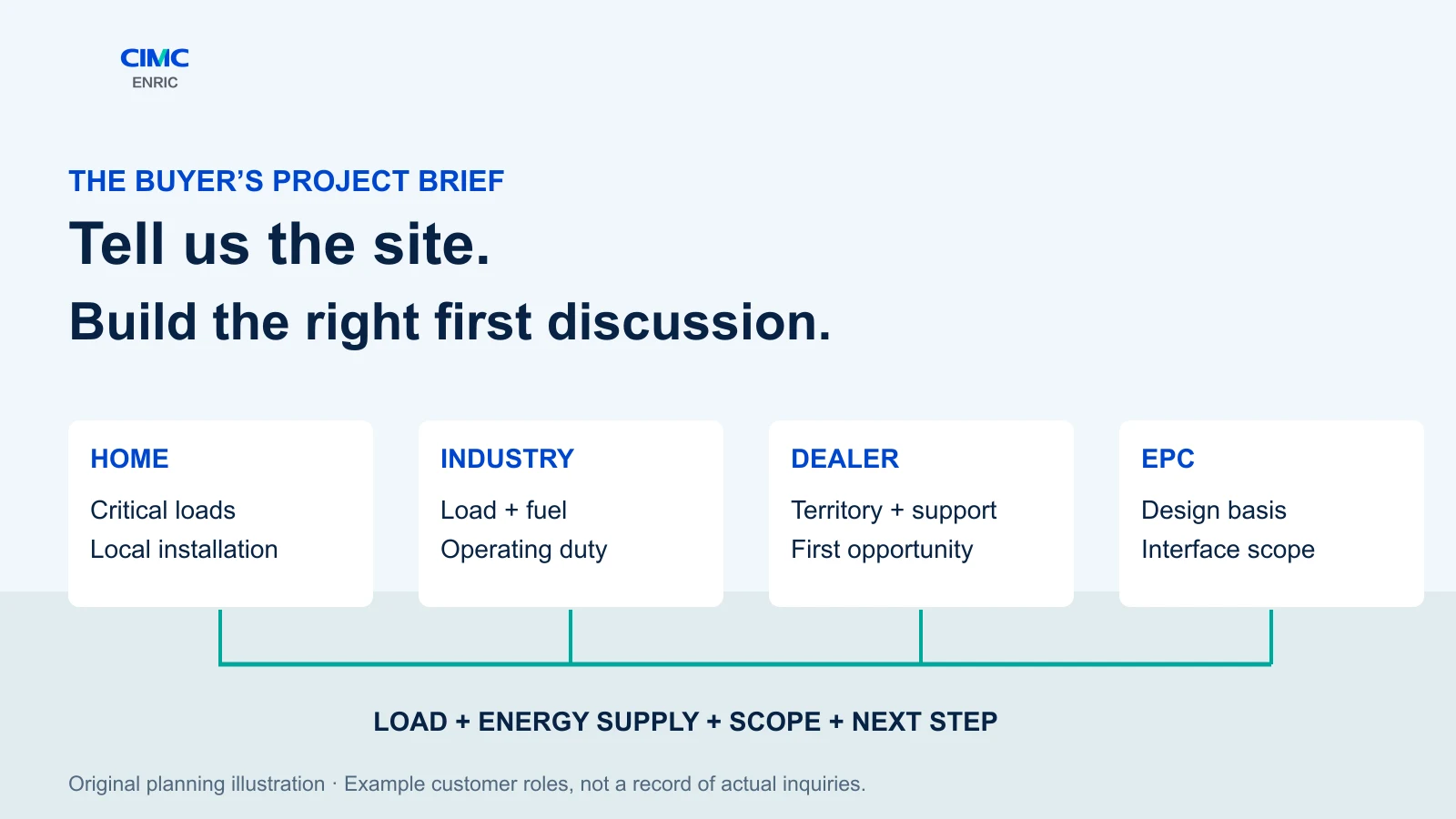
“We need 1 MW” can mean temporary construction power, daily production, emergency backup or a future plant expansion. State which service the customer needs, what is failing today and what decision the first proposal must support. Include the country and site location, the project stage and whether you are the owner, dealer, EPC or another project participant.
Different readers need different starting answers. A household buyer may need an installer and a practical backup route. A factory owner may first need to understand its load and bill. An EPC may already have a design and need a precise supply boundary. The answer finder helps route these questions; it does not replace engineering review.
2. Explain the load with units and time
Give the connected load, measured demand where available, normal and peak operating conditions, major starting loads and daily operating hours. Distinguish real power in kW from apparent power in kVA, and energy in kWh from power. If a value is an estimate, say how it was estimated and which loads it includes.
For backup, list the loads that need to stay supplied and the interruption duration to plan around. For a battery inquiry, state the charge and discharge duty and whether the energy figure refers to a nameplate capacity or required usable output. Include a dated load record or bills when available. A single peak number cannot establish an operating profile.
3. Bring the supply conditions into the same brief
For gas power, identify pipeline gas, LNG, CNG, LPG or another proposed fuel, and attach available composition, pressure, flow and delivery information. State the required 50 Hz or 60 Hz electrical version and site conditions. Do not assume the same engine configuration or output across different fuels, frequencies or climates.
For PV and BESS, identify existing equipment, available space, the grid connection and the desired operating modes. Retaining a generator or inverter requires an interface review. For off-grid or hybrid operation, explain reserve and recovery expectations; an energy-capacity number does not by itself establish compatibility, islanding or uninterrupted power.
4. Separate equipment, integration and local work
Ask whether the proposed scope includes only selected equipment, a factory-integrated package, a modular supply for local assembly or a broader engineering and installation scope. Record foundations, lifting, fuel storage and treatment, switchgear, cables, protection, permits, commissioning and service beside named responsible parties.
Commercial comparisons should use the same boundary. State the delivery basis, destination, currency, taxes and duties to clarify, and any local work that remains outside supply. Early budget information is conditional on its input assumptions and exclusions. It should not be presented as a final engineered offer or a universal price per installed kWh.
Use one interface or comparison register
| Reader | Priority information | Useful next output |
|---|---|---|
| Household / small site | Essential loads, outage duration, fuel access and local installation | Backup route and missing load / installation inputs |
| Factory / commercial owner | Bills, time-based load, outage cost and existing electrical diagram | Energy-use assessment and supply-scope comparison |
| Dealer / distributor | Territory, customer segment, technical team and service plan | Partner discussion and agreed customer-support scope |
| EPC / developer | Design basis, drawings, battery limits and procurement stage | Interface register and preliminary supply exclusions |
| Fuel supplier / project investor | Firm supply, energy customer, delivery route and operating assumptions | Resource-to-load route and feasibility inputs |
5. Adapt the brief to the local delivery partner
A dealer inquiry should explain the customer segment, expected geography, installation resources, maintenance capability, spare-parts plan and the first specific opportunity. For Nigeria, the existing partner page provides the current public entry point. Confirm the product-specific service responsibility for each order rather than extending a general network description into an unconditional warranty promise.
If equipment financing is being explored, identify who buys the equipment, who applies to the bank and which documents the lender requests. Factory supply documents and possible payment structures can support a discussion; the bank decides credit and security conditions, and final payment terms require agreement. Use the existing dealer-financing explanation with the actual parties.
6. Ask for a defined first response
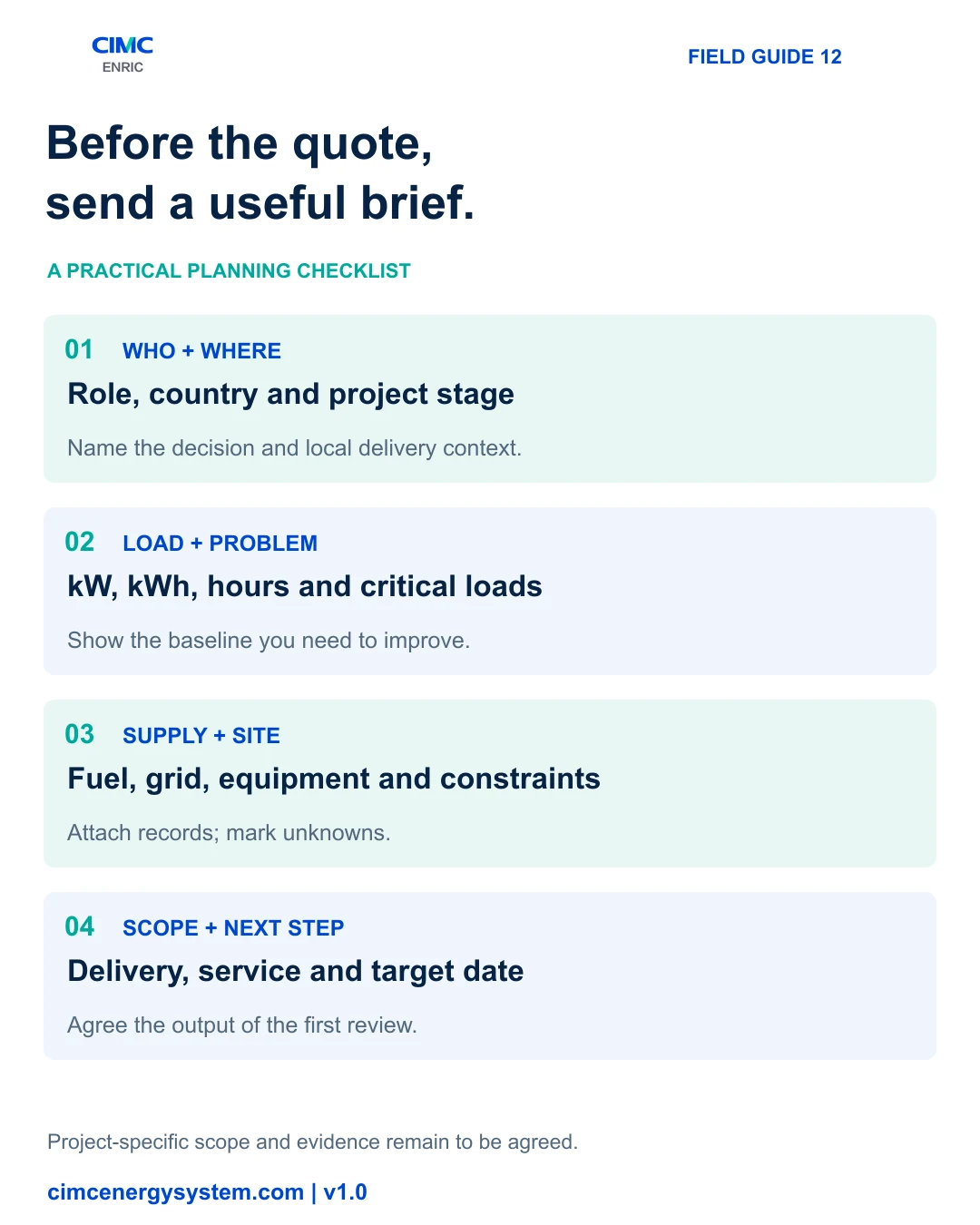
A practical preliminary response can contain a proposed route, the evidence still needed, a preliminary equipment or interface boundary and the next review step. Agree the intended output with the project team. If a budget estimate is requested, ask for its validity, assumptions and exclusions so a colleague or local partner can interpret it correctly.
Use the attached worksheet as a cover page for your supporting records. Attach only material relevant to the project; the initial inquiry does not need personal financial records or bank credentials. Mark unknowns and name the party that can resolve them. This allows the next discussion to focus on the customer's decision rather than repeatedly collecting the same missing basics.
7. Keep one version of the project facts
When the load, fuel or site scope changes, date the revision and identify the changed assumption. Retain the basis of earlier estimates so different suppliers and local partners are comparing the same requirement. After an engineering discussion, turn the agreed inputs and remaining questions into the next revision of the brief.
This checklist consolidates the published planning topics in our current guide series. It is not a report of measured inquiry conversion, customer savings or market demand. The next useful content update should respond to actual customer questions and attributable records, without presenting unknown outcomes as results.
Questions customers ask
Can I request an estimate before all project information is available?
Yes. State what is known and what is assumed. Ask for an indicative range or route with explicit scope, exclusions and data still required; a preliminary estimate is not a binding engineered quotation.
Should a dealer or EPC use the same inquiry as an end customer?
They can use the same core brief, but should add their role, territory or design scope, local installation and service responsibilities, and the specific output they need from CIMC ENRIC.
Start with the project inputs
Download the fillable project worksheet and add your source records, responsible contact and open questions. No guessed technical values are required.
Discuss your project with CIMC ENRIC.
Related customer routes
- Find answers for your role
- Dealer financing discussion
- Local power partner route
- Send your project brief
References and scope
- [1] CIMC ENRIC customer questions and role routing
- [2] Existing financing and supply discussion scope
Original buyer-input checklist based on the existing guide series and public customer routes. No measured inquiry results, credit decision, guaranteed performance or final price is claimed.