
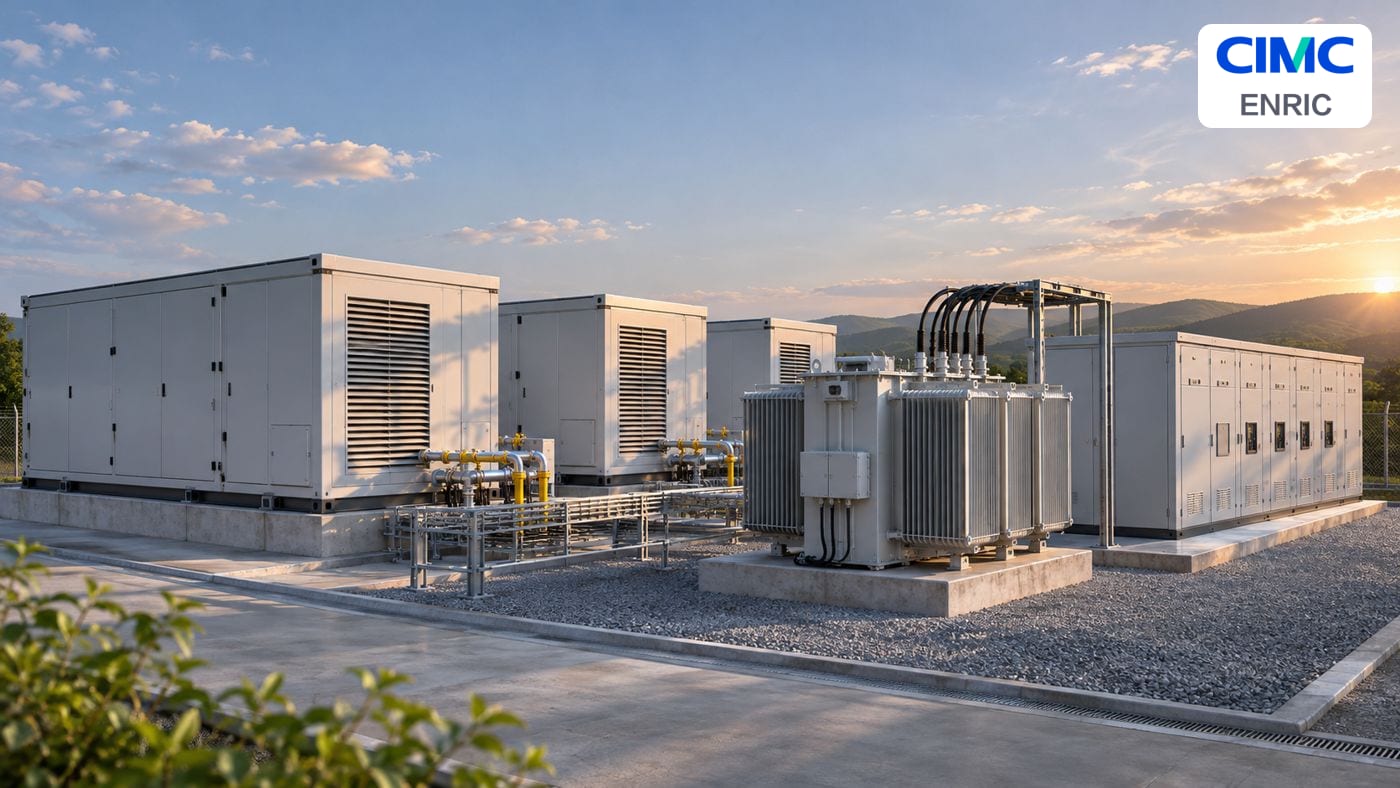
For: Plant engineers, EPCs and gas-generator buyers
A generator must carry the running load and support the largest credible load step while keeping voltage and frequency within the limits of connected equipment. Motor starting kVA, alternator response and the engine’s transient capability matter in addition to kW.
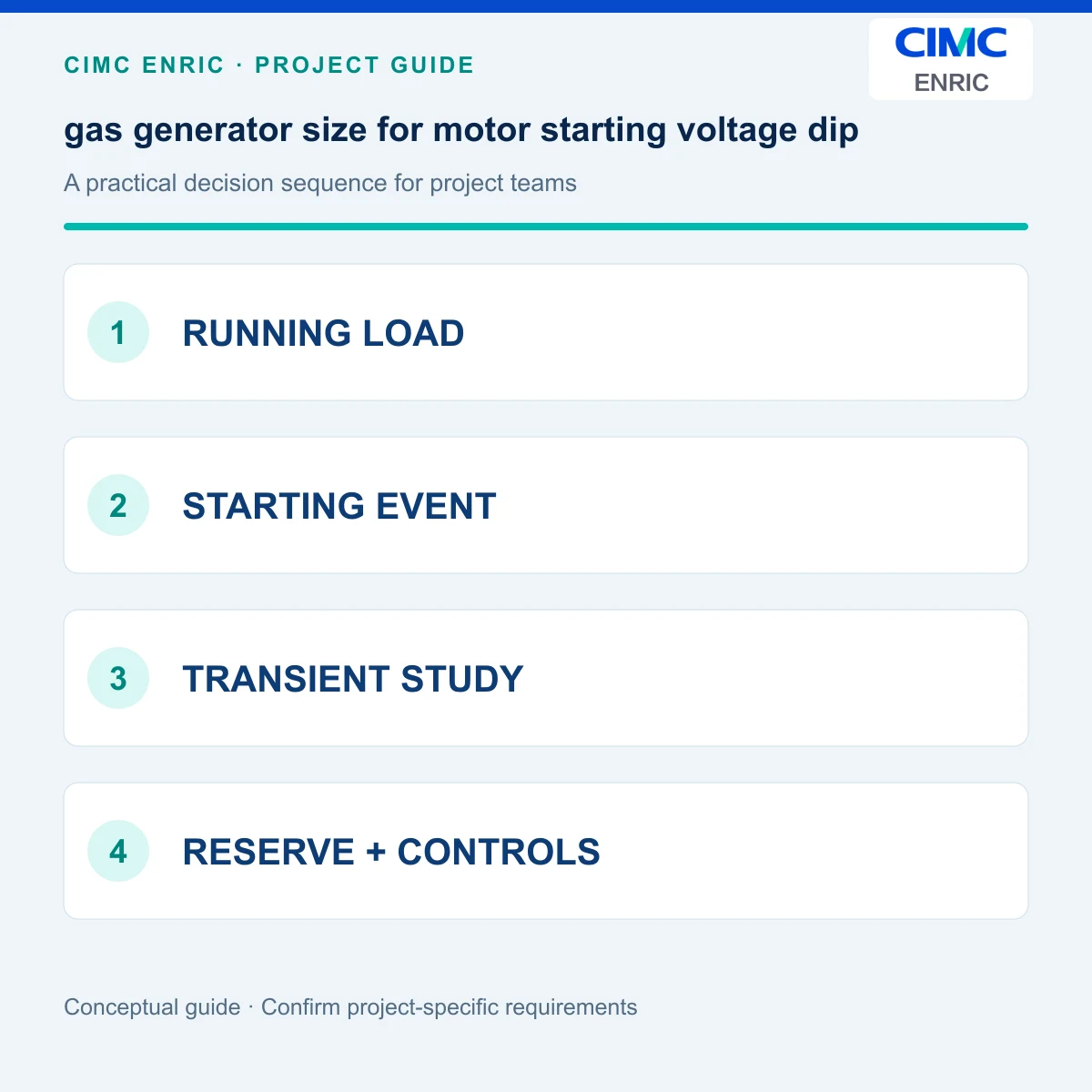
Separate normal demand from starting events
List continuously running kW and kVA, minimum and maximum demand, load power factor and any nonlinear equipment. Then list motors by rated power, starting method, starting kVA or current, inertia and sequence. A pump, air compressor or chiller can create a short demand much larger than its running load.
Record the voltage dip, frequency dip and recovery time that each sensitive load can tolerate. A specification based only on total installed motor kW misses the event that may cause contactors to drop or controls to reset.
Model a credible starting sequence
As an illustrative load schedule, a site might have 350 kW already running and need to start a pump whose vendor supplies a 600 kVA starting requirement. The 600 kVA is not automatically added to 350 kW as if both were the same unit. The alternator and engine supplier must assess the combined transient using actual power factor, starting method and operating point.
Ask whether the motor starts direct-on-line, via a soft starter or with a variable-frequency drive. These arrangements can change inrush, harmonics and process behavior. A staged start can help only if the process and protection scheme permit it.
Distinguish rating, reserve and transient response
Confirm continuous, prime or standby duty as relevant; ambient temperature, altitude and gas quality; and available site output after derating and auxiliaries. If several engines parallel, assess which are online before the motor starts and whether each shares the load as designed.
A nominal N+1 fleet may still share a gas train, controller or switchboard. Show the required load after a unit trip and identify common-mode failures. Battery support can be studied, but inverter capability, state of charge, controls and protection must be demonstrated for the transient.
Give the OEM a load-step schedule
Provide a sequence table listing running loads, each starting event, allowed voltage and frequency limits, motor-starting method and required time between starts. The OEM can then perform the correct transient study for the specific engine and alternator.
CIMC’s AM and Magic Cube product routes provide starting points for discussion; no single module size can be selected safely from a motor nameplate alone. Approved project data and the integrated protection study control the final design.
Questions buyers ask
Will a battery always solve motor starting?
No. It requires sufficient inverter power, control response, energy reserve and protection coordination.
Can I add motor starting kVA directly to generator kW?
No. kW and kVA describe different quantities; the combined transient depends on power factor and system response.
Prepare a project brief
Running kW/kVA; motor starting kVA and sequence; permissible voltage and frequency dip; ambient conditions; selected duty; gas analysis; reserve; switchgear and control architecture.
Explore related CIMC solutions · Read the related project guide · Discuss your project
Source: Caterpillar: standby power and load-starting considerations. The cited material provides context; project decisions require current site-specific engineering and applicable requirements.