
CIMC ENRIC Energy Systems · Household energy planning guide

Start with the circuits you need during an outage, their energy use and the hours they must run. Size battery energy in kWh for that operating period, then check inverter power in kW against simultaneous demand and appliance starting requirements. Solar and a suitable generator can extend the energy supply when their interfaces and operating conditions are confirmed.
A useful home backup plan begins with everyday priorities: keeping food refrigerated, lights on, communications available and selected appliances working. A household can then choose whether to protect those essential circuits or assess a wider whole-home system.
1. Choose the loads that matter during an outage
Make three groups: essential loads, loads you can schedule and loads you can pause. Lighting, refrigeration and communications may belong in the first group. A water pump may also be essential at your property; its starting demand needs a separate check. Electric cooking, water heating, air conditioning and vehicle charging can substantially change the power and energy requirement.
For each selected appliance, record operating power, operating hours, starting demand and the circuit or phase it uses. Refrigerators and other cycling appliances need an energy estimate over the outage period. Their nameplate power alone does not describe eight hours of consumption.
The distinction between selected circuits and whole-home backup matters. The Australian Government’s battery guidance explains that backup capability depends on system type, size and configuration; an installed battery does not automatically protect every circuit. Read the official battery guidance.
2. Separate battery energy from inverter power
kWh describes energy; kW describes power at a particular moment. A battery may contain enough energy for an evening while its inverter cannot supply a particular combination of appliances or start a motor. Check both requirements.
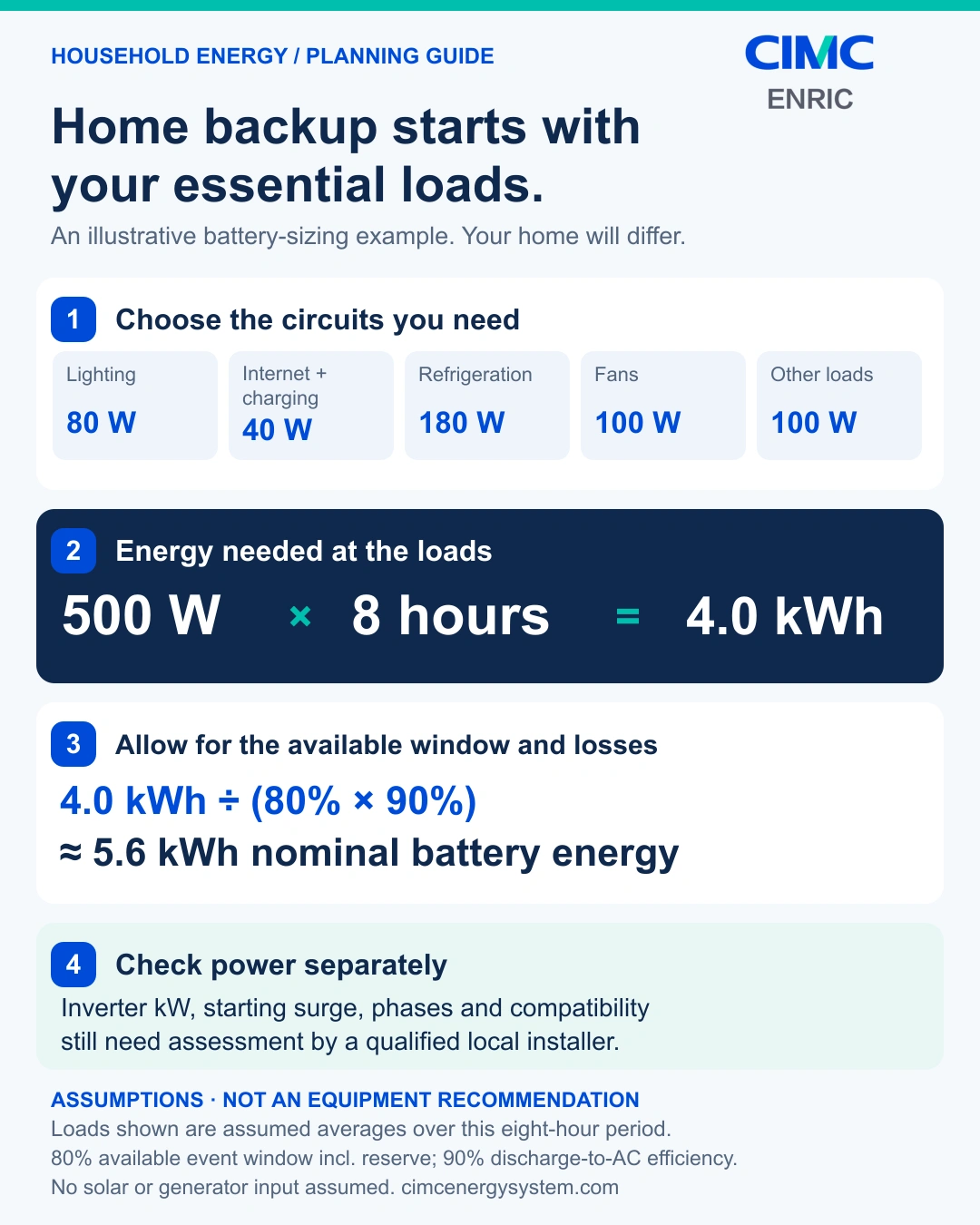
Consider this illustrative eight-hour outage. Every value below is an assumed average over that period, including cycling where relevant. These are placeholders for explaining the method, not appliance specifications or measured customer data.
| Selected load | Assumed average power | Backup period | Energy required |
|---|---|---|---|
| Lighting | 80 W | 8 h | 0.64 kWh |
| Internet and device charging | 40 W | 8 h | 0.32 kWh |
| Refrigeration | 180 W | 8 h | 1.44 kWh |
| Fans | 100 W | 8 h | 0.80 kWh |
| Other selected essentials | 100 W | 8 h | 0.80 kWh |
| Total | 500 W average | 8 h | 4.00 kWh |
At the load terminals, the simplified energy requirement is 0.5 kW × 8 h = 4.0 kWh. For this example, assume that 80% of nominal battery energy is available for the event and that discharge to AC loads is 90% efficient. The indicative nominal capacity is:
4.0 ÷ (0.80 × 0.90) = 5.56 kWh, approximately 5.6 kWh.
The 80% event window includes the assumed usable operating range and retained reserve; reserve is not deducted a second time. The 90% figure is an assumed discharge-path efficiency, not a manufacturer rating or round-trip efficiency. This estimate excludes equipment standby consumption and changing temperature or ageing effects, assumes no solar or generator contribution, and assumes the planned starting charge is available. Actual equipment selection needs those factors and the measured load profile. If a specification already gives usable AC energy, do not apply the same reductions again.
The 500 W average does not determine inverter size. Simultaneous peaks, motor starts, battery discharge limits and phase arrangements still need checking.
3. Check what existing solar can do in a blackout
Existing rooftop solar may be a useful part of the system. Confirm the inverter model and the electrical arrangement before assuming it will operate during an outage. Conventional grid-connected solar generally disconnects when the grid fails; supplying an isolated home requires the appropriate backup configuration. The US Department of Energy explains solar resilience and inverter requirements.
Ask whether the proposed arrangement supports existing PV, an essential-load panel, islanded operation, battery charging during an outage and restarting after the battery reaches its lower operating limit. Solar output during a cloudy outage must also be assessed. Solar panel capacity alone cannot establish overnight backup duration.
4. Evaluate a generator for longer interruptions
A suitable generator can support loads and replenish the battery during extended interruptions. Selection needs the combined load and charging demand, compatible controls, switching and protection, and a dependable fuel route.
Generator integration is model specific. For example, one tier-one manufacturer’s home storage documentation describes partial or whole-home distribution and generator support that depends on the backup-interface version. That illustrates an available engineering route; it does not establish compatibility for every product, generator or country.
For a gas option, assess local LPG or natural-gas supply, delivered fuel cost, replenishment and the approved generator fuel system. An LNG route needs its own logistics assessment. Installation and commissioning must meet the equipment and local requirements. These choices belong in the site assessment before a package is quoted.
5. Include local installation and service in the decision
An equipment list becomes a practical household solution when installation, commissioning, warranty handling and maintenance responsibilities are clear. Ask the local supplier to identify who confirms the circuit list, protects the electrical interfaces and supports the equipment after installation.
CIMC ENRIC’s household programme is being developed around signed cooperation with a world tier-one storage manufacturer in China and Firman. Household configurations, local dealer qualification and country rollout remain development stages. The household programme page records the current scope and roadmap. It also links to the storage-partner cooperation and Firman MOU record.
Where a dealer or bank financing route is being explored, the participating parties need the actual equipment scope and commercial documents. Available finance and eligibility depend on the specific arrangement. See the dealer financing questions.
Two questions homeowners often ask
How much battery capacity do I need for essential loads?
Add the energy each selected load needs over the backup period, then account for the battery’s available operating window and conversion losses where applicable. Check peak and starting power separately. In the illustrative example above, 500 W average for eight hours needs 4.0 kWh at the loads, or about 5.6 kWh nominal under the stated assumptions.
Can I add a battery and a backup generator to my existing solar?
Potentially, after checking the exact inverter, battery, generator, switching and protection arrangement. Confirm whether solar can operate and charge the battery while the home is isolated from the grid. Existing PV capacity alone does not demonstrate backup compatibility.
Prepare your household energy brief
Share your country and city, usual outage duration, essential appliance list, electricity use, phase arrangement, existing PV and inverter details, and any reliable fuel supply. Photos of equipment labels and an electrician’s circuit schedule can help clarify the starting point.