
CIMC ENRIC Energy Systems · Household energy planning
Choose household backup power by asking how energy will reach your home during an outage. A battery needs a reliable charging route; a generator needs compatible fuel, replenishment and local service. LPG, diesel, solar and storage can each play a role. The practical choice depends on your essential loads, outage duration, delivered energy cost and installation conditions.

Start with the next refill or recharge
A home may have access to LPG cylinder deliveries but no natural-gas pipeline. Another may have rooftop solar and dependable daytime charging. A rural household may already know a diesel supplier and service technician.
Before comparing equipment, ask: if the outage continues tomorrow, what replenishes the system? Check the delivery route under the same conditions that cause outages: damaged roads, seasonal demand or interruptions to local services. Ordinary availability and emergency availability may differ.
Keep a short essential-load list: refrigeration, lights, communications, selected fans and any necessary water pump. Record operating hours and starting loads. Our essential-load battery-sizing guide covers this first step.
Compare the routes your household can actually support
This table is a discussion guide. The checks help a local dealer narrow the options before specifying equipment.
| Route | Household situation to explore | What to confirm locally |
|---|---|---|
| Battery, with grid or solar charging | Essential circuits need backup, and a suitable charging source is available | Usable energy, inverter power, outage operation and the next charging opportunity |
| LPG-compatible generation | A dependable LPG delivery or refill route serves the property | Fuel composition, approved engine configuration, storage, supply capacity and maintenance |
| Diesel generation | Delivered diesel and competent local service are practical | Consumption at the expected load, fuel management, installation, noise and servicing |
| Natural-gas generation | A suitable pipeline connection already exists | Utility supply conditions, pressure, available capacity and the approved generator fuel specification |
Propane is one LPG fuel used in household backup generators. LPG composition can vary by market, so an existing cooking-gas supply should be assessed against the generator's approved specification. EIA explains propane's household uses.
Where does LNG fit?
LNG is natural gas transported and stored as a cryogenic liquid, then returned to gas for use. Its storage and regasification arrangements differ from LPG. EIA describes the LNG supply route.
For an individual home, treat an LNG option as a separate engineering and logistics assessment. A shared estate or community supply may justify that assessment where suitable infrastructure exists. This is a planning inference, not a claim that LNG is economical for every home. Pipeline natural gas and delivered LNG also have different supply arrangements.
Ask what happens when the battery runs low
Solar and storage can support household resilience, but the system must be configured for outage operation. The Australian Government notes that battery systems differ: some stop supplying power when stored energy is exhausted, while an appropriately configured islandable solar-and-battery system can continue charging from sunlight. Read its battery guidance.
A proposed hybrid route uses the battery for selected loads and a compatible generator to support longer interruptions or replenish storage. Ask the technical team to confirm the inverter's generator interface, charging limits, switching, protection, controls and supported operating modes. Connecting two devices does not establish a validated hybrid system.
Compare delivered electricity cost
A litre of diesel and a kilogram of LPG are different purchasing units. Compare their cost at the electricity output required by your home.
Generator fuel cost per kWh = delivered fuel price per unit × fuel consumed per hour ÷ electrical output in kW at that operating point.
Use a consistent unit: for example, currency/kg with kg/hour, or currency/litre with litres/hour. Obtain consumption data for the specified model, fuel and expected load. A full-load figure alone may not represent household operation.
Then add the quoted equipment, installation, fuel-storage arrangements and maintenance. For a battery option, include charging electricity, usable capacity, equipment and installation costs, and the agreed warranty basis. Ask the dealer to use the same load profile and evaluation period for every option. Current local quotations are needed to decide which route costs less.
Three household starting points
- Short interruptions with dependable recharging: explore a battery sized around essential circuits and inverter limits.
- Long interruptions with established LPG delivery: assess an LPG-compatible generator, either on its own or with a technically validated battery interface.
- A location with strong diesel service but uncertain LPG replenishment: compare the available diesel route against the actual gas and battery alternatives.
These are starting points for assessment. Each proposal should explain the expected runtime, replenishment assumptions and responsibilities for service.
Get a proposal you can discuss with your dealer
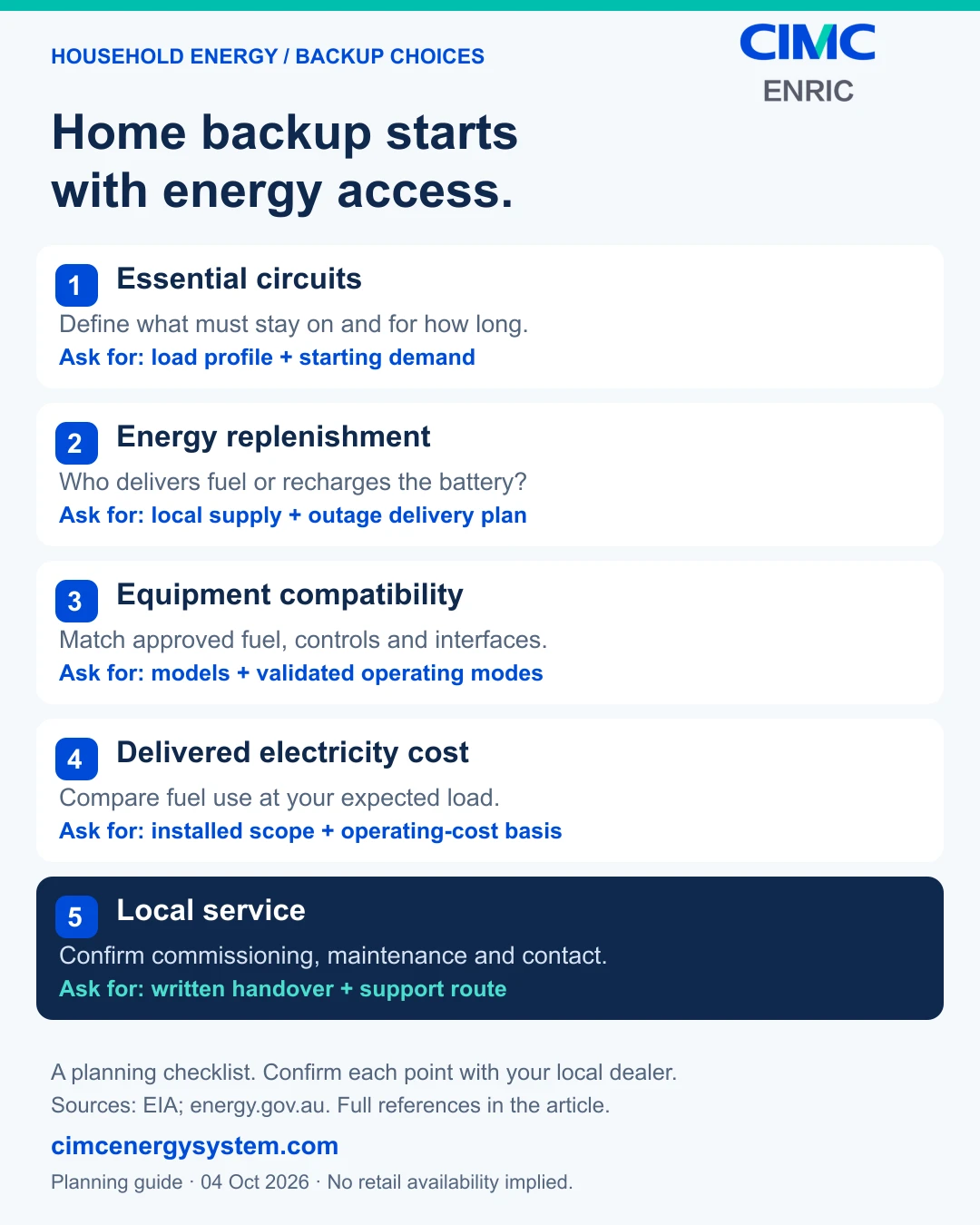
Request a written scope covering:
- The selected circuits, starting demand and target backup duration.
- The proposed models, approved fuel and supported system interfaces.
- The refill or recharge route, including the reserve and replenishment assumptions.
- Installed cost, consumption basis, maintenance and named support contact.
A qualified local team should assess electrical isolation, siting, exhaust, fuel storage and applicable requirements. Engine exhaust contains carbon monoxide. For portable generators, U.S. CPSC guidance calls for outdoor operation far from home openings and working household CO alarms. Fixed installations require the applicable local rules and manufacturer's instructions. See CPSC generator guidance.
How CIMC ENRIC is developing the household route
The signed storage-partner cooperation includes a planned household direction connecting solar, storage and suitable gas backup. The Firman / SUMEC M&E MOU records cooperation on small-scale LPG-to-Power for Africa and exploration of local deployment and service.
Household configurations, validation, dealer arrangements and market availability are being developed. The household roadmap explains the proposed stages. An enquiry helps identify your local requirements; it does not establish that a retail package is already available in your country.
Questions customers ask
Is LPG cheaper than diesel for home backup power?
There is no universal answer. Compare delivered fuel price with the selected generator's consumption at your expected load, then include installation, storage and maintenance. Check that replenishment and local service are practical for both options.
Can an LPG generator and battery power my home for 24 hours?
Possibly, if the selected loads, usable battery energy, fuel supply, equipment duty rating and control arrangement support it. Ask for a documented 24-hour operating assessment, including charging, refills and maintenance requirements. A fuel label or battery capacity alone does not guarantee continuous whole-home power.
Your next step
Tell us your country and city, essential appliances, typical outage duration, existing solar or battery equipment, and available fuel suppliers. Explore household energy or discuss local dealer cooperation. We can use these details to discuss a practical assessment route.