
CIMC ENRIC Energy Systems · Mine owners, developers and EPCs · Hybrid power planning
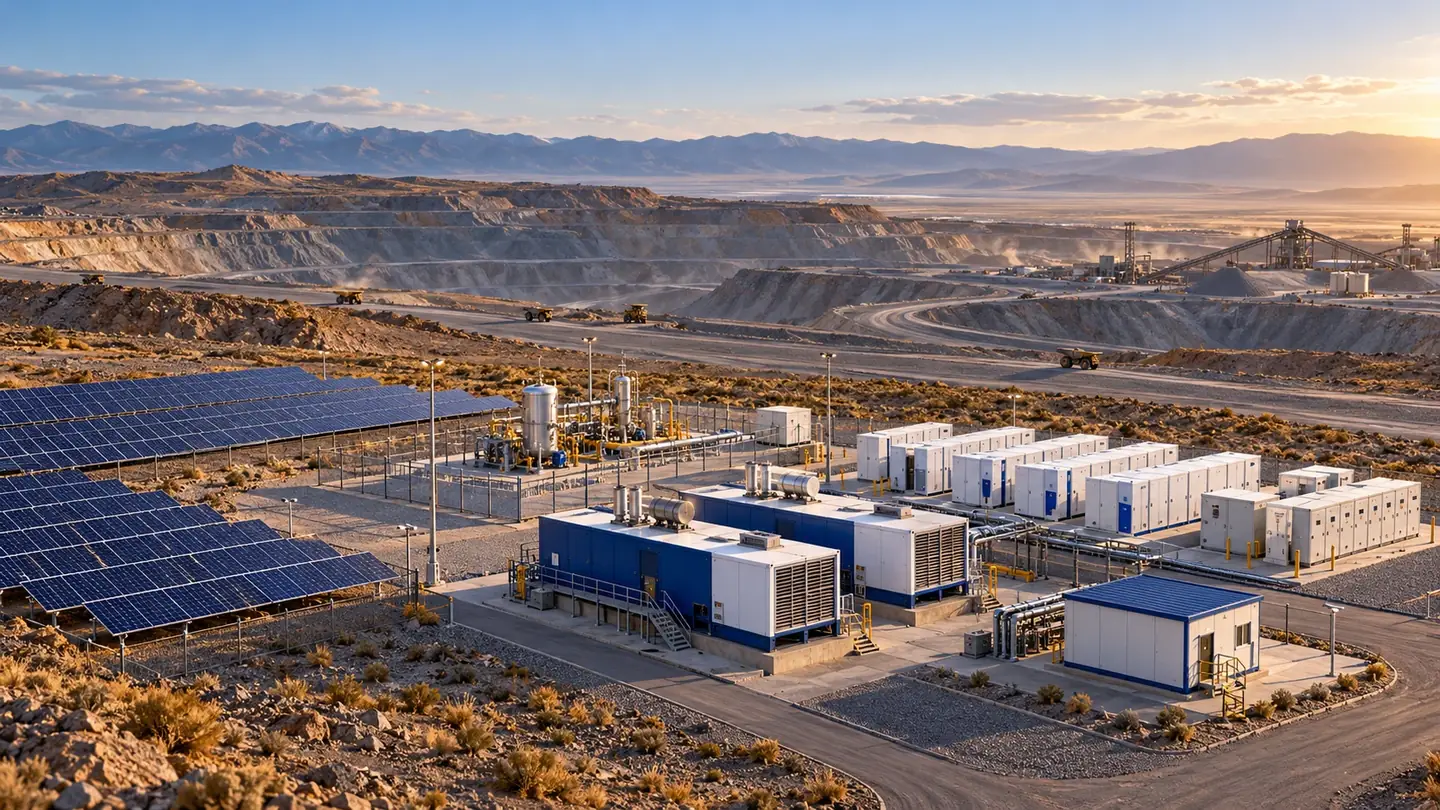
Plan gas generation, solar and battery storage as one mine-site operating system. Define the electrical boundary, operating modes, control roles, protection and acceptance responsibilities first. Then size and compare equipment against the same load, fuel and reserve assumptions.
1. Start with one operating plan
A mine's crusher, pumps, ventilation, workshops and camp can have very different starting and interruption requirements. A total MW figure cannot explain which loads must remain supplied during a trip, what can be shed or how the plant should restart. Bring a time-based load profile, major motor-starting information and a critical-load list to the first engineering discussion.
Define whether the site is permanently islanded, grid connected, or intended to move between approved modes. Mark the proposed point of common coupling, existing generators, switchgear, transformers and earthing arrangements on a single-line diagram. The mining solutions page covers several starting routes; this guide addresses the interfaces to review when gas, PV and storage are being considered together.
2. Give each resource an explicit job
- Gas generation: agree the qualified fuel envelope, available site output, operating duty, minimum-loading constraints and service reserve. Include upstream treatment, supply interruptions and delivery logistics. Use the generator-duty guide alongside the gas-quality checklist.
- PV: assess the local production profile and how output is limited when generation exceeds what loads and storage can accept. Solar output is variable; an installed PV rating is not a guaranteed reserve at the moment a generator trips.
- BESS and PCS: define available charge/discharge power, usable energy, state-of-charge limits, temperature conditions and auxiliary demand. Reserve held for a contingency cannot simultaneously be treated as fully available for energy shifting. The BESS scope guide separates power, energy and supply boundaries.
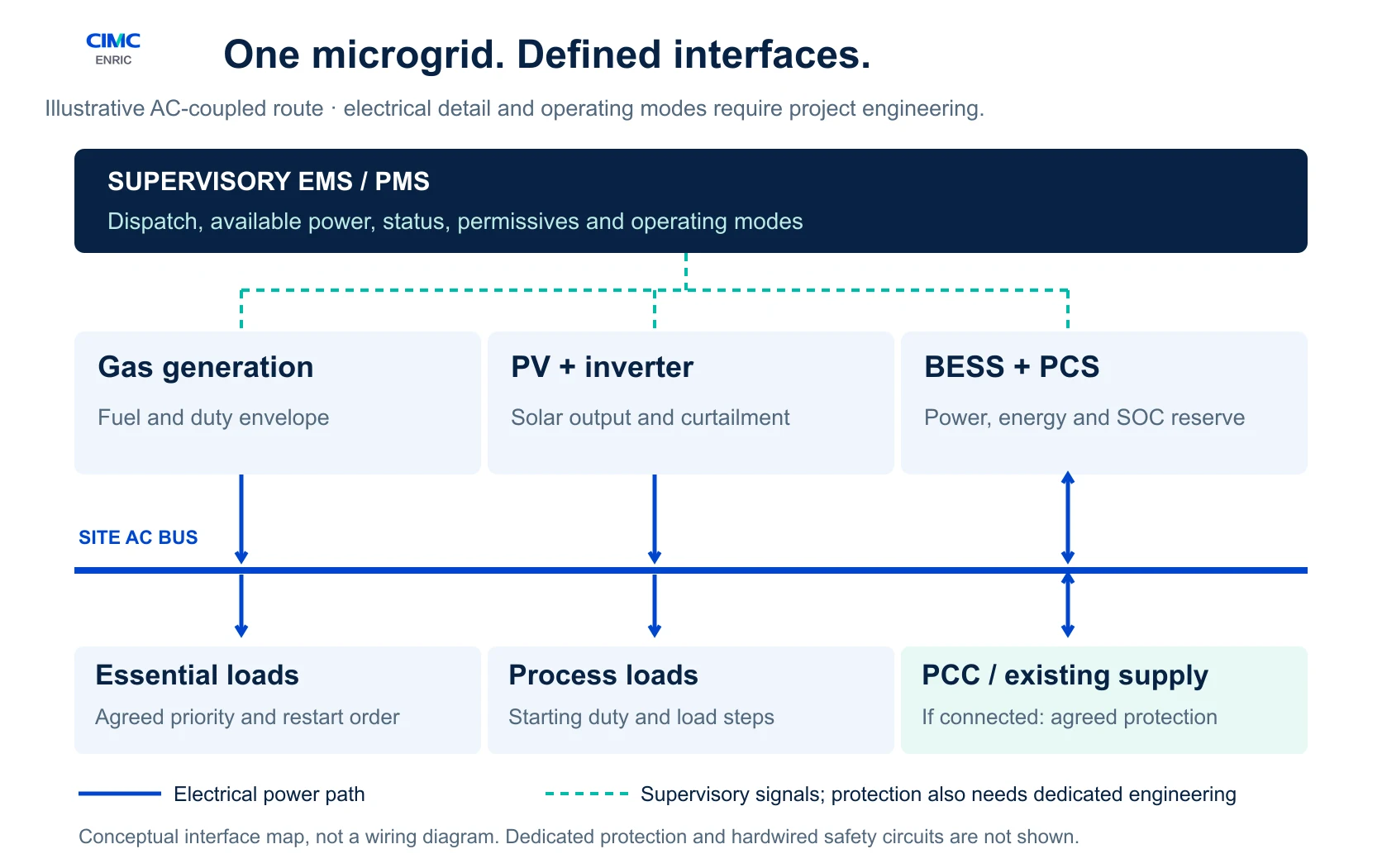
3. Separate dispatch from electrical protection
Supervisory EMS/PMS logic can coordinate schedules, operating limits and resource availability. Fast equipment controls, protection relays, interlocks and safety shutdowns still need defined responsibilities. A communications connection or an EMS label does not establish how a plant behaves during a fault or lost connection.
For every operating mode, identify which approved resource establishes voltage and frequency and which resources follow that reference. A grid-following inverter uses an existing electrical reference; a grid-forming function can establish one within its approved operating envelope. Battery capacity alone does not establish islanding or black-start capability.[1] A restart sequence must also account for fuel preparation, cooling, controls and other auxiliaries that need power before the main load can return.
Agree setpoint limits, timestamped measurements, alarm priorities, communications-failure behavior and who may change settings. The required response times and protection settings belong in the engineering and acceptance documents, rather than being inferred from a monitoring dashboard.
4. Turn the handovers into a responsibility matrix
Ask each supplier and the site team to name the accountable party at every boundary. The following is a discussion matrix; it does not assign contractual responsibility to a particular partner.
| Interface | Define before equipment selection | Evidence or sign-off |
|---|---|---|
| Fuel → generator | Composition, pressure, flow, treatment and interruption envelope | Gas report, inlet conditions and reviewed engine duty |
| Generator → AC bus | Voltage/frequency, synchronization, breaker logic and protection | Single-line diagram, approved settings and operating modes |
| PCS/BMS → EMS/PMS | Available power, SOC reserve, signals, alarms and fallback behavior | Versioned signal map, limits and witnessed functional cases |
| Site → existing supply | PCC, earthing, fault contribution, islanding and reconnection where applicable | Protection study and applicable local connection approval |
| Control → mine loads | Essential-load priorities, start sequence and permitted load shedding | Owner-approved load list and recovery sequence |
| Supplier → operator | Training, settings handover, spares, local support and remote-access permissions | O&M scope, access roles and acceptance records |
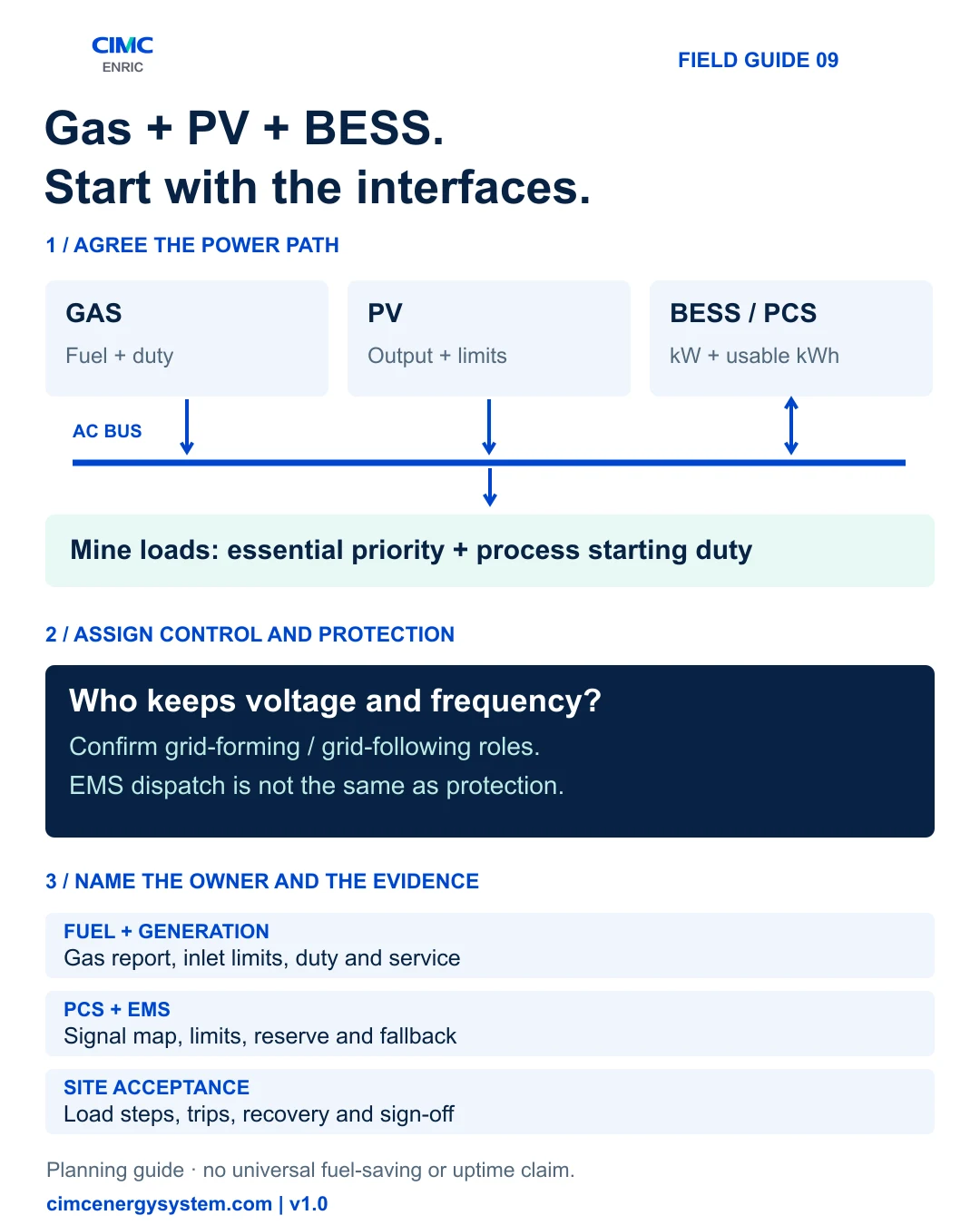
5. Agree the acceptance cases before procurement
Factory tests confirm the agreed equipment and integration scope. Site acceptance must also address the installed electrical network, actual controls, auxiliaries and loads. Plan the applicable cases with qualified engineers and the mine's operating team: major load starts and steps, reduced PV output, a generator trip, low battery reserve, grid loss and reconnection where relevant, communications failure, and the agreed restart sequence.
For each case, record the initial conditions, permitted operating limits, evidence to capture and the person who signs off. Use agreed simulations, factory demonstrations and site procedures as appropriate. Do not infer seamless transfer, uninterrupted operation or black-start performance from the presence of a battery and controller.
6. Connect the engineering scope to a credible business case
Compare the same delivered-energy requirement and critical-load policy against the existing site baseline. Include fuel consumption and delivered fuel price, solar availability, battery losses and operating limits, auxiliaries, maintenance, local works and reserve. A fuel-saving percentage from another duty cycle is not a forecast for this mine.
CIMC ENRIC's published SolaX partnership timeline describes signed cooperation linking microgrid/storage capability with gas generation and site-energy integration. The joint white-paper route remains in preparation. Project configuration, control ownership, performance obligations and commercial scope must be confirmed for each application.
Questions customers ask
Can existing diesel generators remain in a gas, PV and BESS microgrid?
They may be assessed as part of an agreed operating or reserve arrangement. Confirm their condition, controls, protection, load-sharing capability and integration scope. Keeping an existing unit does not by itself establish compatible parallel operation.
Does adding a battery make a mine ready for island operation?
No. Confirm the selected PCS functions, voltage/frequency reference, protection, auxiliaries, reserve and restart sequence. Demonstrate the agreed operating cases for the actual system; battery kWh alone does not prove islanding capability.
Bring the interfaces into the first project brief
Share the mine location, load profile, starting loads, critical-load priorities, existing single-line diagram, generator data, gas report and supply conditions, solar/site information, target operating modes and expansion plan. Mark unknowns. Use the downloadable interface worksheet to add an owner and evidence requirement beside each handover.
Discuss your mine microgrid scope with CIMC ENRIC.
Technical reference and scope
[1] The U.S. Department of Energy explains grid-following and grid-forming inverter functions. This supports the general distinction; it does not certify any selected equipment or prove a mine's performance. CIMC product, project and partnership references are linked in the text. This article is an initial planning guide and is not the forthcoming joint white paper.