
CIMC ENRIC Energy Systems · Energy Guides · Factory owners, energy managers and EPCs · 07 October 2026
A large electricity bill is a reason to investigate, not proof that a battery will pay for itself. First identify the problem: expensive demand peaks, time-dependent energy prices, unused solar generation or production interruptions. Then match the tariff, measured load and operating requirements to a storage strategy. Select equipment after that assessment.

1. Decide what the battery must achieve
An owner may want a lower bill, while production staff need continuity and an EPC needs clear electrical interfaces. Write the primary objective first. A useful assessment compares storage with practical alternatives, including changing operating schedules or correcting an unsuitable tariff.
| Objective | Evidence to collect | Decision to examine |
|---|---|---|
| Reduce billed demand | Demand tariff and interval import data | Can discharge reduce the peak used for billing? |
| Shift energy purchases | Time-of-use periods and charging opportunities | Does the price difference cover losses and lifecycle costs? |
| Use more onsite solar | PV output, site demand and export terms | Is there surplus generation when storage can accept it? |
| Support critical production | Outage records and critical-load requirements | What must remain powered, and for how long? |
These objectives can compete for the same battery. Energy kept in reserve for an outage is unavailable for routine price shifting. Do not count the same stored energy twice when combining benefits.
2. Read the tariff, not only the bill total
Separate energy charges, demand or capacity charges, and fixed items. A bill may use kWh, kW or kVA for different purposes; record the billed unit and rule exactly. Dividing the total cost by total kWh produces a blended historical rate, not necessarily the cost avoided by discharging a battery.
Check time bands, seasons, billing intervals, minimum charges and any rule that carries an earlier peak into later bills. The US Department of Energy explains these tariff structures in its utility-rate review guide. They are useful review questions, not a description of every country's tariffs. Obtain the applicable local schedule and confirm it with the supplier or utility.
3. Ask for load data with timestamps
Monthly energy totals cannot reveal whether consumption is steady or concentrated into short peaks. For an initial review, prepare 12 months of bills and the current tariff, then request the meter's available interval data. Preserve its native interval, time zone, units, import/export convention and missing-data flags. Identify whether readings represent power or energy per interval.
REopt's load-data guidance distinguishes monthly bills from more detailed interval measurements. Our practical request is a full year where available, with production shifts, shutdowns and known changes marked. A shorter dataset can support an initial discussion, but seasonal gaps remain unresolved. Label any substitute profile as an assumption.
Compare the data against bill totals before modelling. Also establish whether the meter records net grid imports after existing solar; otherwise PV may be counted twice.
4. A short peak example: power and energy answer different questions
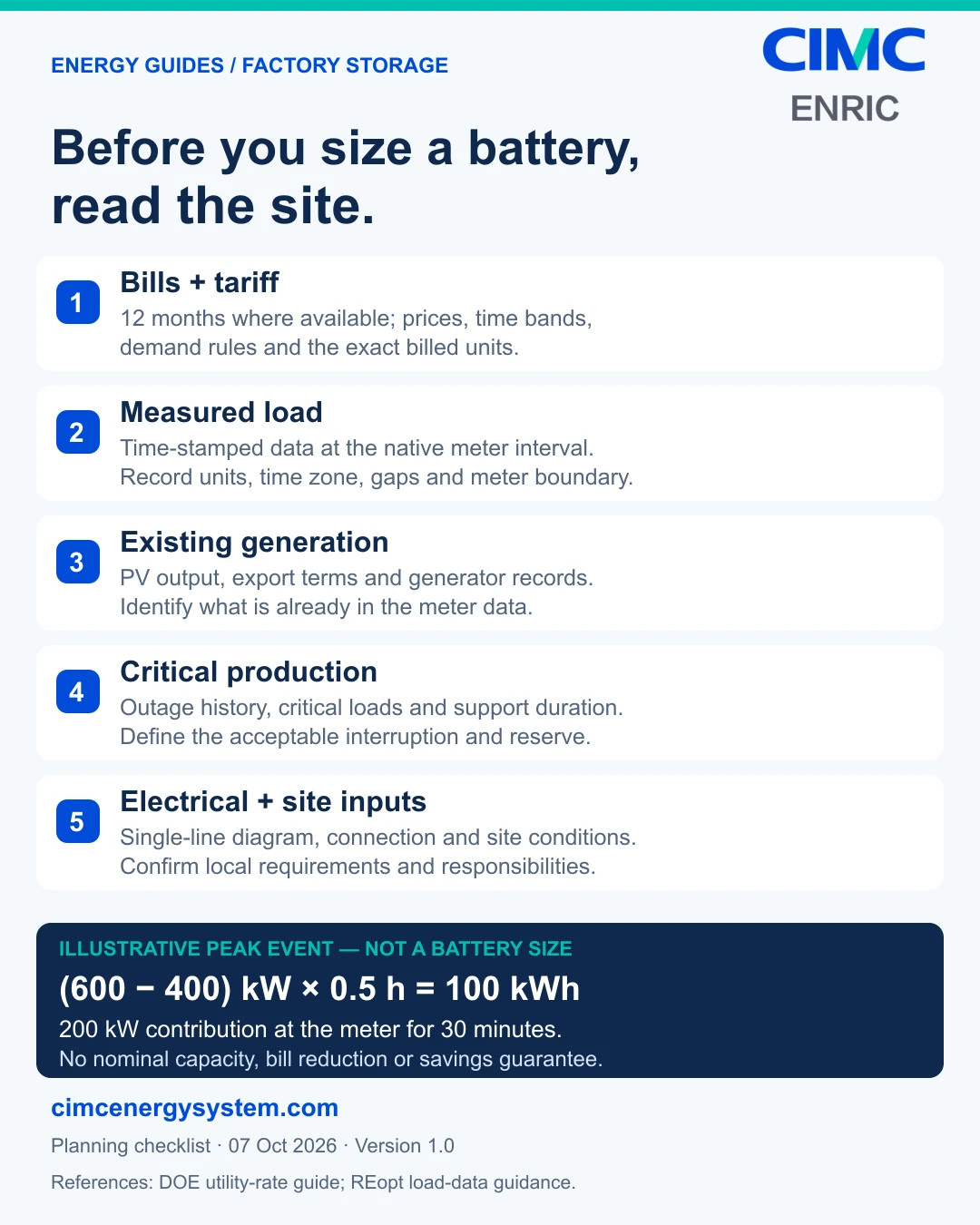
Consider a deliberately simplified illustration, not a customer bill or product recommendation:
| Illustrative input | Assumption |
|---|---|
| Grid import during one flat peak | 600 kW |
| Desired import ceiling | 400 kW |
| Peak duration | 30 minutes, or 0.5 hours |
| Battery contribution at the grid-meter boundary | 200 kW for that period |
| Energy contribution at the same boundary | 200 kW × 0.5 h = 100 kWh |
The 100 kWh is the energy associated with this one idealized event. It is not nominal battery capacity. Equipment selection must also allow for usable state-of-charge limits, reserve, conversion and auxiliary losses, temperature, ageing and repeated peaks. An irregular measured profile requires integrating the discharge needed above the target over time.
The intended bill reduction is unproven until every relevant billing peak is assessed. A later peak or a new charging peak could set the month's demand charge instead. The example establishes neither a guaranteed 200 kW billing reduction nor annual savings.
5. Model the operating strategy and the costs together
Begin with the site's baseline bill, then compare feasible operating schedules under the same tariff. For energy shifting, calculate charging purchases from the delivered discharge energy and the stated round-trip efficiency; include auxiliary use consistently. For solar charging, account for any export revenue forgone.
Demand savings depend on the billing rule and the simulated peak after both charging and discharging. Include equipment and site works, service, degradation, possible replacement and the applicable project assumptions. Keep outage-related business value separate from utility-bill savings. A simple payback headline cannot replace this comparison.
REopt provides an example of analysing system size and dispatch together. Any planning model still needs applicable site inputs and a review of its assumptions. A free tool's result is not a utility approval or a supplier's performance guarantee.
6. Lower bills and backup power require different checks
A battery proposed for bill management should not automatically be described as factory backup. Confirm the critical circuits, acceptable interruption, motor-starting demand, islanding arrangement, protection and coordination with existing PV or generators. Extended outages also require a credible replenishment plan.
The Department of Energy's inverter explanation distinguishes grid-following from grid-forming operation. The installed system must be designed for its intended outage mode; battery energy alone does not establish that capability. Local electrical engineering and approval requirements remain project-specific.
Questions customers ask
Can you size a factory battery from one electricity bill?
One bill can start the discussion, but cannot establish seasonal demand, the shape of peaks or outage needs. Share the applicable tariff, a year of bills where available, and time-stamped load data. If information is missing, the result should state its assumptions and remain preliminary.
Will a battery for reducing demand charges also keep production running during a blackout?
Only if the full system is designed for the required backup operation. Confirm critical-load power and duration, available reserve, switching, controls and protection. A storage system's nominal kWh does not establish safe islanding, uninterrupted transfer or whole-factory backup.
For related planning questions, use the energy answer finder. For equipment boundaries, see our 500 kW / 1.2 MWh quotation comparison guide.
Prepare the first assessment
Download the editable information checklist below. It covers tariff and bill details, interval data, existing PV and generators, critical loads and site constraints. You can remove account numbers and unrelated personal information before sharing. Where data is unavailable, mark it as unknown.
The first discussion should identify the intended use case, information gaps and options worth modelling. It should not begin with a universal savings percentage or a fixed battery size. Explore the BESS and microgrid route for wider system context.
Discuss your factory's energy requirements with CIMC ENRIC.
Evidence reviewed: 07 October 2026. US reference material explains planning principles; local tariffs, utility rules and equipment requirements must be confirmed for the project.