
CIMC ENRIC Energy Systems · Household energy and local partner guide
A local dealer should connect your household’s energy needs with a suitable equipment package, qualified installation and a named service contact. Before ordering, ask who owns the site assessment, commissioning, warranty process and ongoing support. If you need instalments, confirm the actual local financing terms separately from the equipment offer.

A home energy system becomes useful when it fits everyday life: the circuits you want to keep running, your property, local electricity conditions and the people who will support it. A local dealer can help coordinate those decisions, provided the technical and service responsibilities are clear.
Our first household guide explains essential-load and battery planning. This second guide follows the next question: who turns that plan into an installed, supported system?
1. Start with your home, then select the package
Give the dealer a short brief: country and city, essential appliances, desired backup hours, existing solar or generation equipment, electricity supply and the intended installation space. Explain whether your priority is outage backup, everyday energy use or both.
The site review should clarify the switchboard, circuits and phases, equipment locations and any additional work. Where gas backup is proposed, the qualified local team also needs to assess fuel compatibility, replenishment and installation requirements. A household package does not automatically need every energy component.
As a country-specific example, the Australian Government’s retailer and installer guide explains how site visits can reveal installation complications and recommends clear quote, warranty and support information. Australian accreditation requirements apply in Australia; your own country’s installation and connection requirements need local confirmation.
2. Ask for a responsibility map before you order
The company selling the equipment, the installer and the component manufacturers may be different organisations. Ask for their names and responsibilities in your proposal.
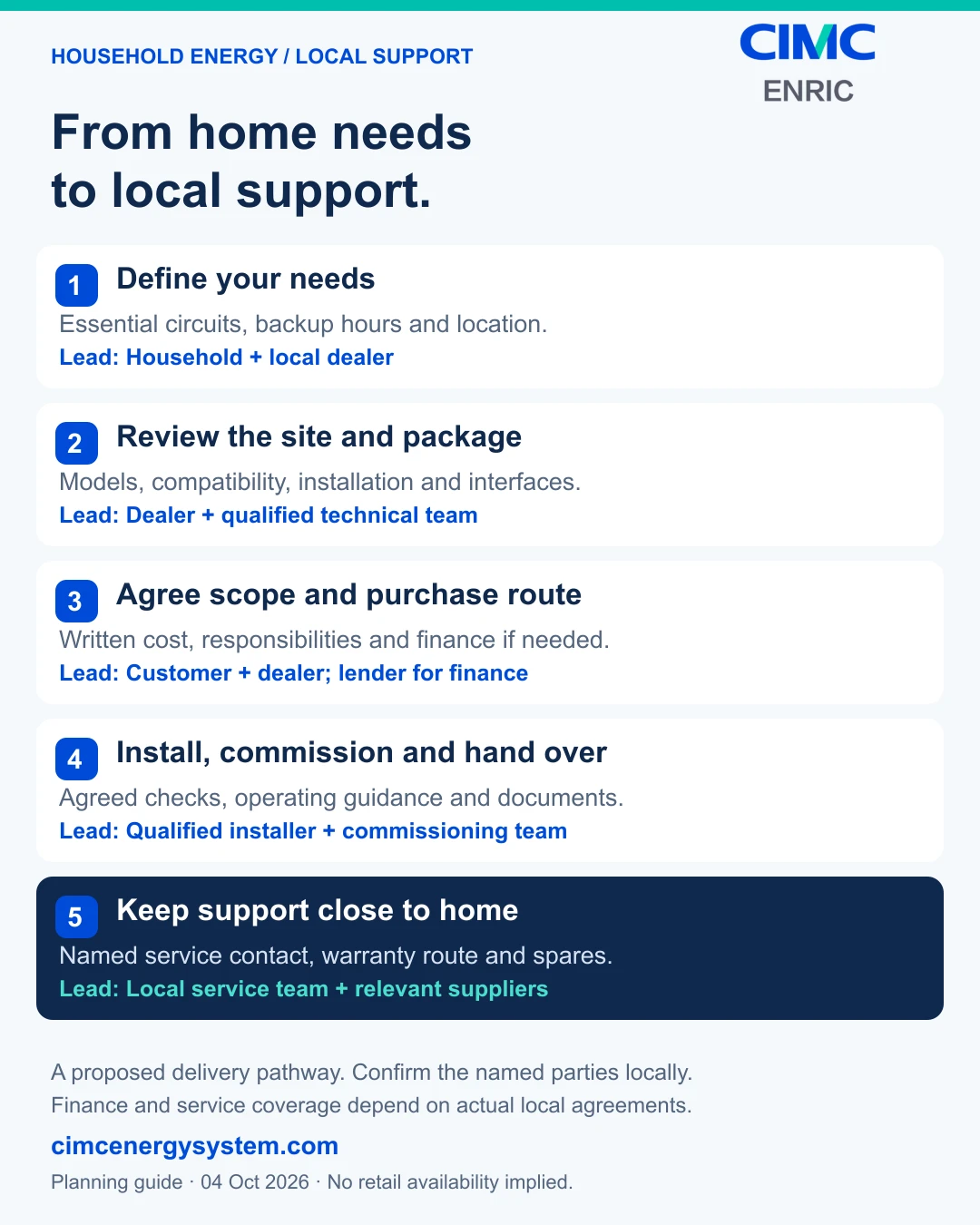
The table below is a suggested discussion map. The actual contract and local arrangements determine the appointed parties.
| Work to agree | Lead to identify | What the household should receive |
|---|---|---|
| Needs and site review | Dealer with qualified local technical team | Essential-load brief, site findings and additional-work list |
| Equipment and interfaces | Dealer, system designer and relevant suppliers | Model list, system boundaries and compatibility assessment |
| Installation and connection | Qualified installer and applicable local parties | Installation scope, approvals or connection steps where required |
| Commissioning and handover | Appointed commissioning team | Agreed operating checks, settings, manuals and user demonstration |
| Service and warranty coordination | Named local service contact with relevant suppliers | Contact route, warranty responsibilities, maintenance and spares arrangements |
| Finance, if requested | Identified lender and borrower | Eligibility assessment and actual repayment and ownership terms |
For dealers, this map also helps define the work to be priced, the skills needed locally and the support expected from suppliers. Agree who handles an issue that spans several components, rather than leaving the household to coordinate suppliers alone.
3. Treat handover and after-sales as part of the offer
Ask the installer to demonstrate the agreed operating modes and explain which circuits receive backup. The handover should identify the equipment, provide operating and maintenance documents, and confirm access to any agreed monitoring system.
Make the service arrangements practical: who receives a fault report, what information they need, which work can be handled locally and when a supplier becomes involved. Ask what warranty covers, what maintenance is required and how labour, transport or site visits are treated in the offer. A response time should be stated only where the responsible service provider has agreed it.
Keep the proposal, equipment identifiers, commissioning record and service contacts together. They give both the household and the dealer a common reference if the system changes or support is needed later.
4. Keep household instalments and dealer funding separate
There are two different discussions. A household may seek finance for its installed system. A dealer may seek funding to buy equipment, operate an asset or hold stock for resale. These involve different borrowers, repayment sources and arrangements.
For a household enquiry, prepare the proposed system scope, installed-cost breakdown, quote validity and the lender’s requested application information. Ask about contribution, total repayment, fees, ownership and how payments relate to installation and handover. The Australian Government’s commercial finance guide notes that financing depends on lender eligibility and that payment structures can change the total cost. It is an Australian example, not a financing offer for another market.
For dealer funding, distinguish equipment retained for operation from inventory intended for resale. CIMC can discuss agreed specifications, quotation and delivery documents that support the dealer’s bank conversation. The local bank assesses the facility and eligible security. Supplier payment milestones remain a separate commercial agreement. Our dealer financing page provides the detailed discussion route and a bank-shareable brief.
5. Where the CIMC household route stands
The published storage partnership timeline records a signed strategic cooperation agreement. The Firman / SUMEC M&E page records the MOU signing and facility visit, with small LPG-to-Power cooperation as a direction.
The household programme page sets out a staged route: package development, validation, dealer qualification and market rollout. Approved household configurations, participating dealers and financing options are to be confirmed market by market. The current cooperation milestones do not establish a retail launch or service coverage in your city.
Local dealers can start the discussion with their market, customer segment, installation and service capabilities, fuel relationships where relevant, and intended purchase route.
Questions customers ask
Who will install and service a household energy system in my city?
Ask for the named qualified installation team, the local service contact and the supplier warranty responsibilities before ordering. CIMC’s household route envisages qualified local dealers and service teams; an approved dealer list and market-specific terms have not yet been announced on the programme page. Share your location so the appropriate route can be discussed.
What information is needed to discuss household instalments?
Start with a site-specific equipment and installation proposal. The participating lender determines its application documents, eligibility, contribution and repayment terms. Household instalments and dealer equipment funding are separate arrangements. A partnership agreement does not itself approve a customer loan.
Your next step
Tell us your country and city, household or dealer role, essential loads, existing equipment and target timeline. Dealers can also describe their installation and after-sales team. That gives the project team a useful starting point for a local delivery discussion.
Discuss household energy or local dealer cooperation.
Source review: 4 October 2026. The responsibility map and delivery pathway are proposed planning tools. Local arrangements and published programme status should be reconfirmed for each project.